Saint Athanasius Church, Aiginio: A Late-Medieval Orthodox Church
Site at a Glance
- Rating
- 4.9
- Popularity
- Very Low
- Country
- Greece
- Primary era
- Medieval
- Eras represented
- Medieval, Early Modern
- Civilizations
- Ottoman
- Site type
- Religious
- Remains
- Church
On this page6 sections
History
Foundation and Orthodox use
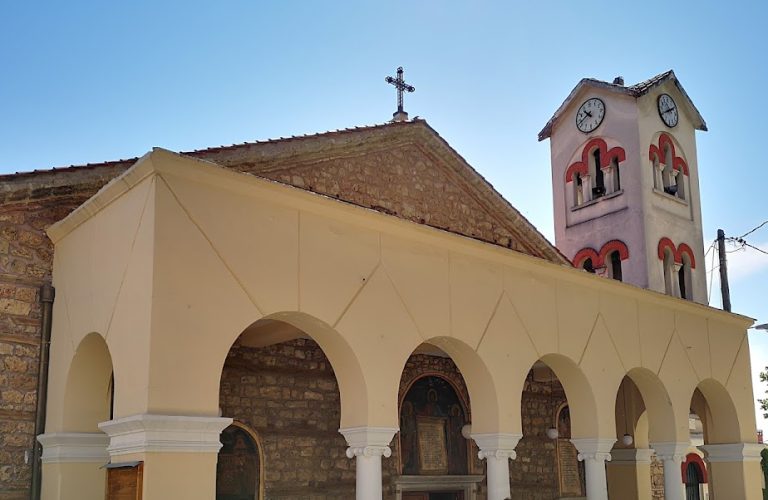
Saint Athanasius Church is a late-medieval Orthodox church in Aiginio, Greece, built during the second half of the fifteenth century, between 1460 and 1500. It stands in the Kavakli quarter of Libanovo, another name associated with Aiginio, and belongs to the Kitros, Katerini, and Platamon Diocese of the Ecumenical Patriarchate of Constantinople, the senior-ranking patriarchate in the Eastern Orthodox Church.
Named for Saint Athanasius, a fourth-century Christian bishop and theologian who defended Nicene Christianity and the doctrine of Christ’s divinity, the church began as a small single-nave building. It remained an active place of worship until 1964. During later restoration, original wall paintings were uncovered, although the paintings have not been fully revealed.
Protection and preservation
In 1983, Saint Athanasius Church was declared a protected cultural monument. Its restoration brought renewed attention to the surviving structure and to the wall paintings preserved beneath later layers.
Remains
Church structure and additions
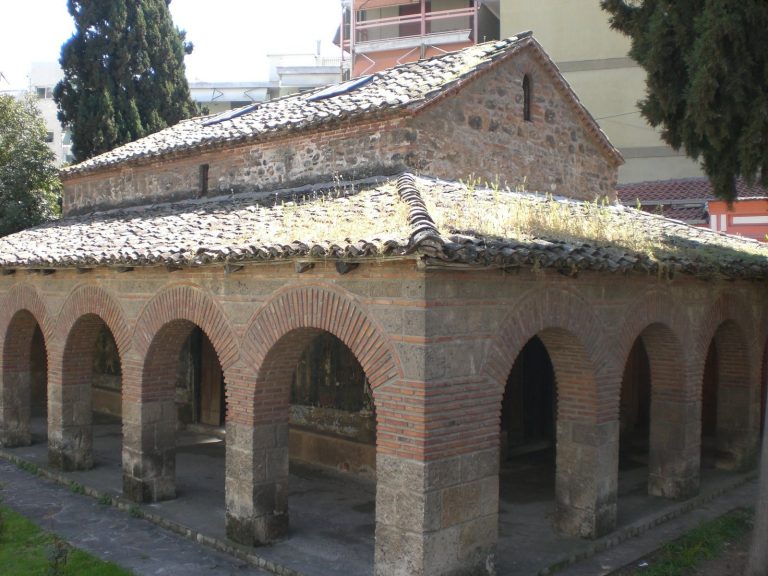
The present church is a two-nave basilica, a longitudinal church arranged around parallel naves, with a wooden roof. Its earliest form was a low single-nave building with an apse, a polygonal or rounded end enclosing the sanctuary, and small windows on the north side. The doors were deliberately made very low, so that Muslims could not enter on horseback and desecrate the church. A northern nave supported by columns was added later, together with a raised women’s gallery on the south side. The building also acquired a western narthex, or pronaos, an entrance hall where catechumens stayed.
The exterior of the eastern apse has three sides, while the prothesis, the sanctuary area used to prepare the Eucharistic elements, is pentagonal. Two stone candlestands are fixed to the floor in front of the iconostasis, the screen separating the nave from the sanctuary. They also supplied additional illumination inside the church, whose lighting comes through many small windows.
Frescoes and liturgical features
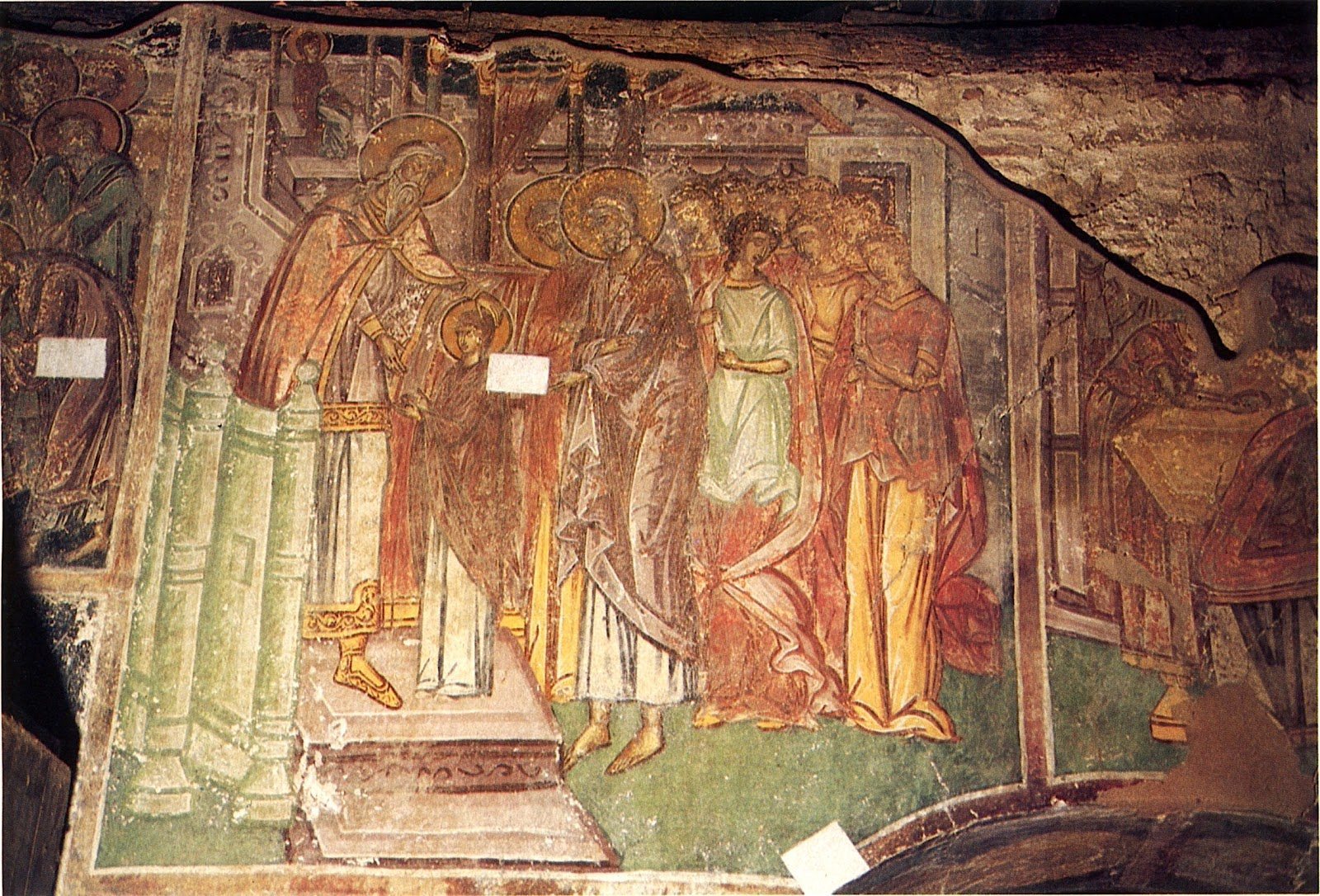
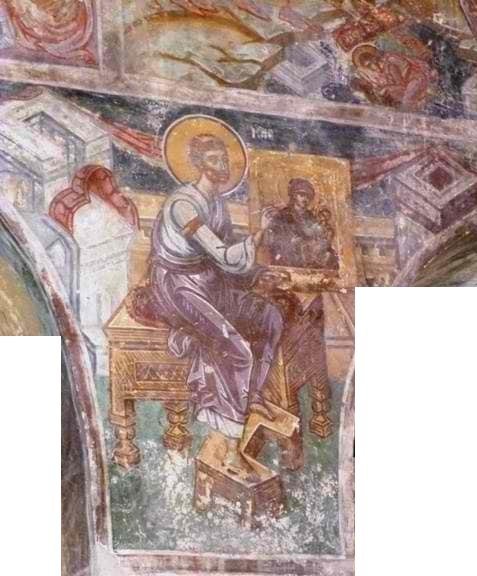
The interior preserves frescoes from the late sixteenth century, including a depiction of the Presentation of the Virgin, the Christian subject showing Mary being brought to the Temple. A master of the Kastoria artistic school painted the works. Their three-dimensional figures reflect Italian and late Gothic influence.
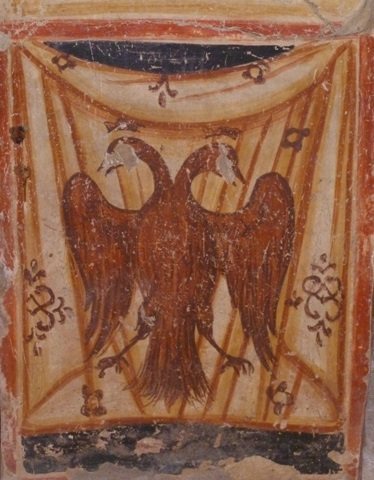
An omphalos, a central point marking the middle of the church interior, lies at the center of the building, where the priest performs the sacraments. A double-headed eagle is painted at the base of the Holy Table, the altar table used in Orthodox worship, in the sanctuary. The church also retains old silver liturgical vessels, including a chalice. A star-shaped liturgical implement made in Russia in 1876 was brought by refugees from Kavakli in Bulgaria.
The cross above the iconostasis carries the traditional symbols of the four Evangelists. Mark is represented by a lion, Luke by an ox, Matthew by a human figure, and John by an eagle.