Okadayama Kofun: A Burial-Mound Group in Matsue, Japan


Site at a Glance
- Rating
- 3.7
- Popularity
- Very Low
- Country
- Japan
- Primary era
- Medieval
- External website
- Open
- Eras represented
- Classical, Medieval
- Civilizations
- Yamato
- Site type
- Burial
- Remains
- Necropolis
On this page10 sections
History
Okadayama Kofun is a group of seven burial features in Matsue, Japan, built during the Kofun period, the era from approximately the third to seventh centuries named for its monumental burial mounds. The group lies on a low hill at the southwestern edge of the Iu Plain in Okusa-cho. Its principal mound, Kofun No. 1, probably dates to the latter half of the sixth century, while the large circular Kofun No. 2 belongs to the middle Kofun period, from the late fourth to the fifth century.
A group within ancient Izumo
Okadayama formed part of a wider landscape of burial groups in eastern Izumo, where the Yamashiro-Oba Kofun Group was one of the major clusters. The relatively small scale of most Okadayama mounds has encouraged the interpretation that their occupants held subordinate positions beneath a major regional paramount chief. The group therefore provides evidence for the political structure of the region as well as for its burial practices.
The sword recovered from Kofun No. 1 adds further evidence about this organization. Its silver-inlaid inscription includes the words “Nukatabe no Omi.” The name combines the Nukatabe hereditary group with omi, an elite title in ancient Japan. Nukatabe communities, associated with Princess Nukatabe, later Empress Suiko, were established in different regions as hereditary service communities. The inscription indicates that the be system of organized hereditary communities had extended into this part of Izumo by the latter half of the sixth century.
The inscription also points to a dual political structure in Izumo. Local leaders associated with the kuni no miyatsuko, or regional governors who represented local authority, operated within a wider system of control exercised by the central Nukatabe clan.
Excavation and preservation
Kofun No. 1 first came to archaeological attention in 1915, when the landowner excavated it after recognizing the mound as a burial site. Grave goods were recovered during the work. Umehara Sueji investigated the mound in 1917 and published a report in 1923. In 1925, Umehara joined Hamada Kosaku, Shimada Sadahiko, and Suzuki Masutaro for another investigation. The mound was also described in the fourth volume of the former Shimane Prefectural History, published that year, where it was identified as a keyhole-shaped mound of an unusual form.
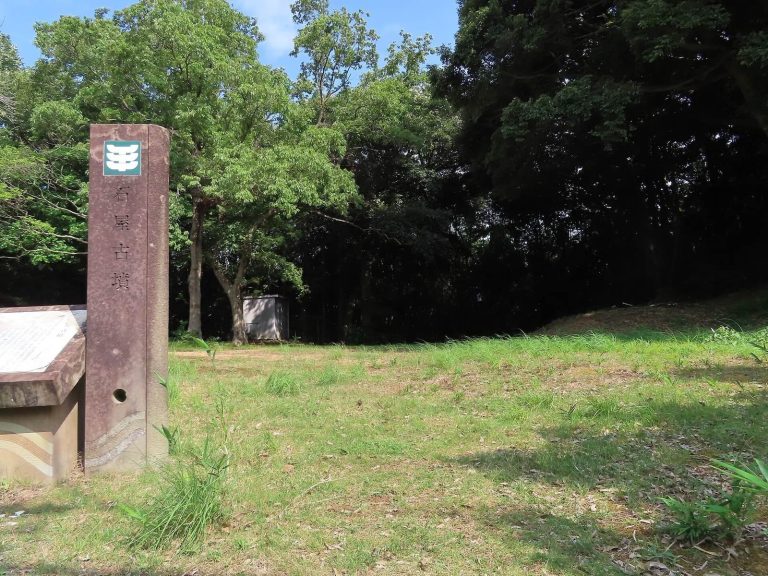
Iwasa Fumiko introduced the site in 1947. Residential development proposals in 1964 led to surveys and a preservation campaign by the Matsue Archaeological Discussion Group, including Yamamoto Kiyoshi, together with the Shimane University Archaeological Society. Kofun Nos. 1 and 2 were designated together as the National Historic Site “Okadayama Kofun” on April 9, 1965.
An archaeological investigation of Kofun No. 1 took place in fiscal year 1970 in connection with the establishment and development of the Yakumotatsu Fudoki-no-oka archaeological park, which opened in 1972. Conservation treatment in 1983 addressed corrosion affecting the iron objects, and the sword inscription was identified during that work. The artifacts from No. 1 became the National Important Cultural Property “Artifacts Excavated from the Izumo Okadayama Kofun” on June 6, 1985. The site is preserved and publicly presented within the archaeological park, with Nos. 1 and 2 conserved as its principal remains.
Remains
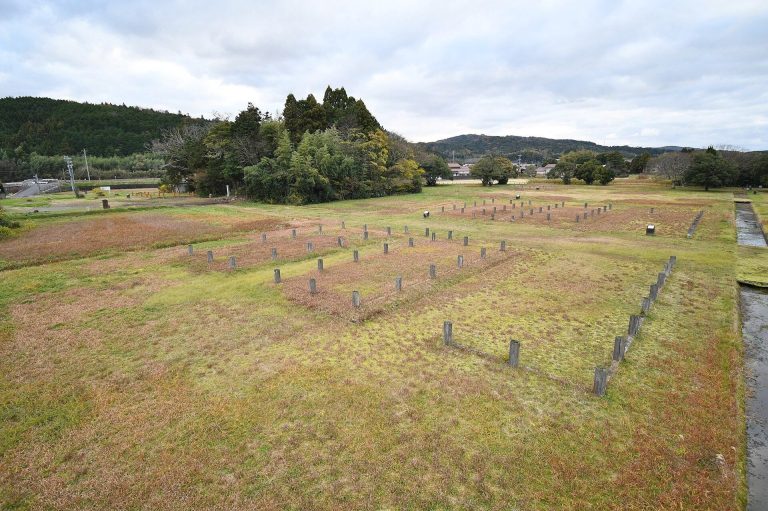
Okadayama occupies a low hill and is arranged around two principal mounds, with Kofun No. 2 about 30 meters south of No. 1. The group also includes square mounds and box-shaped stone coffins. Its most distinctive surviving structure is No. 1, a small front-and-rear rectangular mound. This form joins two rectangular sections, unlike a keyhole-shaped mound, which combines a rectangular section with a circular one.
Principal mounds
Kofun No. 1
Kofun No. 1 has its front section directed south. Its total length is approximately 24 meters when only the two upper earthen stages are counted, or about 47 meters when the artificially shaped natural ground forming the first stage is included. The rear section is about 14 meters wide and 4 meters high, while the front section is about 14 meters wide and 3.5 meters high.
The mound has an unusual three-stage appearance. A rectangular, platform-like base was first cut and shaped from the natural ground, after which two stages of front-and-rear rectangular embankment were added. The first stage measures about 47 meters in length, 16 to 29 meters in width, and 1.6 meters in height. An irregular rectangular, terrace-like area extends in front of the front section, measuring approximately 23 meters long, 28 to 29 meters wide, and 1.6 meters high. This first stage has been interpreted either as a foundation platform or as evidence that construction began on a larger mound and was later reduced.
The upper stage rises strongly in both the front and rear sections, creating an appearance resembling two adjoining square mounds. Slab-like stones covered part of the slope of the second stage. Cylindrical haniwa, clay funerary objects placed on or around burial mounds, stood outside the mound together with a Sue-ware jar fitted with smaller attached jars. Sue ware was a high-fired, wheel-made ceramic tradition of the Kofun period.
Burial chamber and sarcophagus
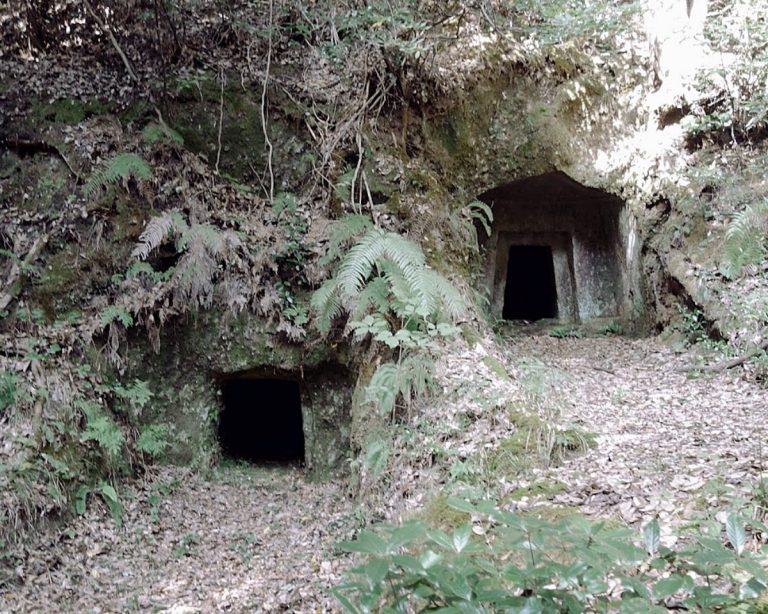
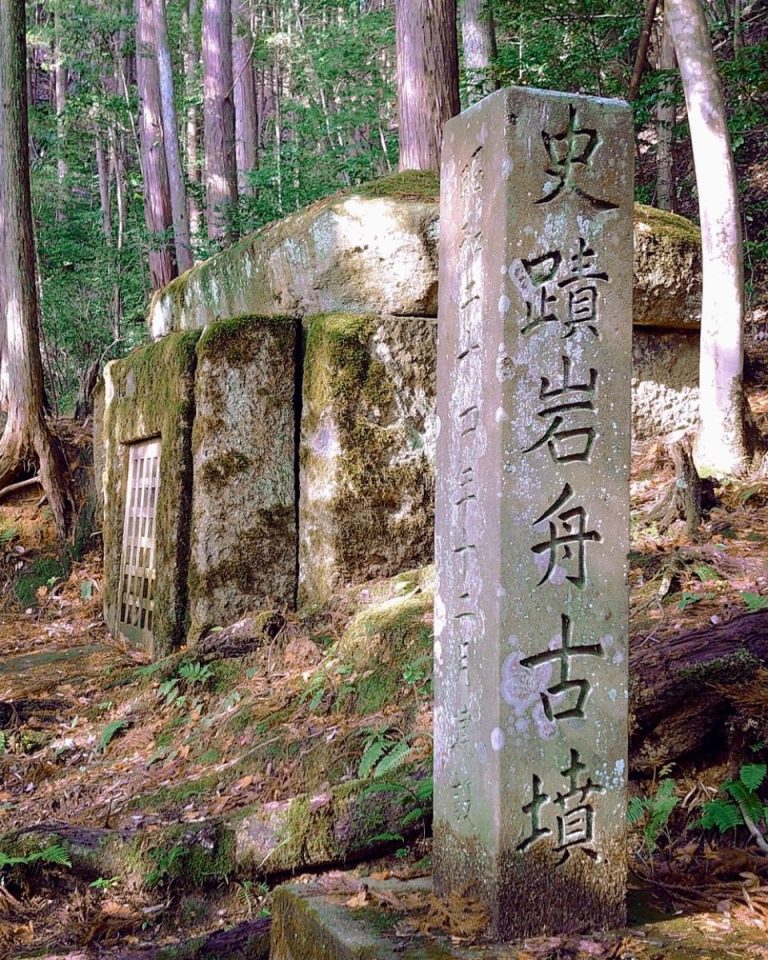
The burial facility in the rear section is a small horizontal stone chamber, entered through a passage from the side of the mound. Projecting side walls at the entrance create a double-sleeved form, and the entrance opens westward. The structure is 5.6 meters long and was built with natural and split stones set with their narrow ends facing outward. The chamber walls curve sharply inward through corbelling, a method of building by placing successive stones slightly inward. The corbelling and the upright stones at the entrance connect the chamber with stone chambers in Kyushu.
The burial chamber measures 2.8 meters long, 1.8 meters wide at the rear, 1.3 meters wide near the entrance, and 2.2 meters high. Its entrance passage is 0.4 meters long, followed by a corridor 2.4 meters long, 1.1 meters wide, and 1.2 meters high. A flat blocking stone closed the entrance, with another arrangement of stones extending toward the forecourt.
A small composite house-shaped sarcophagus made of tuff stands toward the rear of the chamber, parallel to its central axis and facing the entrance. A row of partition stones separates it from the chamber wall. Its interior is 1.15 meters long, 0.35 meters wide, and 0.4 meters deep, and its surfaces carry red pigment. The body consists of five fitted stones: a floor stone, two long side stones, and two end stones. The lid has eight circular projections for holding ropes, arranged in pairs at the front and rear and in three pairs along the sides.
Gold earrings, iron arrowheads, a knife, and rounded beads were found inside the sarcophagus. A separate box-shaped facility made from joined stone slabs stands on the entrance side and was probably used for grave goods. It too was coated with red pigment. An inward-facing bronze mirror with a floral design and four swords were recovered from it, three of which survive.
Inscribed sword and associated objects
One surviving sword is a decorated, round-headed weapon with a silver-inlaid inscription. About half of its blade, including the point, is missing, but the remaining portion is 52 centimeters long. Its round pommel carries an elaborate pattern of paired phoenixes joined by tortoiseshell-like hexagons. Twelve characters were identified on the blade, including four readable characters representing an abbreviated form of “Nukatabe no Omi.”
Other objects associated with No. 1 include bronze mirrors, earrings, rounded beads, iron arrowheads, knives, weapons, horse harness, Sue-ware pottery, and haniwa. The 1915 excavation recovered earrings, beads, arrowheads, and a knife from the sarcophagus, as well as the mirror and four swords from the box-shaped facility. Horse harness and Sue ware came from outside the sarcophagus. The 1970 investigation added iron arrowheads, bow fittings, and further horse harness.
During the 1915 excavation, access to the burial chamber was made through the top of the rear mound by removing one ceiling stone, allowing the grave goods to be taken out. By the 1970 investigation, earth and sand had entered the chamber, while the corridor remained blocked.
Kofun No. 2
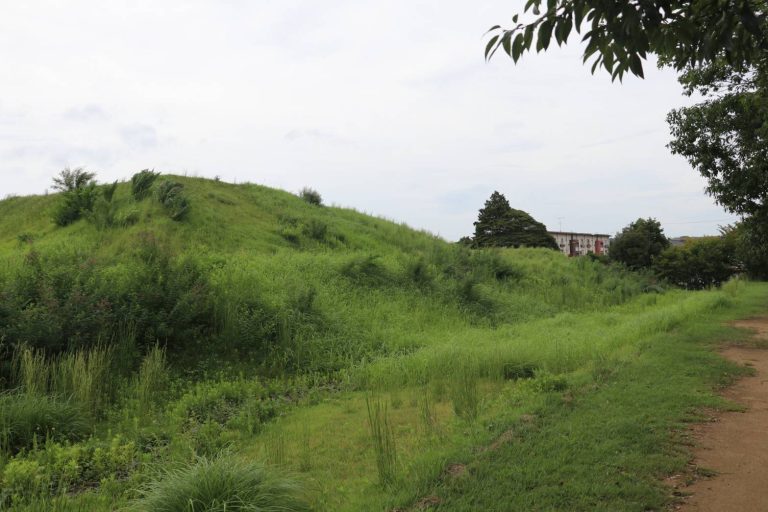
Kofun No. 2 is a large, two-stage circular mound about 44 meters in diameter and 5.4 meters high. Stone surfacing covers its slopes. Older records mention cylindrical haniwa associated with the mound, although that evidence is uncertain. No. 2 is an unusually large circular mound for eastern Izumo, where square mounds were more common, and its scale is described as among the largest in the region.
Additional burial features
Below the level of Kofun No. 1 are four further features and two square mounds. Nos. 3, 4, and 7 are box-shaped stone coffins, while Nos. 5 and 6 are square mounds. The features were either destroyed during the construction of No. 1 or covered by its earth fill. Their presence shows that the principal sixth-century mound was built within an earlier funerary landscape.
Excavated artifacts from the group are displayed at the Yakumotatsu Fudoki-no-oka Exhibition Learning Hall. Replicas of the artifacts from Kofun No. 1 are displayed at the Ancient Izumo History Museum.