Saint-Nicolas de Marcheroux Abbey: A Premonstratensian Monastery in France
Site at a Glance
- Rating
- 4.2
- Popularity
- Very Low
- Country
- France
- Primary era
- Early Modern
- Eras represented
- Medieval, Early Modern
- Civilizations
- French
- Site type
- Religious
- Remains
- Monastery
On this page12 sections
History
Saint-Nicolas de Marcheroux Abbey is a former Premonstratensian monastery in Beaumont-les-Nonains, France, founded in the twelfth century by a community associated with Saint Norbert of Xanten. Its history includes relocation, religious reform, repeated destruction, rebuilding, and suppression during the French Revolution.
Foundation and relocation
In 1122, Ulric, a companion of Saint Norbert of Xanten, established a religious community at Jouy-la-Grange, within the present commune of Beaumont-les-Nonains. Known as Saint-Nicolas-en-Thelle, it occupied land that Ulric held as a perpetual tenant. The arrangement required an annual rent of 50 setiers of wheat, a historical French grain measure whose quantity varied according to place and period.
Around 1145, the local lord Ansculphe de Sénots donated land at Marcheroux, less than five kilometres away, and the community moved there soon afterward. Pope Eugene III confirmed the donation in a papal brief dated 15 June 1147. The abbey was placed under the authority of Saint-Josse de Dommartin and became part of the Premonstratensian Order, a Catholic order founded by Saint Norbert whose communities combined religious life with clerical and pastoral work.
Ansculphe de Sénots also gave the Beaumont farm to Ulric, who established a nunnery there. Although the farm was destroyed in 1192, the nunnery apparently continued until the middle of the thirteenth century. The association with the nuns is reflected in the name Beaumont-les-Nonains.
Medieval development and destruction
Around 1180, Marcheroux founded the daughter house of Notre-Dame d’Abbecourt Abbey, then in the northern part of the Diocese of Chartres and now in Yvelines. Despite this expansion, Marcheroux remained financially poor. Its dependencies provided the revenues of only one parish church, and a document from 1249 records the sale of a priory to Saint-Denis Abbey.
At the end of the twelfth century and the beginning of the thirteenth, Guyard, a descendant of Ansculphe de Sénots, ravaged the abbey. The complex suffered another destruction around 1430 during the English siege of the town and remained in ruins until the beginning of the sixteenth century.
Rebuilding, reform, and suppression
A new abbey church was constructed in the early modern period and consecrated in 1536, but it collapsed in 1615. In 1668, the community joined the Congregation of Primitive Strict Observance, a reform movement initiated by Servais de Lairuelz to restore the earlier discipline of the Premonstratensian Order.
In 1727, the abbey entered the commendatory system. Under this arrangement, an abbot could hold the office and its revenues without residing in the community or exercising the duties of a regular monastic superior. Marcheroux remained poorly endowed, receiving about 1,600 livres annually, compared with 22,000 livres at Froidmont Abbey and 20,000 livres at Notre-Dame de Breteuil Abbey.
At the French Revolution, only seven religious remained at Marcheroux. An inventory listed more than 400 books in the abbey library. The monastery was suppressed in 1791, and its buildings and goods were sold for conversion into an agricultural holding. During the nineteenth century, the abbey church served as a barn after its vaults had been destroyed.
The abbey and the archaeological deposits within its enclosure have been protected as a monument historique since 1995, under an inscription issued by an order dated 9 November 1995.
Remains
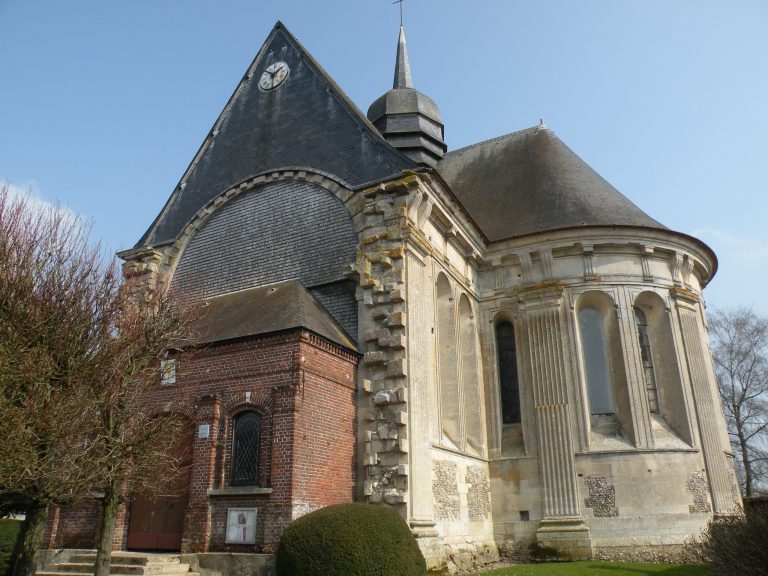
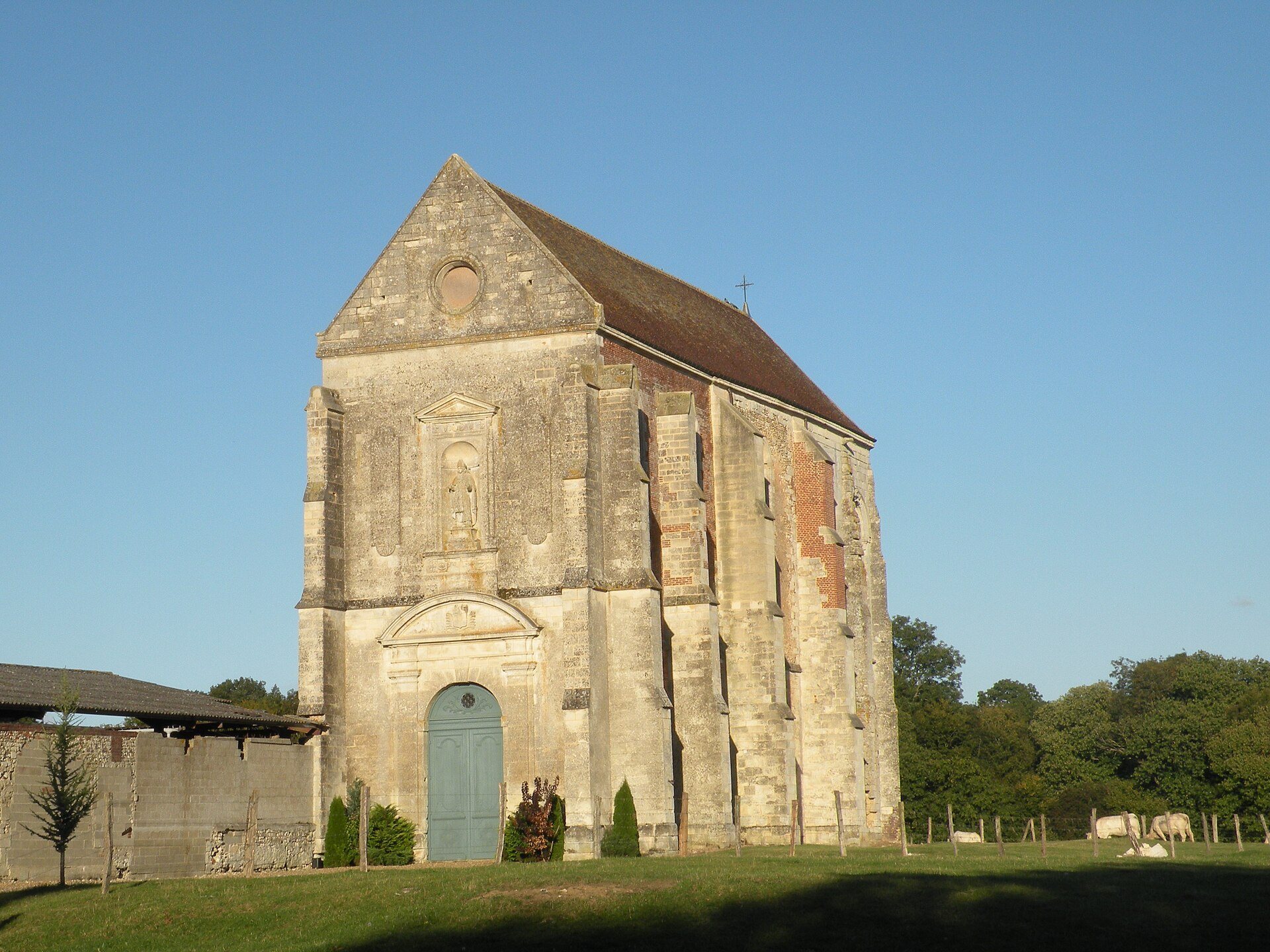
The surviving complex combines medieval church fabric with later rebuilding and archaeological deposits within the former abbey enclosure. The church retains part of its thirteenth-century choir and apse, while the nave and west facade belong to work carried out around 1710. Other surviving elements include the eighteenth-century entrance gateway, a ruined portion of the conventual residence, and furnishings transferred to nearby parish churches.
Abbey church and conventual buildings
Choir and apse
Part of the church’s thirteenth-century choir and apse survives. These medieval elements belong to the earlier architectural history of the abbey and remain incorporated into the standing church.
Nave and west facade
The nave and west facade were rebuilt around 1710. This later work formed part of the church that was used as a barn in the nineteenth century after the vaults had been destroyed.
Gateway and residence
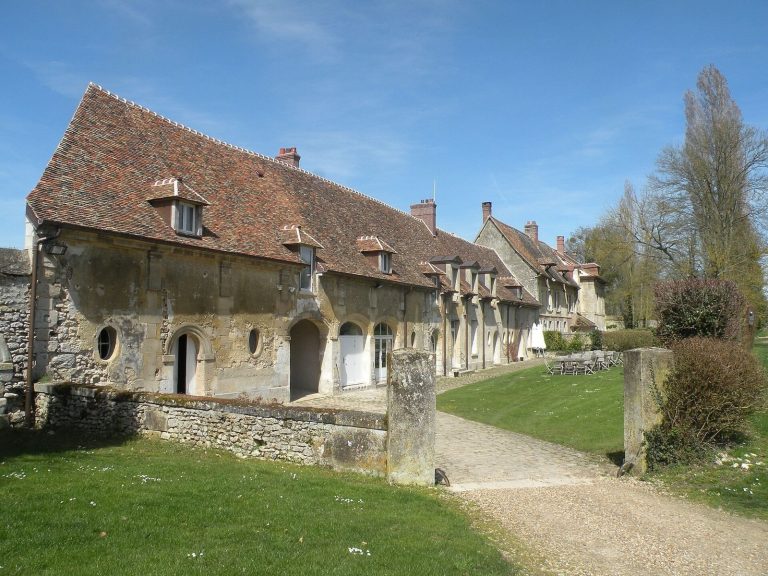
The eighteenth-century entrance gateway remains in place, although its triangular pediment recently collapsed. Only a ruined section of wall survives from the seventeenth-century conventual residence. Archaeological deposits remain within the former abbey enclosure.
Dispersed church furnishings
Saint-Christophe at La Houssoye
Parts of the abbey church’s fittings and furnishings were transferred to nearby parish churches. Saint-Christophe at La Houssoye preserves sixteen wooden choir stalls, together with two altars, their retables, and a tabernacle behind the stalls. A retable bears a relief of Saint Nicholas and the three children in the salt barrel. The group is dated by an inscription to 1716. A retable is an ornamental altarpiece placed behind an altar, while a tabernacle is a receptacle used to reserve the Eucharist. The image of Saint Nicholas reflects the abbey’s dedication to the Christian saint associated with charity and the protection of children.
Parish church at Montjavoult
The parish church at Montjavoult contains two eighteenth-century altar frontals from the abbey church. They depict the Presentation of Jesus at the Temple. An altar frontal is a decorative covering or panel placed on the front of an altar.