Abbaye Saint-Léonard de Corbigny: A Benedictine Monastery in France
Site at a Glance
- Popularity
- Low
- Country
- France
- Primary era
- Early Modern
- Eras represented
- Medieval, Early Modern, Modern
- Civilizations
- French
- Site type
- Religious
- Remains
- Monastery
On this page12 sections
History
Foundation and independence
Abbaye Saint-Léonard de Corbigny is a Roman Catholic Benedictine monastery in France, traditionally founded in 864 during the reign of Charles the Bald. Its monks followed the Rule of Saint Benedict, a guide to communal religious life. The abbey contributed to the growth of Corbigny and became the center of a network of estates, churches, and dependent religious houses.
A reference from 721 names Corbiniacus and Antonum with their dependencies. The abbey’s foundation, however, is traditionally placed in the ninth century. According to that account, Égile, abbot of Flavigny, established a house at Corbigny for twelve religious. The foundation was said to fulfil a charter granted earlier by Charlemagne to Manassès, another abbot of Flavigny, authorizing a dependent monastery.
The relationship with Flavigny became a recurring dispute. In 1034, Helmuin, bishop of Autun, returned Corbigny to Flavigny’s authority. In 1076, Helmuin’s successor, Aganon, backed Corbigny’s independence, and the monastery’s prior appealed in Rome against Flavigny’s claim. Pope Paschal II confirmed Corbigny’s exemption from another church’s jurisdiction in 1107; Pope Adrian IV reaffirmed it in 1155.
Land, priories, and parishes
The abbey’s holdings grew across the Nivernais. Before leaving on a crusade, a religiously sanctioned military expedition, Hugues dit le Roux de Champallement gave it a domain at Montreuillon around 1146–1147. On 2 October 1152, Henri, bishop of Autun, granted the church of Ruages with its dependencies and possessions. A papal bull, a formal document issued by a pope, recorded a house at Autun in 1253 and also named Germenay, Dreuzy, Auxois, Renebourg, Combres, and Doussas, with some of these places associated with nearby churches or settlements.
Corbigny’s priories, small dependent religious houses or establishments, were mostly in the Nivernais. They included Abon, Anlézy, Decize, Franay, Chevannes-Gazeaux, Héry, Sainte-Camille, Reviry, Anthien, Ruages, Cuzy, and Sainte-Pallaye. Their organization varied: some were linked to an office, had only a few monks, and lacked a shared conventual life; others may have developed into religious houses. Abon, Anlézy, Saint-Privé, and Ruages continued to be identified as priories in later centuries. Revolutionary-era records listing property for sale identified Abon, Anlézy, and Saint-Privé as dependencies.
The abbey also held parishes in the former dioceses, or church territories under bishops, of Autun, Auxerre, and Nevers. Its Autun holdings included Anthien, Chevagnes, Mhère, Ruages, Saint-Léger-du-Bois, Saint-Martin du Puy, and Vauclaix, as well as the churches of Crucifix, Saint-Jean, and Saint-Seine at Corbigny. Sainte-Pallaye belonged to the former diocese of Auxerre. In Nevers territory, the abbey’s parishes included Abon, Anlézy, Asnan, Brain, Chassenay, Chevannes, Dirol, Frasnay, Héry, Pazy, Saint-Privé, Sainte-Camille, and Sauzay.
Community, devotion, and conflict
In 1407, the community comprised an abbot and thirteen or fourteen religious, with officers overseeing the monastery’s worship, care of the sick, provisions, charity, guests, and administration. Ten religious were recorded in 1538. During an episcopal visit in 1624, six were present and six absent; by 1718, the community numbered six. A will made at Troyes in 1442 by Robert de Colaverdey, lord of La Chapelle-Saint-Luc, requested a pilgrimage to Saint-Léonard of Corbigny on his behalf. The abbey’s name also changed in written records: forms included Ecclesia de Corbegni in 1191, Conventus Sancti-Leonardi de Corbigniaco in 1315, and Sainct-Lienard in 1477.
The Wars of Religion, conflicts that deeply affected the region, brought a period of decline. In 1552, Gilles Franchet, judge-provost of Corbigny, was called to inventory the abbey’s reliquaries, containers for sacred relics, and silver vessels. Together they weighed eighty marks, a historical weight unit whose value varied by place and period. In 1562, material removed from the reliquaries included two gold ingots weighing twenty-two marks and sheets of silver weighing thirty-three marks. The treasury fell into the hands of Huguenots, French Protestants associated with the Reformed tradition, in 1563.
Rebuilding and later uses
From 1754, most of the abbey was rebuilt during the second half of the eighteenth century under the influence of the Maurist reform, a Benedictine reform movement in France. Work followed architectural plans and remained unfinished when the Revolution began; the church had not yet been consecrated. In 1790, the establishment’s income was 10,612 livres, a pre-decimal French unit of money. Four religious lived there, while the commendatory abbot, who held the title and revenues without necessarily residing at the abbey, was absent.
From 1789, the buildings served, among other purposes, as a stud farm, a small seminary, schools, and a gendarmerie. They later became town property and now house the Cultural Spaces of the Nivernais Morvan region and the cultural project Abéïcité. The former abbey was classified as a historic monument in 2001, with protection covering its above-ground buildings and enclosure features, including twentieth-century buildings.
Remains
Setting and layout
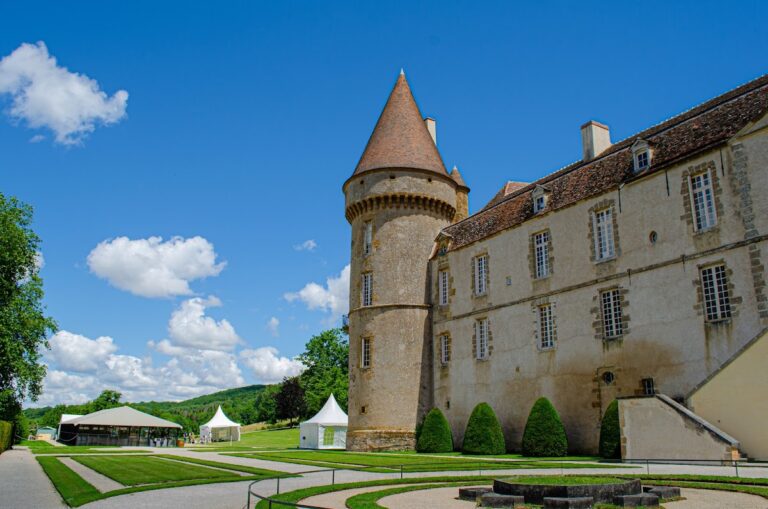
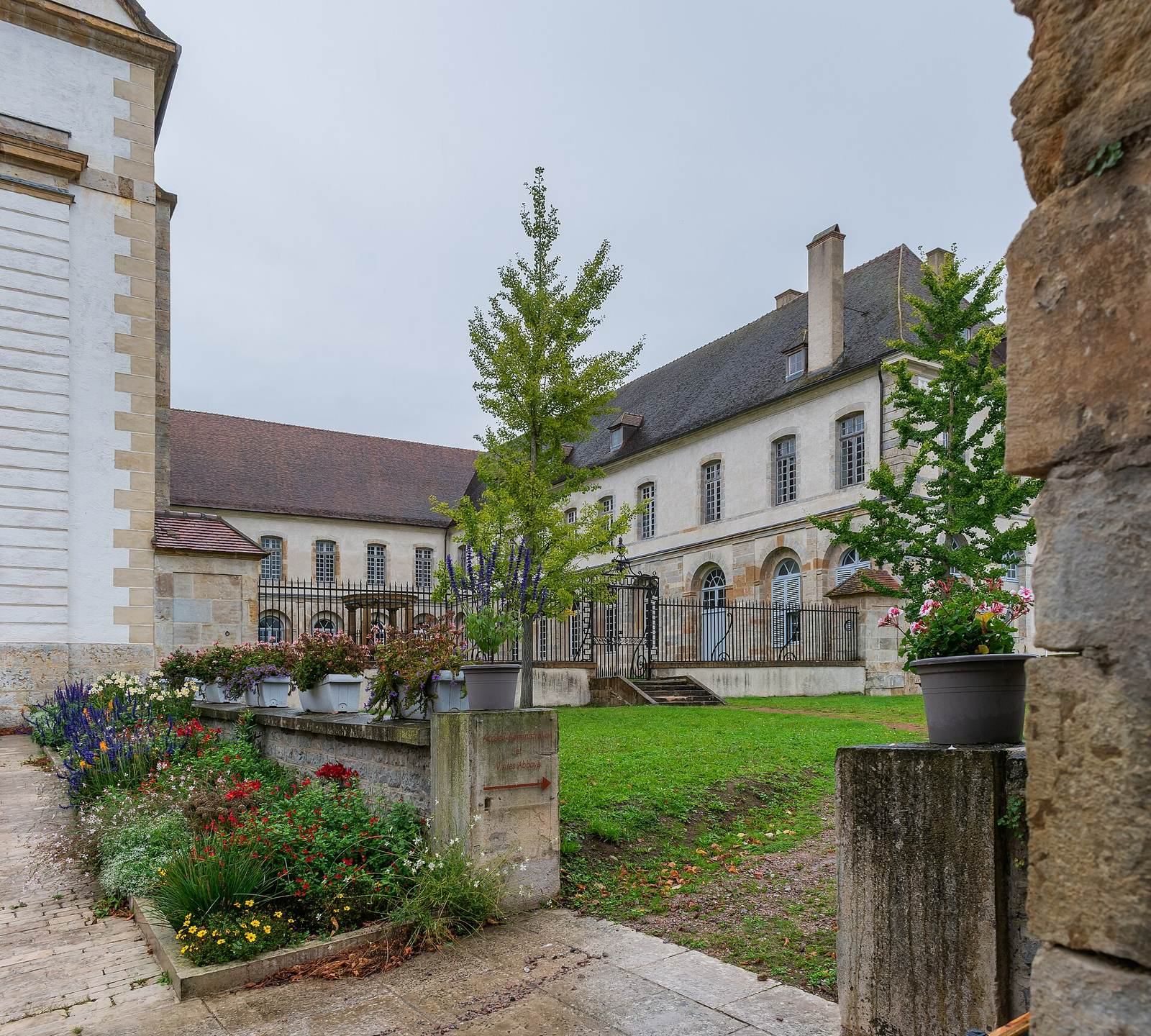
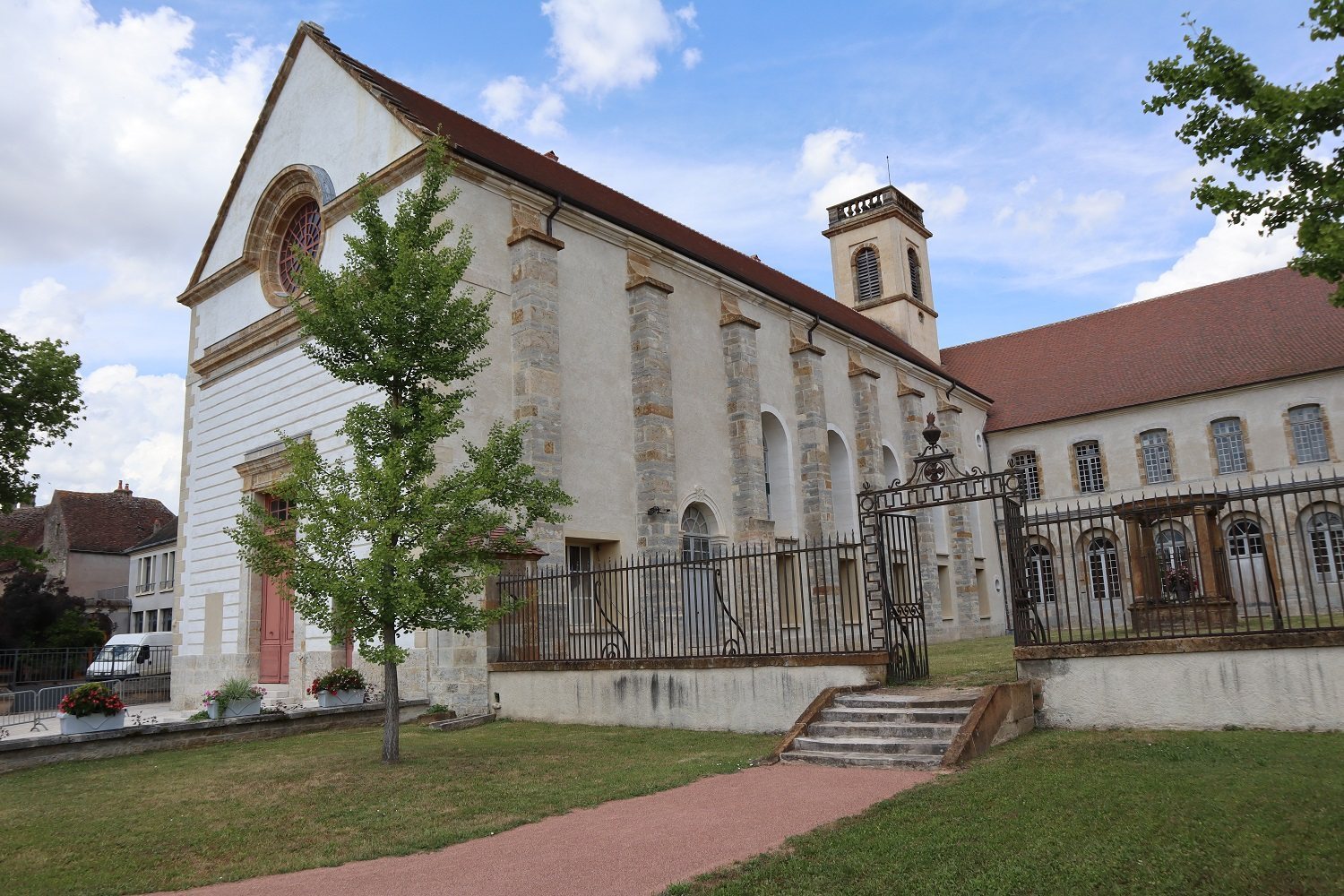
The abbey occupies a mound 195 metres above sea level in the Anguison valley, north of Corbigny, at the junction of the Nevers–Dijon and Clamecy–Luzy roads. Its buildings form a U around a central courtyard. A circular well with columns stands within the courtyard, enclosed by a grille. The north wing contains the abbey church, while long galleries in the east wing and adjoining south wing form a cloister, a covered walkway around a courtyard. The complex is predominantly classical in style.
Earlier fabric and interiors
The fifteenth-century abbatial residence is the main surviving exception to the extensive eighteenth-century rebuilding. Remains of the earlier abbey are visible at basement level. Inside, original paving, ironwork, and moulded door and window frames survive. The monumental staircase retains a wrought-iron handrail decorated with plant motifs.
Historical objects and seals
Relic treasury
An inventory made in 1537 describes objects associated with the abbey’s religious life. They included a transparent vessel said to contain the Virgin Mary’s milk, supposed teeth of Saint John the Baptist and Saint Peter set in gilt silver, and two arms attributed to Saint Leonard inside a silver reliquary. The inventory also lists a head-relic of Saint Vétérien and a votive offering made from metal chains.
Abbey seals
A seal of the abbey’s jurisdiction from 1789 shows two joined shields beneath a marquis’s crown, a bishop’s mitre, and an inward-facing crozier, a staff symbolizing pastoral authority. The right shield bears the abbot’s arms; the left has a blue field scattered with gold fleurs-de-lis, the abbey’s arms. An older seal associated with the provost’s administrative office shows a key and two chains. These appear to refer to Saint Peter and Saint Leonard, a Frankish saint traditionally associated with the release of prisoners.
Artworks
Three artworks were created at the abbey. Krijn de Koning’s The Blue Room dates to 2006 and was acquired in 2007. Lawrence Weiner created Au Pays in 2009, and Vincent Mauger made The Multiplication of Constraints in 2011.