Antoniev Monastery: An Orthodox Monastic Centre in Veliky Novgorod


Site at a Glance
- Rating
- 4.8
- Popularity
- Very Low
- Country
- Russia
- Primary era
- Medieval
- Eras represented
- Medieval, Early Modern, Modern
- Civilizations
- Novgorod Republic, Russian
- Site type
- Religious
- Remains
- Monastery
On this page15 sections
History
Antoniev Monastery is a former Orthodox monastery in Russia, located in Veliky Novgorod on the right bank of the Volkhov River. Tradition dates its foundation to 1106, during the period of the Novgorod Republic, and attributes it to Anthony of Rome. The monastery became one of the principal centres of spiritual life in Novgorod and rivalled Yuriev Monastery in importance.
Foundation and early development
The foundation tradition places the monastery’s origin on the feast of the Nativity of the Mother of God. According to the legend, Anthony arrived from Rome on a rock that broke away from the shore and floated towards Novgorod. He established the monastery at the place where he landed. Anthony’s exact origins remain uncertain, however. A more historically plausible interpretation connects him with the Kiev Caves Monastery, a major Orthodox centre in medieval Rus that supplied missionaries, church leaders, and monastic traditions to other lands.
Bishops Nikita and Nifont, who supported Anthony, also came from the Kiev Caves Monastery. Bishop John Popian, by contrast, was hostile to Kiev and may have sought greater independence for the Novgorod see. Bishop Nikita blessed Anthony’s establishment, but after Nikita’s death Anthony spent many years in conflict with Prince Vsevolod and Bishop John Popian. In 1131 Archbishop Nifont appointed him hegumen, the head of an Orthodox monastery.
Anthony directed the construction of the monastery’s stone cathedral between 1117 and 1119 and arranged for its fresco decoration in 1125. A stone refectory church, attached to communal monastic dining facilities, followed in 1127. Anthony died in 1147, after which his disciple Andrey became head of the monastery. Andrey later wrote the first Life of Anthony, which is now lost.
Monastic culture and medieval conflicts
Antoniev Monastery was associated with Kirik the Novgorodian, a monk, deacon, and church musician who also worked in mathematics and music. He wrote the Teaching on Numbers, the earliest known mathematical treatise in Eastern Slavdom, as well as the theological Questions of Kirik. He also contributed entries to the First Novgorod Chronicle.
The monastery owned land in the Vodskaya and Shelonskaya administrative districts and was the fourth-largest landowner among Novgorodian monasteries. Much of this property was confiscated after Moscow conquered Novgorod. The monastery gradually rebuilt its holdings through gifts and acquisitions.
In 1221 a flood submerged the monastery, nineteen other religious buildings, and part of Novgorod. From the thirteenth century onward, princes hostile to Novgorod repeatedly attacked the city and its religious institutions. Novgorod citizens removed the monastery’s treasury to protect it from invaders, but the complex was burned in 1386 during resistance to the forces of Dmitry Donskoy. The cathedral survived, while the wider monastery was left in ruins.
Sixteenth-century rebuilding and renewed veneration
Restoration began in the early sixteenth century, but later attacks on Novgorod during the campaigns of Ivan IV undermined this recovery. During Ivan IV’s massacre of Novgorod in 1570, the monastery’s hegumen and brethren were killed.
In 1528 Archbishop Macarius introduced a communal rule, a system governing shared monastic life and property. This change was followed by a new building campaign. Under Archimandrite Gerontius, a senior Orthodox monastic rank often held by an important abbot, the Sretensky Church and the Church of Anthony the Great, described as being “under the bells,” were built between 1533 and 1536.
Hegumen Kirill revived the monastery after the disturbances and executions in Novgorod. In 1597 Anthony’s remains were miraculously discovered and transferred with the legendary stone associated with his arrival to a reliquary near the cathedral altar. His cult consequently gained greater importance. Although pan-Russian veneration had begun during the sixteenth century, Anthony was formally included among the pan-Russian saints in 1597.
Seventeenth- and eighteenth-century expansion
The monastery suffered a final destruction by Jacob De la Gardie, after which it entered a long period of prosperity under the Romanovs. In 1651 Tsar Alexei Mikhailovich appointed an archimandrite to govern it.
Between 1708 and 1723 the monastery housed the residence of the bishops of Novgorod’s vicariate, before the see was transferred to the Alexander Nevsky Monastery. The bishops supported extensive construction, including a hospital with the Church of Alexander Nevsky, a kelar’s chamber, treasurers’ and other cells, a kvass brewery, a bathhouse, and a new enclosure.
In 1740 Archbishop Ambrosius founded the Novgorod Theological Seminary at Antoniev Monastery. With few exceptions, the monastery’s abbots also served as the seminary’s rectors from 1743 onward. The institution was reduced to a four-class level between 1788 and 1800 and closed in 1918.
Closure and later institutional use
The monastery was closed in 1920 after the October Revolution and never resumed its religious activities. Its buildings later housed the Novgorod State Pedagogical Institute, a home for homeless children, and faculties of Novgorod State University.
In January 1925 the seminary library, which contained about 30,000 volumes, was transferred to the Novgorod provincial museum. In 2001 the Novgorod Theological Seminary’s book collection was transferred to the Novgorod branch of the Russian National Library. The former monastery buildings now form part of the Novgorod United Museum-Preserve, while university faculties occupy part of the historic complex.
Antoniev Monastery is included within the Historic Monuments of Novgorod and Surroundings, which was inscribed on the UNESCO World Heritage List in 1992 under criteria ii, iv, and vi. It is also designated a cultural-heritage site of federal significance in Russia.
Remains
The monastery complex occupies the northern part of Veliky Novgorod on the right bank of the Volkhov. Its principal surviving monument is the Cathedral of the Nativity of the Mother of God, accompanied by the Presentation Church, remnants of other churches and bell towers, seminary and hospital buildings, and nineteenth-century residential, administrative, and service structures. The buildings preserve evidence of the monastery’s medieval foundation, sixteenth-century rebuilding, and later institutional development.
The Cathedral of the Nativity of the Mother of God
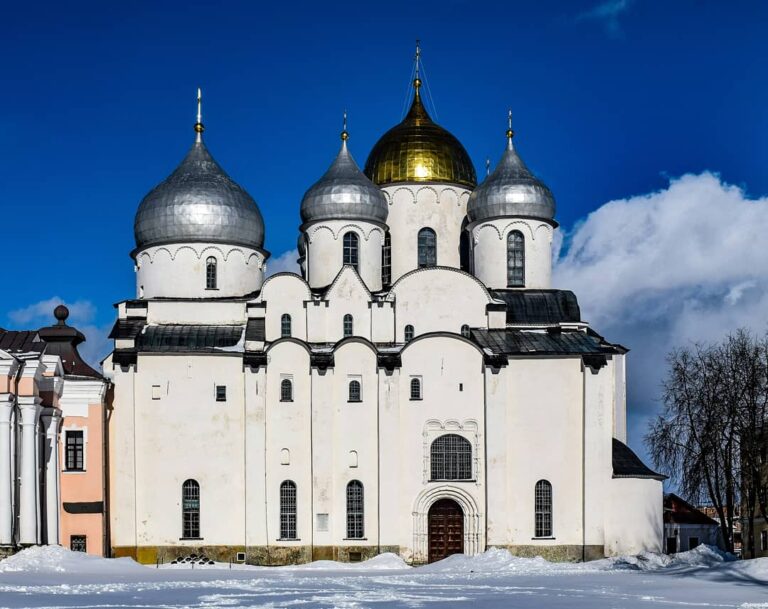
The Cathedral of the Nativity of the Mother of God was founded by Anthony in 1117 and completed in 1119. Bishop John consecrated it two years after its foundation. It is a three-nave church that was originally single-domed and includes a circular stair tower. Its plan follows that of the Church of the Annunciation at Gorodishche, known through archaeological excavations.
The cathedral’s number of domes was increased in antiquity to resolve the visual asymmetry produced by the original dome and stair tower. It now has three asymmetrically arranged domes, including one above the cylindrical tower at the north-west corner. Compared with the princely cathedrals of the early twelfth century, its architectural forms are simplified and its masonry is relatively rough. The choir gallery, an elevated space for singers, extends over the narthex, or entrance vestibule, while the eastern pair of piers is T-shaped and the middle pair is hexagonal.
Later alterations widened the original narrow windows, added a low gallery around three sides, replaced the early domes with large onion domes, and removed the choir gallery. The cathedral is one of Russia’s surviving twelfth-century buildings and one of the country’s relatively few churches with three domes.
Fragments of medieval frescoes survive, particularly around the apse, the usually semicircular or polygonal sanctuary area at the eastern end of a church. Much of the visible painting dates from the sixteenth or seventeenth centuries and is in poor condition. Frescoes from the 1120s were uncovered beneath nineteenth-century overpainting during the Soviet period. Earlier paintings had also been found beneath plaster in 1898, when some were initially overpainted before later cleaning revealed further fragments.
Sixteenth-century churches
Church of the Presentation and refectory
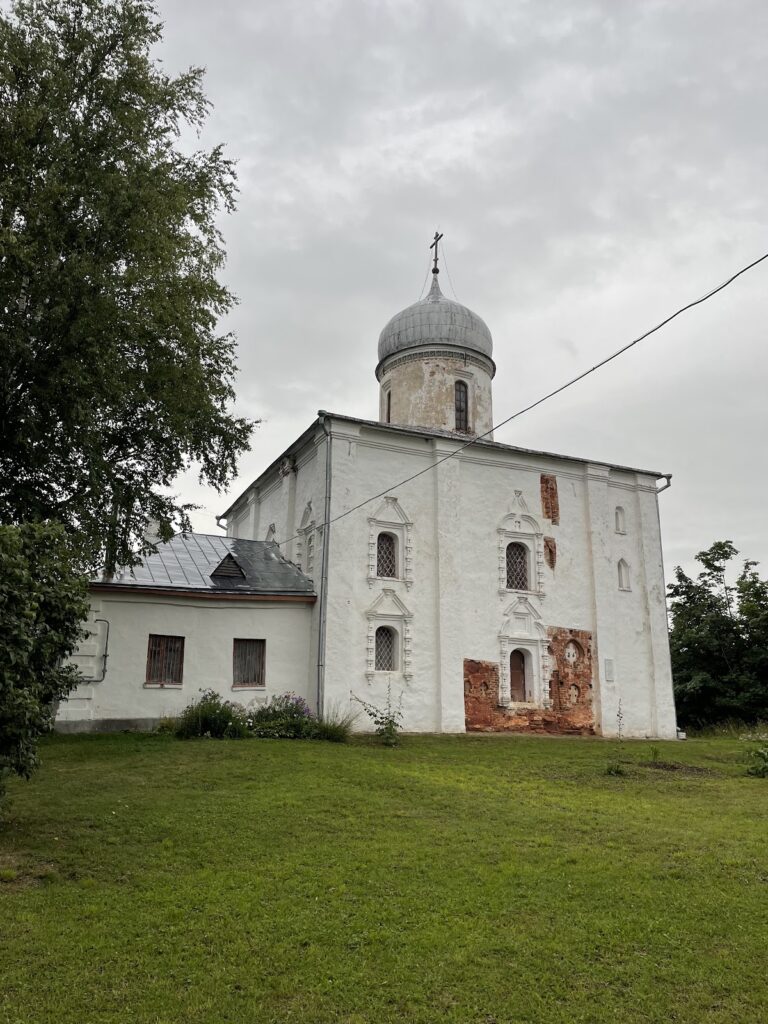
The stone Refectory Church of the Presentation was built between 1533 and 1536. It is a small, single-domed, pillarless church and one of the earliest churches of this type in the Novgorod region. Its shallow dome rests directly on the walls and on curved transitions called tromps, which support the dome above the corners of the square central volume.
A spacious refectory adjoins the church on its western side. Its vault is supported at the centre by an octagonal pillar. The Presentation Church also preserves an old icon of Anthony and objects associated with him, including six mosaic icons, two phelons, or sleeveless outer vestments worn by Orthodox priests, and an orarion, a narrow liturgical stole worn by a deacon.
Church of Anthony the Great
The Church of Anthony the Great, known as the church “under the bells,” was built in the mid-sixteenth century. It collapsed and was demolished in 1804. Its foundations were discovered and investigated during the 1980s, preserving archaeological evidence of this phase of the monastery’s construction.
Gates, later buildings, and sacred remains
Gate churches and bell towers
The hospital Church of Alexander Nevsky and the Church of the Beheading of John the Baptist above the southern gate were built in the 1670s. Both were dismantled in 1804. An earlier bell tower had been built above an entrance gate and was also demolished in that year. A replacement bell tower was erected in the early nineteenth century, although its upper tiers were later dismantled, leaving the lower part standing.
Seminary and service buildings
The surviving complex includes a seminary library built in 1780, a hospital building from 1801, and several nineteenth-century residential, administrative, and service buildings. Some of these structures were later converted for residential use, while other parts of the historic complex are occupied by university faculties.
Anthony’s stone and the monastery’s relics
The stone associated with Anthony’s legendary arrival was set into the cathedral’s exterior wall in the mid-sixteenth century. It is now kept in the cathedral vestibule, immediately to the right of the entrance, beneath a fresco of Bishop Nikita of Novgorod.
Anthony’s remains are preserved in a silver reliquary in the Cathedral of the Nativity. The cathedral also contains relics associated with the monks Nikita, Kirill, Nicephorus, Clement, and Isaac, identified as the wonderworkers of Sokolnitsa. Other religious figures, including Archbishop Ambrosius Yushkevich, are buried in the vestibule.
Nearby sites