Church of the Nativity of the Theotokos on Mikhalitsa: A Medieval Monastic Church in Veliky Novgorod


Site at a Glance
- Rating
- 4.9
- Popularity
- Very Low
- Country
- Russia
- Primary era
- Medieval
- Eras represented
- Medieval, Early Modern, Modern
- Civilizations
- Novgorod Republic, Russian
- Site type
- Religious
- Remains
- Church
On this page7 sections
History
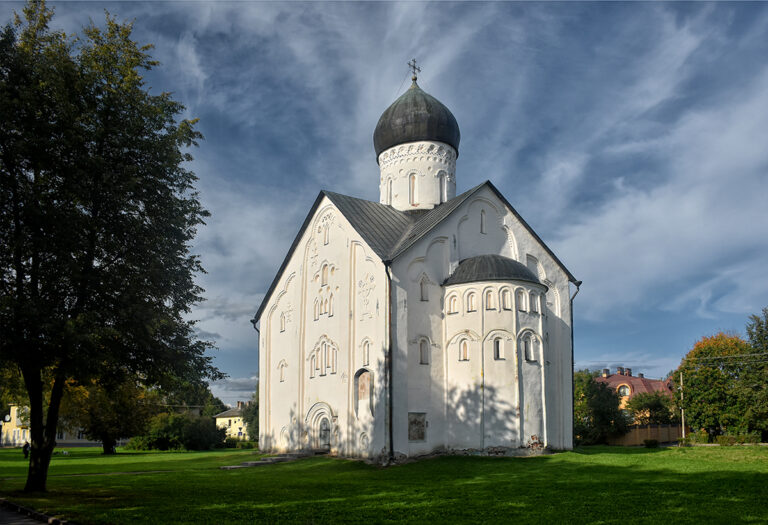
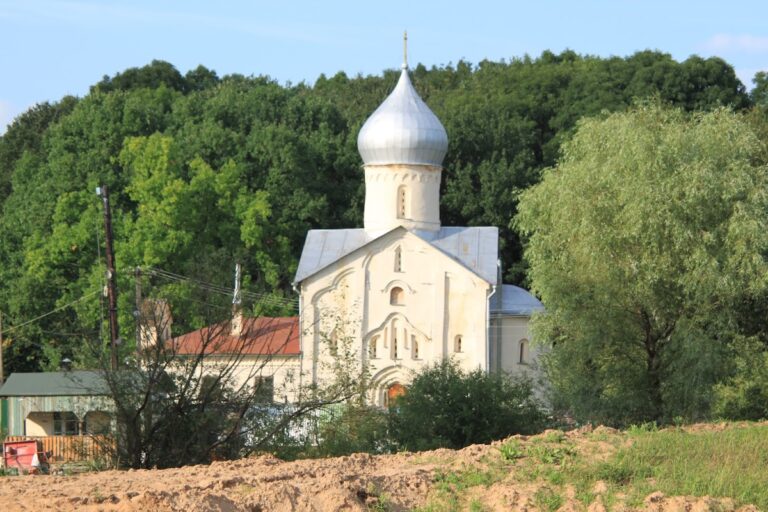
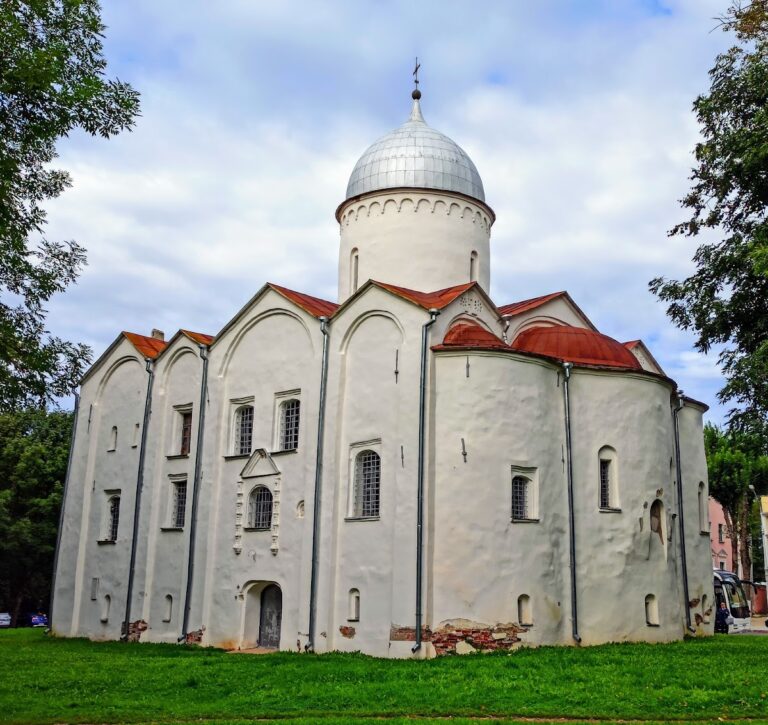
The Church of the Nativity of the Theotokos on Mikhalitsa is a medieval masonry church in Veliky Novgorod, Russia, built in 1379 in the Novgorodian cross-domed tradition. The Theotokos is Mary, the mother of Jesus, and her Nativity is the feast commemorating her birth. The church stands in the historic Plotnitsky End, one of medieval Veliky Novgorod’s boroughs, on the site of an earlier wooden church.
Foundation and medieval rebuilding
A chronicle entry for 1199 records the establishment of a church and the Monastery of the Nativity of the Theotokos at Mikhalitsa by Rostislava Mstislavna, described as the second wife of Yaroslav II of Vladimir, a medieval ruler of the Vladimir-Suzdal principality. The earlier wooden church later burned in a fire. Its replacement, the present masonry building, was erected in 1379 and served as the cathedral of the Mikhalitsa Monastery.
The name Mikhalitsa predates the church’s foundation, although its original reference is uncertain. It may have described the monastery or a district. One chronicle called the location Mikhailova Street, but that identification was considered mistaken because another street of that name lay farther south in the Slavensk End. Archbishop Makary proposed that Mikhalitsa came from an earlier Church of Michael Maleinus, whose name was also associated with the monastery and settlement.
Later changes and changing use
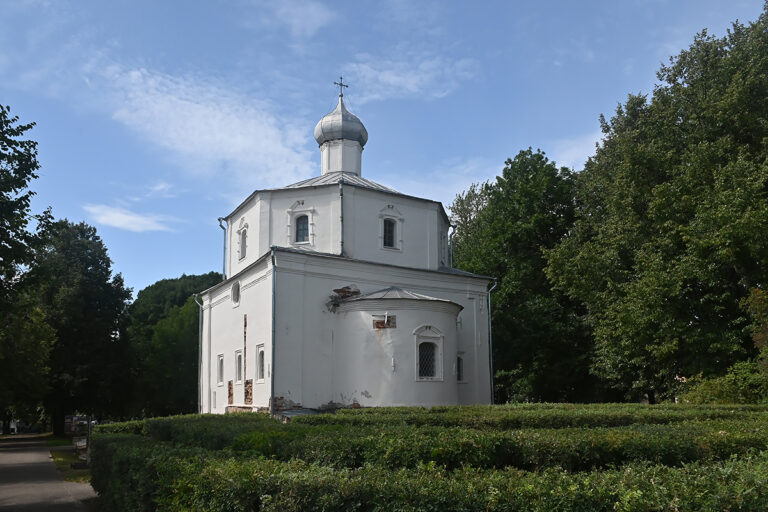
The church stands on present-day Molotkovskaya Street, an area historically associated with blacksmith workshops and people who worked as smiths. The building was altered and substantially reconstructed in the late seventeenth century. A western vestibule was added during the nineteenth century.
The Mikhalitsa Monastery was dissolved in 1764, when new ecclesiastical staffing establishments were introduced. In 1786, both of its churches were converted into parish churches. Since 1989, the Nativity church has belonged to a Pomor Old Believer community. Pomor communities belong to the Old Believer tradition, whose adherents preserved forms of Russian Orthodox worship that separated from the official church after reforms in the seventeenth century. The building remains an active church and is a federally significant cultural-heritage monument of the Russian Federation.
War damage and restoration
Bombing during the Second World War severely damaged the monument. Almost all its vaults and the dome were destroyed. In 1955, the church was described as a stone shell with extensive vertical cracks. The southeastern pier, a substantial masonry support, had crumbled, while the apse, the rounded eastern projection of the church, had tilted considerably and contained a large opening above a window.
Restoration took place in summer 1956. L. E. Krasnorechev researched the building and prepared the restoration design. The church was restored in forms based on its seventeenth-century appearance, while architectural forms and details from the fourteenth century were brought to light.
Remains
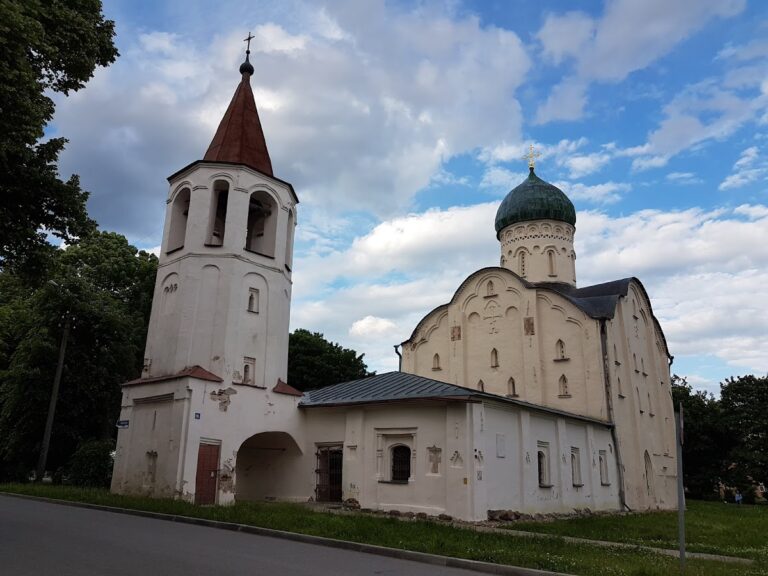
The surviving complex is organized around the Nativity church, a masonry cross-domed building whose vaulted structure was arranged around a central dome over the crossing of intersecting arms. The monastery complex also includes a refectory with the Church of Michael Maleinus and a bell tower. The church’s western side carries the vestibule added in the nineteenth century, while the restored structure preserves evidence of both its later reconstruction and its medieval origins.
Church structure and decorative details
Distinctive inset stone crosses are incorporated into the church’s masonry, including examples on the southern facade. Beneath the cornice of the dome skirt runs a belt of colored ceramic tiles. These surviving details belong to the building’s architectural fabric and help distinguish its exterior treatment within the restored church.
Damage and reconstructed fabric
Wartime destruction removed nearly all the vaults and the dome, and the later restoration reconstructed the building in seventeenth-century forms. At the same time, the work exposed fourteenth-century architectural details, allowing the present church to retain evidence of its 1379 construction beneath the restored appearance.