Abbazia di Sant’Egidio: A Bergamasque Romanesque Basilica and Former Cluniac Priory


Site at a Glance
- Rating
- 4.8
- Popularity
- Low
- Country
- Italy
- Primary era
- Medieval
- External website
- Open
- Eras represented
- Medieval, Early Modern, Modern
- Civilizations
- Holy Roman Empire, Italian, Venetian
- Site type
- Religious
- Remains
- Church
On this page17 sections
History
Abbazia di Sant’Egidio is a Bergamasque Romanesque basilica and former Cluniac priory in Sotto il Monte Giovanni XXIII, Italy, founded at Fontanella on 13 January 1080 through the initiative and endowment of Alberto da Prezzate. Alberto was an eleventh-century Lombard nobleman and religious patron associated with monastic foundations around Bergamo. He donated land where construction of a monastery had already begun, dedicated it to Saint Giles, and provided for the spiritual benefit of Teiperga, Isengarda, and Giovanni. The church was consecrated in 1096.
Foundation and Cluniac association
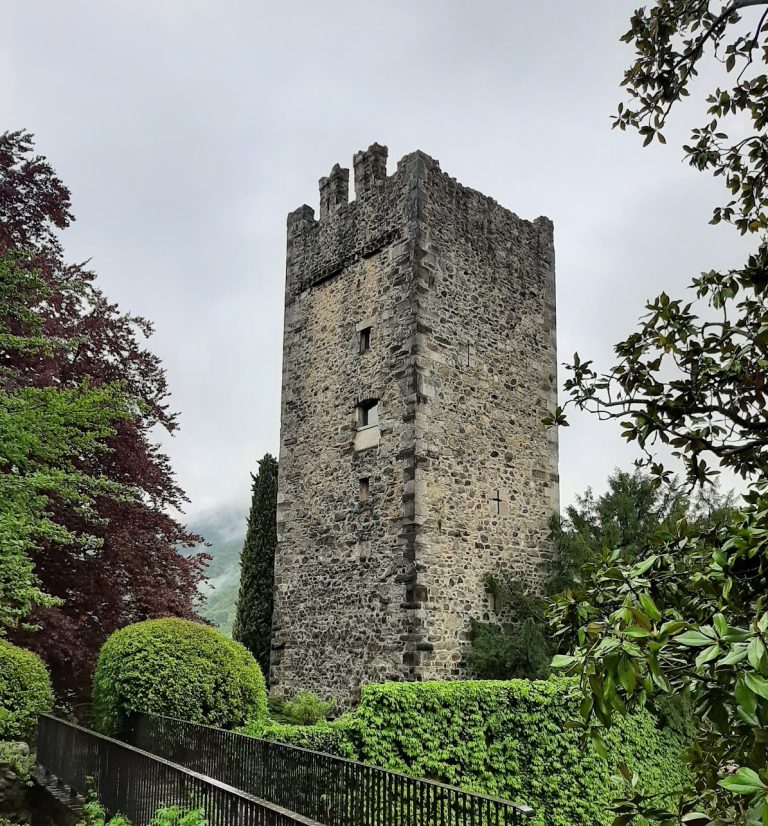
The foundation followed soon after that of the monastery at Pontida. It may initially have been intended for nuns, but its distance from urban centers made the site insecure for a female community. Monks were instead established there, with the first recorded prior appearing in the twelfth century. The early construction of the tower may indicate that the monastery was also conceived as a fortified religious complex.
Sant’Egidio became part of the European network of Cluniac priories. The Cluniac tradition was a medieval Benedictine reform movement centered on the Abbey of Cluny in Burgundy, whose affiliated houses were connected institutionally and liturgically to Cluny or to other priories in its network. In 1177, Gerardo, a deposed bishop who had renounced a schism and received forgiveness from Pope Alexander III, withdrew to the monastery.
The monastery in the twelfth and fourteenth centuries
A document dated 17 September 1178 records Guala’s renunciation of a tithe in favor of the monastery in exchange for a single lamb for Easter. It also names the prior, ten monks, and four lay brothers. This community is stated not to have changed in number. In 1180, Prior Lanfranco received an annual rent of three and a half measures of millet and rye from Provost Bonifacio Suardi of the Alexandrian church of Bergamo. On 18 May 1193, Lanfranco received extensive land donations and represented Olrico of Solbiate, treasurer of the archbishop of Milan.
Vocations declined during the thirteenth century, although six young French clerics were recorded at the monastery. Before leaving for a general chapter at Cluny on 12 March 1308, Prior Guglielmo commissioned an inventory of the monastery’s lands, furnishings, books, and community for his successor. He was followed by Durante, a French monk from Auvergne. By 1350, six monks were recorded, possibly reflecting the effects of the plague of 1348.
Visconti rule and changing administration
During Visconti rule, Federico del Pozzo of Trescore became prior. He was of Bergamasque origin and had been ordained a deacon on 23 February 1342. Conflicts between the papacy at Avignon and the Duchy of Milan, together with the abandonment of the Cluniac order, brought heavier taxation and disputes. A pact between Pope John XXII and Azzone Visconti, lord of Bergamo, prohibited taxation of the clergy, but repeated synods and assemblies did not prevent further fines and excommunications.
The monastery also administered a hospital on Bergamo’s Via Borgo Canale, recorded in 1346. The hospital accommodated monks who stayed in the city for administrative business. Federico del Pozzo was authorized to celebrate services at the nearby church of Saints John the Baptist and Erasmus and to retain its revenues, apart from offerings made on the feast days of its patron saints.
After September 1373, Sant’Egidio entered a difficult period. Like Pontida, it had been plundered by Bernabò Visconti in retaliation for the violent death of his eldest son, Ambrogio. Three years later, after complaints and a request for reimbursement, Visconti confirmed the privileges and exemptions of Pontida and Fontanella. Fontanella may already have been held under commendatory administration, in which a person held a monastery’s title and revenues without necessarily residing there or directing its daily religious life. In 1429, Luca, son of Leonino Brembati, administered the monastery’s property.
Venetian rule and suppression of the community
After Bergamo came under Venetian rule in May 1428, the Republic of Venice initiated repairs and provisions for churches, monasteries, and abbeys damaged during Visconti rule. Giovanni da’ Vavassori, prior of Pontida, requested compensation from Bergamo’s podestà, Marco Giustiniani. Sant’Egidio was subsequently administered by commendatory priors, including Franchino Gabriele of the Avogadro family, who placed relatives in charge of the monastery’s property.
In 1451, the prior of Fontanella was Giovanni Barozzi, bishop of Bergamo. The priorate later passed to Giovanni Buccelleni, who was appointed bishop of Chrysopolis and became the last prior of Sant’Egidio at Fontanella. Pope Sixtus IV suppressed the monastic community on 12 April 1473.
Parish and diocesan chapel
On 8 October 1575, Carlo Borromeo, archbishop of Milan, incorporated the priorate and its assets, together with those of Pontida, into the properties of Saint Mark’s Basilica in Venice. In the seventeenth century, the procurators of the basilica transferred the priorate and related properties to the Giovanelli family, a noble family of Bergamasque origin. Around 1630, the church returned to the authority of the Diocese of Bergamo.
The parish of Fontanella was established on 27 May 1699 with a parish priest and a cleric. It had 1,200 parishioners in 1861. The parish was transferred to the Church of the Sacred Heart of Jesus at Botta on 7 July 1945, restored to autonomy on 7 May 1946, and suppressed on 17 July 1986, when Fontanella again became part of the Sacred Heart parish. Until about 1986, the locality was called Fontanella del Monte, and the parish was correspondingly known as Sant’Egidio of Fontanella del Monte.
Don Giacomo Carminati began restoration work at the church during the 1960s with assistance from Don Giovanni Roncalli, the future Pope John XXIII. From 1964 to 1992, the church was the residence of David Maria Turoldo, an Italian Catholic priest, poet, and theologian associated with religious and social reflection. He was buried in the nearby cemetery.
On 18 May 1998, Bishop Roberto Amadei established the church as a bishop’s chapel and appointed a rector. The rector received the pastoral powers normally exercised by a parish priest, including the celebration of the sacraments, while the church was defined as a place of prayer and silence open to all. It remains a bishop’s rectory of the Diocese of Bergamo and continues pastoral activities associated with the historic religious site. Conservation restoration inside the church was carried out from 1998 to 2000 for the Jubilee of 2000. Earlier work had taken place in 1910 and 1911, including structural reinforcement, changes to the facade and bell tower, and cleaning of several frescoes. In 1959 to 1962, later additions were demolished through the efforts of Pope John XXIII.
Remains
Basilica structure and apses
Naves and roofing
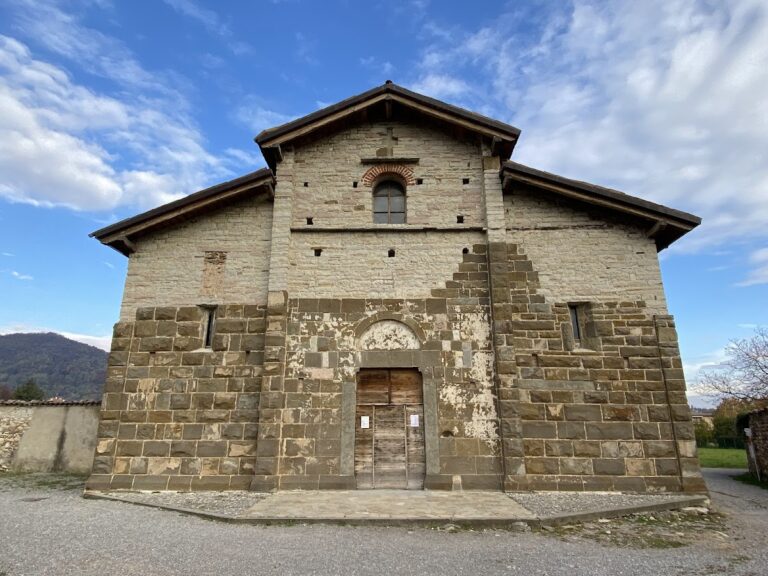
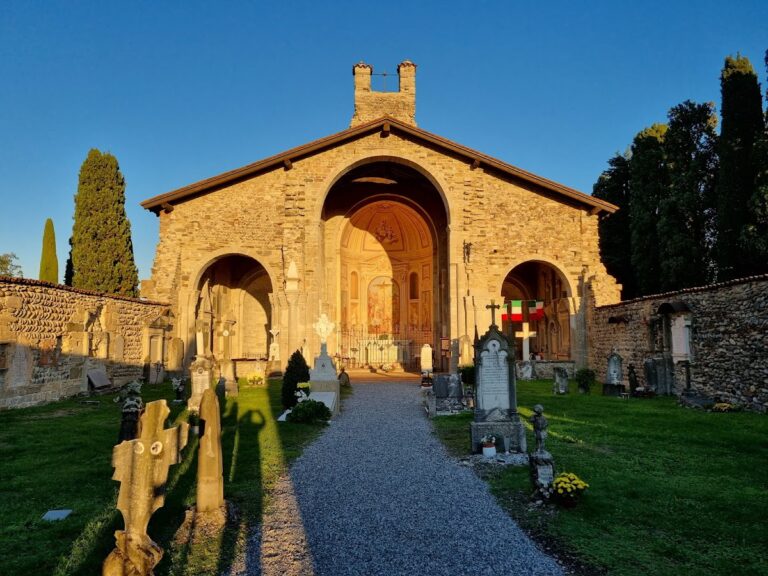
The church is a three-naved Bergamasque Romanesque basilica. Two rows of round arches divide the naves, resting on stone columns with carved capitals. The main and central nave areas have timber truss roofs. At the terminal end, a square-based bell tower rises above the central nave and contains several three-light openings. On the exterior, the three-aisled building culminates in three lightly ornamented apses.
Central apse
Each nave ends in a semicircular apse or apsidiole, with round-headed single-light windows. The central apse is larger than the two lateral apsidioles. Its vault contains a Renaissance-period fresco of Jesus Pantocrator enthroned among the symbols of the Evangelists. In Christian art, the Pantocrator represents Christ as universal ruler, usually enthroned and blessing or holding a sacred text.
Right apsidiole
Cristoforo I Baschenis entirely frescoed the right apsidiole in 1574. The central scene depicts Saint Roch between Saints Giles and Sebastian, while scenes from the life of Saint Roch occupy the side walls. The vault shows God the Father blessing, accompanied by angels. Saint Roch was traditionally associated with protection against plague, while Saint Giles was the hermit to whom the church and former monastery were dedicated.
Left apsidiole and nave paintings
The left apsidiole houses the Blessed Sacrament. Its vault contains a Lamentation over the Dead Christ, and its walls show scenes from the life of Saint Anthony the Abbot, an early Christian ascetic traditionally regarded as a founder of monasticism. Other surviving paintings include saints and a Pietà in the left nave and a Madonna and Child in the right nave. Fifteenth- and sixteenth-century frescoes remain legible on the interior walls, although not every depicted figure can be identified with certainty.
Exterior features and furnishings
Cloister and crucifix
A small cloister stands outside the right nave. Above the apse arch, on the rear wall of the nave, is a wooden Crucifix by Pietro Bussolo dated 1515. Bussolo was an Italian sculptor active during the Renaissance period.
Teoperga monument
A small chapel attached to the exterior southeast side of the church contains a funerary monument traditionally associated with Teoperga, a locally venerated female religious figure whose historical identity remains uncertain. The monument consists of a stone sarcophagus dated 1472 and a carved cover slab bearing a presumed life-size effigy in relief. The sarcophagus, slab, and attribution remain uncertain because they differ in date and style, their measurements do not correspond, and their original arrangement was different.
Teoperga’s tomb stood beside the church on the south side and was described as neglected in 1536. A pastoral visitation in 1575 described it as a stone sarcophagus outside the church toward the parish priest’s house. Eight lamps were said to burn at the tomb during Mass, Matins, and Vespers, reflecting the devotion associated with her. The monument had been neglected until the first half of the twentieth century.
Pipe organ
A pipe organ built by the Pirola brothers in 2013 stands at the rear of the left nave. It has electric transmission with a multiplex system, 24 stops derived from five real stops, and 325 pipes enclosed within an expressive case. The facade pipes are silent. Its projecting console has two 58-note manuals, a straight 30-note pedalboard, and stop controls arranged as draw knobs in several vertical columns beside the manuals.
Nearby cemetery
A small cemetery a few dozen meters from the chapel contains the graves of Cardinal Loris Francesco Capovilla, secretary to Pope John XXIII, and David Maria Turoldo.
Nearby sites