Zverin Monastery: A Women’s Orthodox Monastery in Veliky Novgorod
Site at a Glance
- Country
- Russia
- Primary era
- Medieval
- Eras represented
- Medieval, Early Modern, Modern
- Civilizations
- Novgorod Republic, Russian
- Site type
- Religious
- Remains
- Monastery
On this page14 sections
History
Zverin Monastery is a women’s monastery of the Russian Orthodox Church in Veliky Novgorod, Russia, within the Novgorod and Staraya Russa diocese. Its foundation date is unknown, but it existed by 1148. That year, its wooden Church of the Intercession, dedicated to the Virgin Mary’s protection of the faithful in Orthodox belief, burned after a lightning strike on 27 June.
Early history
The monastery was established beside Zverinets, a protected woodland where Novgorod princes hunted. A chronicle entry for 1069 describes a Novgorodian victory over Vseslav, prince of Polotsk, in connection with the woodland.
Occupation and institutional change
During the Time of Troubles, a period of political crisis and foreign intervention in Russia, Swedish forces occupied Novgorod from 1611 to 1617 and badly damaged the monastery. The Church of the Intercession was later rededicated to the Deposition of the Robe of the Virgin, an Orthodox feast commemorating a relic associated with Mary. A Church of the Annunciation was first mentioned in 1582–1583 and was still described as old in the seventeenth century.
In 1721, reforms by Peter I, also known as Peter the Great, led to the monastery’s suppression as an independent institution and its subordination to Syrkov Monastery. It was re-established in 1727. At the end of the eighteenth century, neighboring Nikolo-Belsky Monastery joined the complex, and the two monasteries were enclosed together.
Renewal, closure, and return
By the late nineteenth century, Zverin was classed as a second-class, non-cenobitic monastery, meaning its nuns did not follow communal monastic living. This was a period of renewed growth.
In 1919, the Intercession Cathedral became a parish church and the monastery closed, although the nuns remained there. When complete closure threatened in 1920, the sisters tried unsuccessfully to establish a dairy cooperative. Parish activity ended in January 1930, when the monastery’s property was nationalized.
The monastery’s buildings suffered severe damage during the Second World War, and restoration began in the 1960s. The Intercession Cathedral returned to the faithful in 1989. Around the end of the twentieth century, about forty nuns lived at the monastery. The complex now houses a theological seminary and a museum. It forms part of the UNESCO World Heritage property Historic Monuments of Novgorod and Surroundings, inscribed in 1992, and is also a Russian cultural heritage monument of federal significance.
Remains
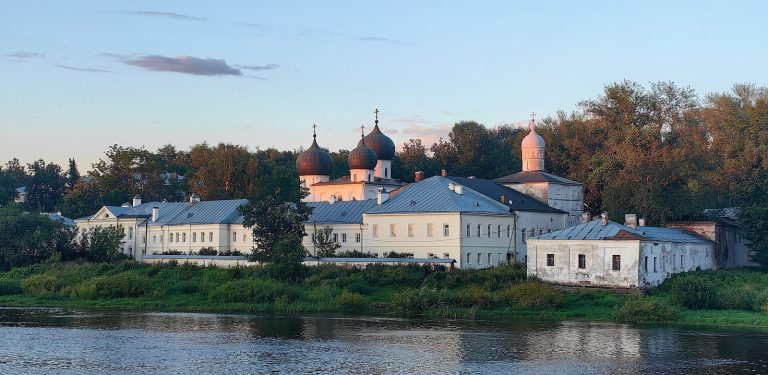
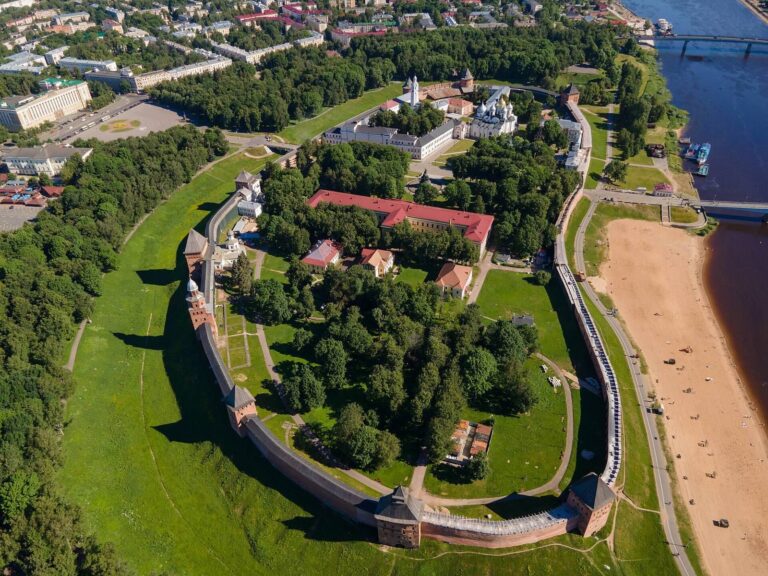
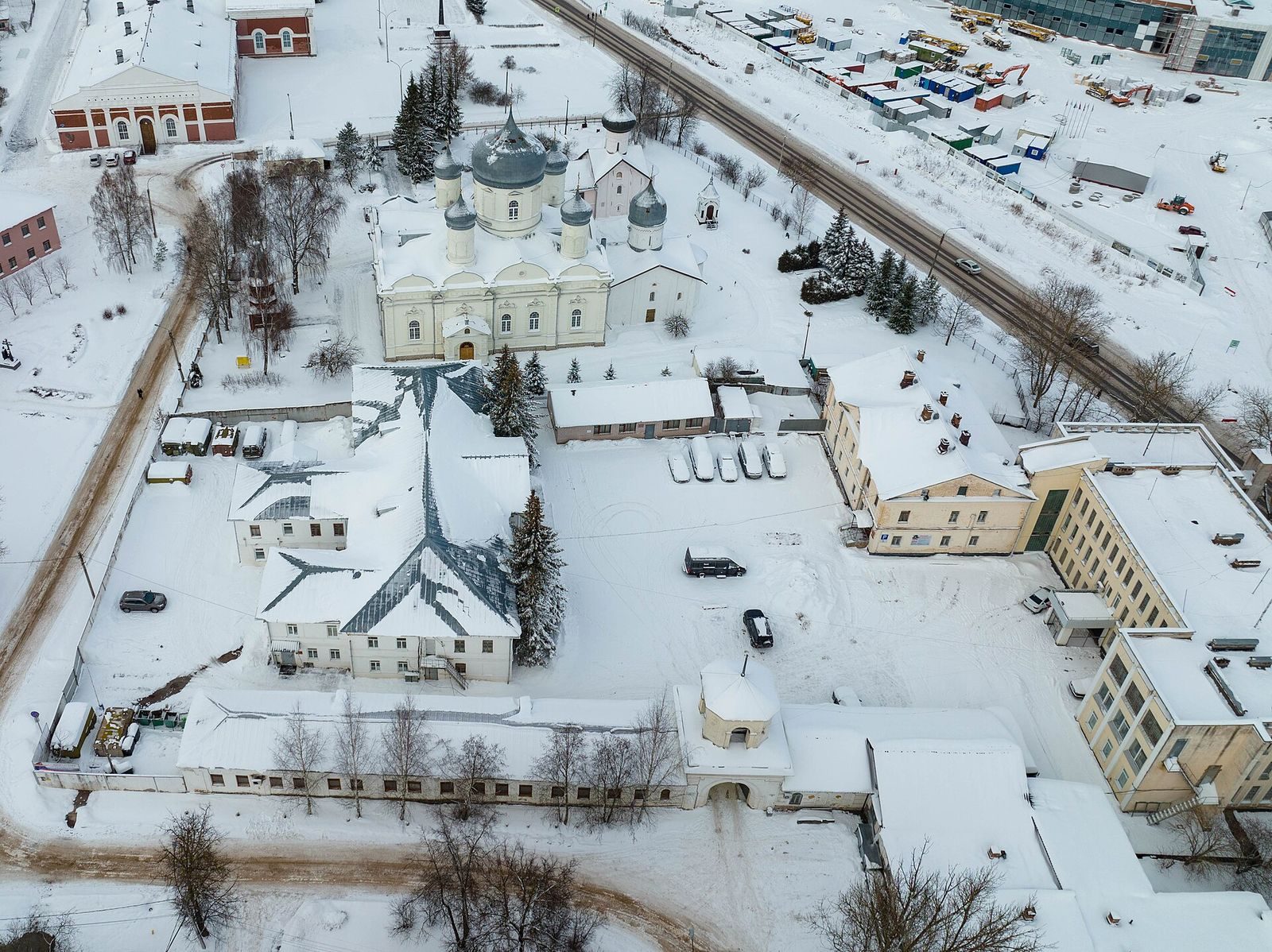
The complex stands on the left bank of the Volkhov, north of the Novgorod Kremlin and near the river’s confluence with the Gzen. Its buildings are enclosed by a perimeter wall, and the churches include structures from different periods of construction and rebuilding.
Churches and enclosure
Perimeter wall
A wall enclosing the monastery complex was built between 1840 and 1860.
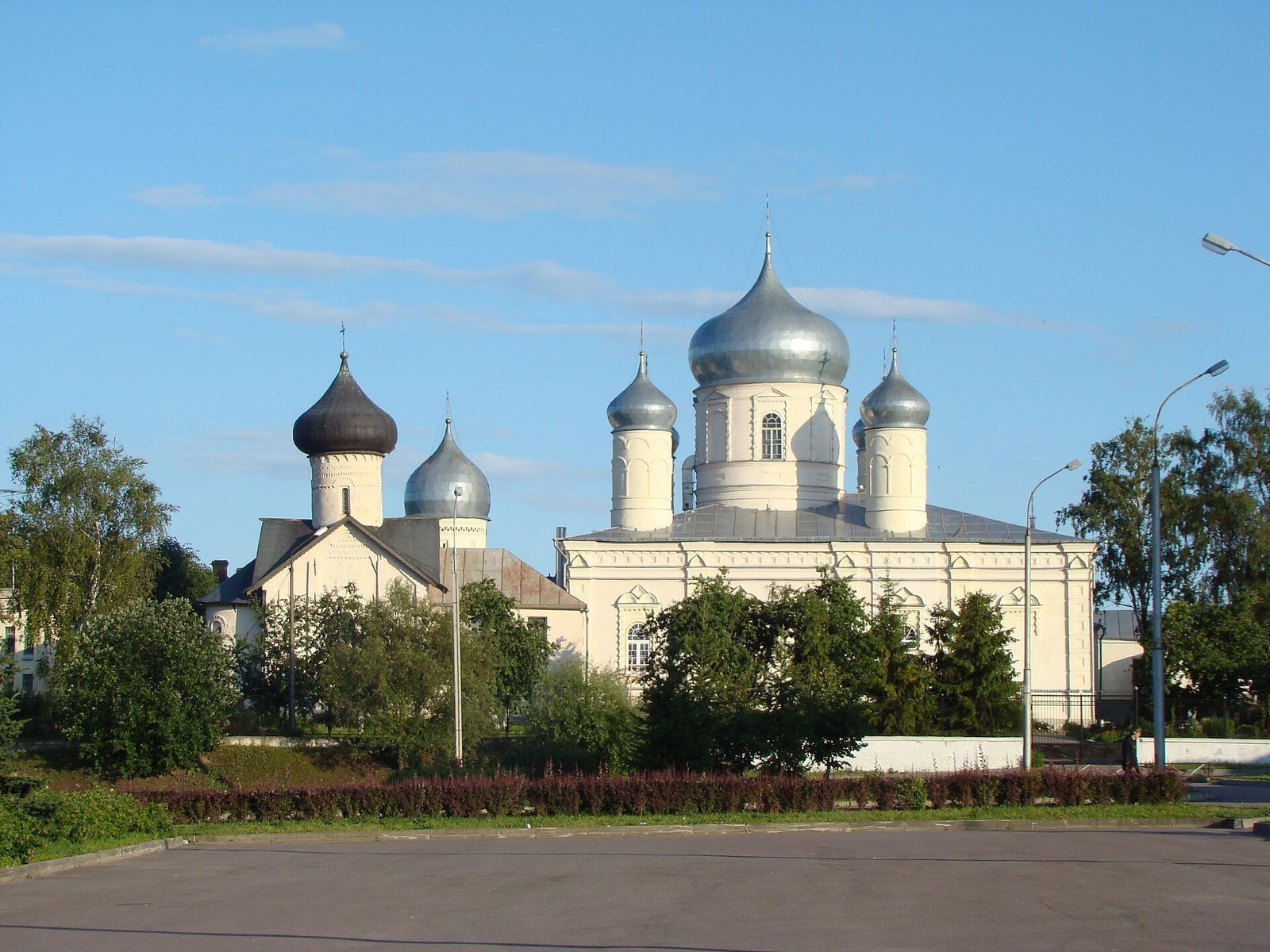
Older Church of the Intercession
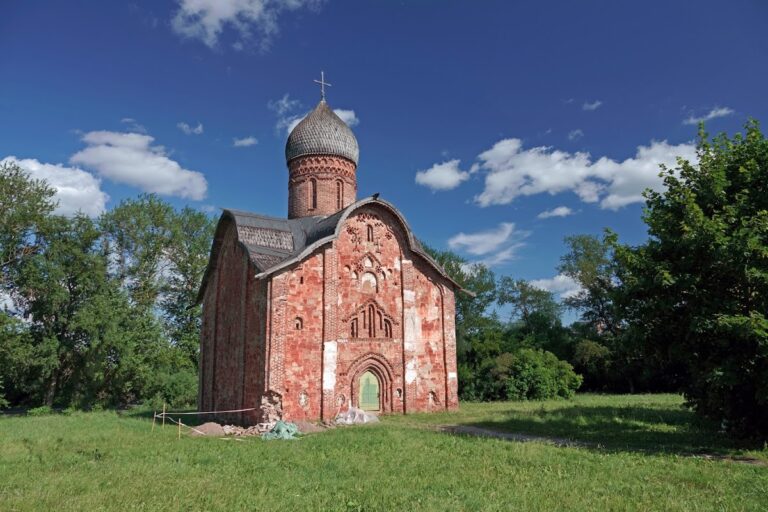
The stone church on the site of the earlier wooden building was begun in 1335 under Archbishop Vasily Kalika, with construction continuing in 1399 under Archbishop John II. It is the monastery’s oldest surviving building. The church was substantially rebuilt after the Swedish devastation and again during construction of the cathedral beside it. When the new cathedral took the Intercession name, the older church was renamed for the Tikhvin Icon, an Orthodox image of the Virgin Mary.
Church of St. Simeon the God-Receiver
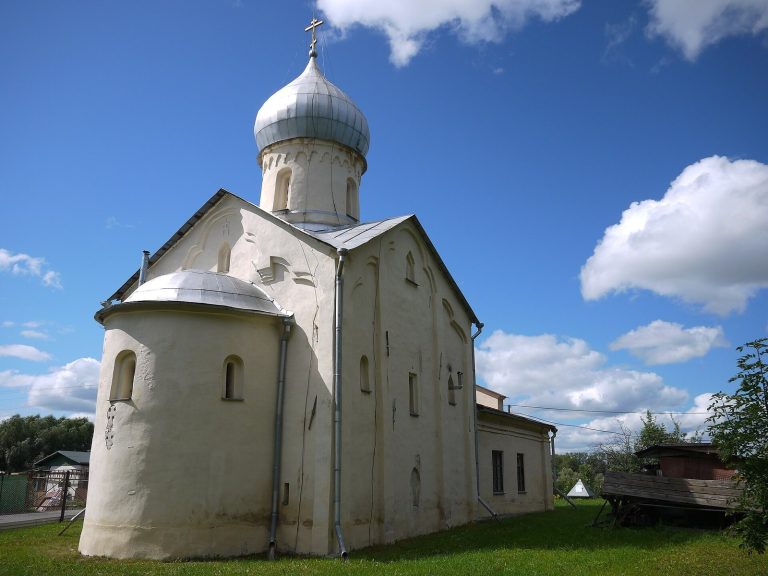
During a plague affecting the Novgorod and Pskov republics, residents built a wooden church here in a single day in 1467; a stone church followed the next year. The small building has one dome and one apse, a recessed area at the end of a church. A secondary structure was added on its west side in the nineteenth century.
Brightly colored fifteenth-century frescoes, paintings made on wet plaster, cover its walls, vaults, and ceilings. Bust-length saints are arranged in a sequence corresponding to the church calendar. The church also held an icon, a devotional religious image, of Simeon the God-Receiver, the saint traditionally said to have recognized the infant Jesus as the Messiah. The monastery regarded the image as miraculous and its most valuable relic.
Cathedral and associated features
Intercession Cathedral
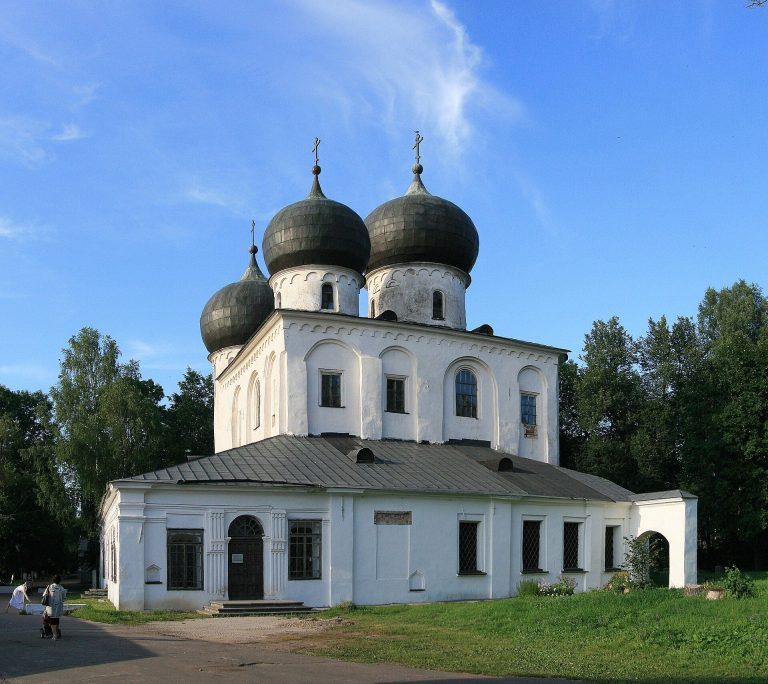
Built beside the older church in 1899–1901, the cathedral replaced a dilapidated church erected there in the early nineteenth century. Builders considered reusing the earlier foundations, but examinations showed that they could not carry the new building’s greater volume, so the cathedral received new foundations. The complex’s tallest building has five domes and an eclectic design, combining elements from different architectural styles. Archbishop Gury Okhotin consecrated it on 30 September 1901.
Bell tower
The monastery had a bell tower supported by four pillars and fitted with three small bells.
Burials
Ivan Matveyevich Muravyov-Apostol, a Russian writer and public figure, was buried near the Church of the Intercession in 1851. His second wife, Praskovya Vasilyevna, born Grushetskaya, was buried beside the church in 1852.
Relics of Savva of Vyshersk
The relics of Savva of Vyshersk, a Russian Orthodox monk revered as a saint, were found in 1992 during excavations at the foundations of a cathedral at the monastery named for him. Relics are physical remains or objects associated with saints and venerated by the faithful. They were transferred to the Intercession Cathedral on 20 March 1995.