Church of Saints Peter and Paul in Kozhevniki: An Orthodox Church in Veliky Novgorod


Site at a Glance
- Rating
- 4.8
- Popularity
- Low
- Country
- Russia
- Primary era
- Medieval
- Eras represented
- Medieval
- Civilizations
- Novgorod Republic
- Site type
- Religious
- Remains
- Church
On this page6 sections
History
Medieval origins
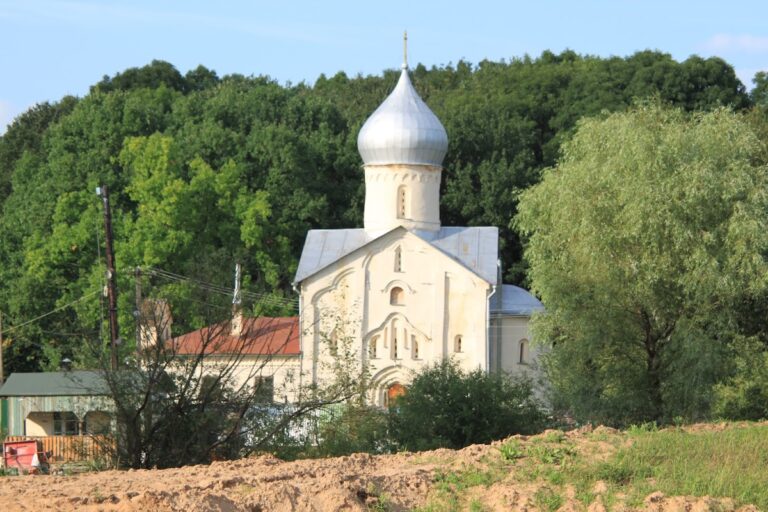
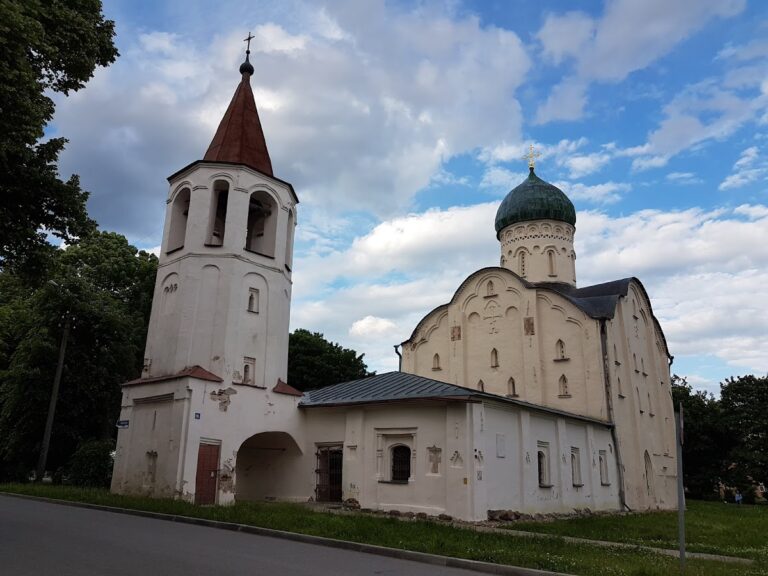
The Church of Saints Peter and Paul in Kozhevniki is a 1406 Orthodox church in Russia, built in the architectural tradition of the medieval Novgorod Republic. Saints Peter and Paul were leading apostles of early Christianity. The church stands south of Zverin Monastery, an Orthodox monastic institution, on what is now Bredova-Zverinaya Street.
A wooden church occupied the site by 1227. Fire destroyed it in 1384, and artisan tanners then financed the construction of the present stone building, completed in 1406. The church’s modest scale and carefully arranged masonry decoration reflect the distinctive building traditions of medieval Novgorod.
War damage and later use
The church suffered severe damage during the Second World War. L. M. Shulyak and G. M. Shtender restored it in 1959, while its bell tower had already been demolished in the 1930s. The building is now inactive as a place of worship and functions as a museum. Its icons are preserved and exhibited in the Novgorod Historical Museum in the Kremlin.
The church is a federally significant cultural-heritage monument of Russia. It also forms part of the UNESCO World Heritage property Historic Monuments of Novgorod and Surroundings: Zverin Monastery and its Environs, inscribed in 1992 under criteria ii, iv, and vi.
Remains
Form and masonry
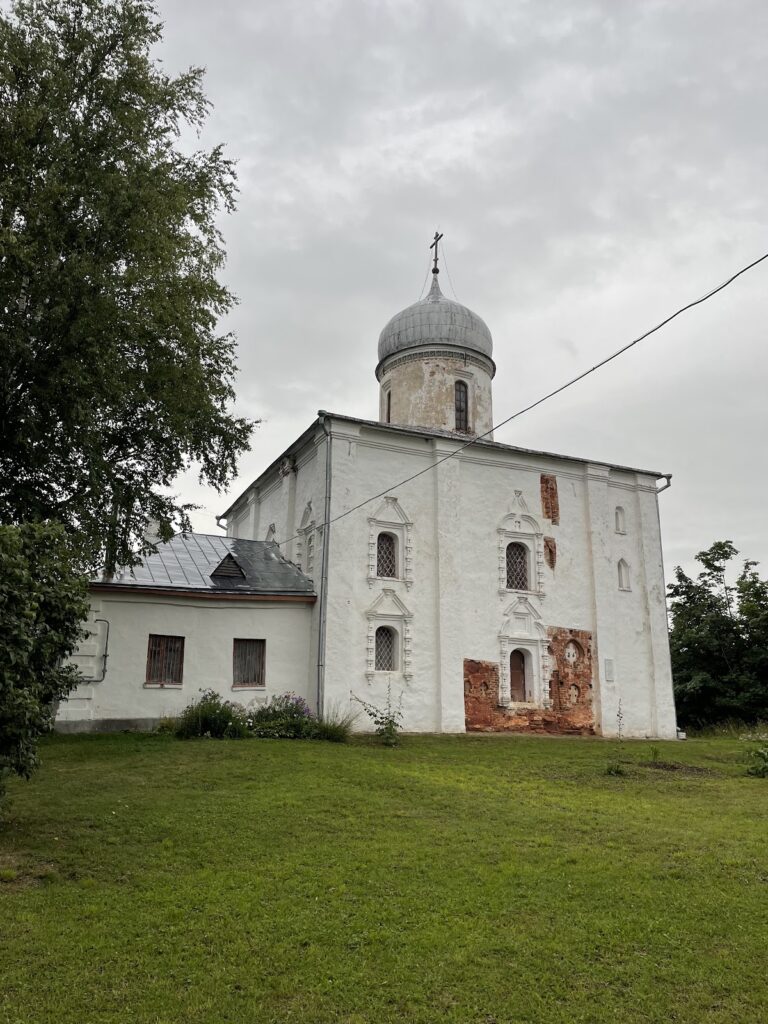
The church is a compact, cube-shaped cross-in-square building. This plan centers on a domed space whose arms create an internal cross within a roughly square layout. Four internal pillars support the structure, which is crowned by a single dome carried on a drum, the cylindrical support beneath a dome, and an upper termination formed by three curved lobes.
Limestone blocks and brick make up the construction, and the masonry remains unplastered. The facades, apses, and dome drum carry patterns formed directly in the masonry. These include rosettes, crosses, arches, triangular recessed motifs, and inset crosses, with brick used for some decorative elements.
Facades and surviving icons
The south and west facades receive the richest treatment, with elaborate brickwork and inset crosses. The east facade, which faces the Volkhov, is more sparsely ornamented, while the north facade is plain. The church is modest in scale and simple in form compared with other Novgorod buildings. It is regarded as one of the most mature examples of Novgorod Republic architecture and as the only building from that period restored to an appearance considered close to its original form.
The associated icon collection includes Old Testament Trinity, from the late sixteenth or early seventeenth century, and icons from the festal and Deesis tiers, rows of icons in an Orthodox iconostasis, from the mid-sixteenth century. It also includes The Virgin and Child, dating from the first half to the middle of the fourteenth century. These works belong to the Novgorod museum collection rather than remaining inside the church.