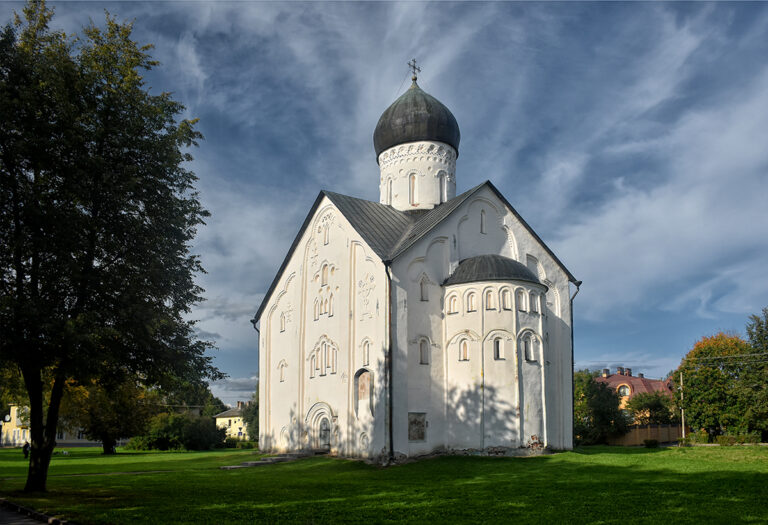
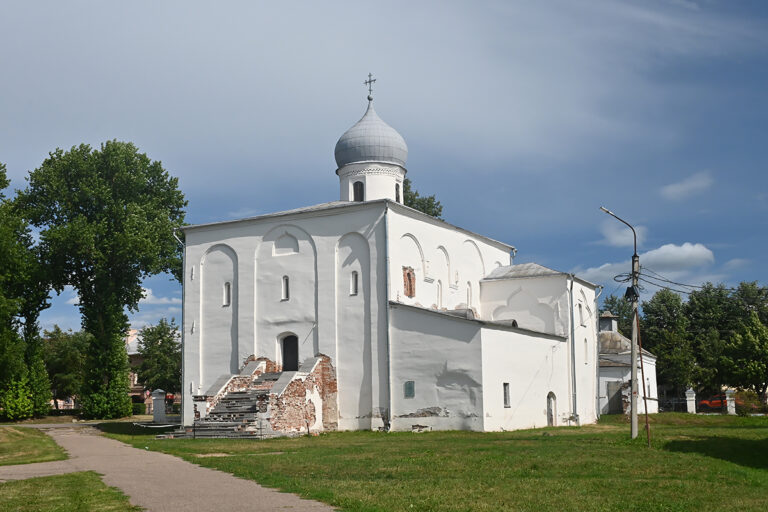
Church of Saint Theodore Stratelates on the Brook, Veliky Novgorod: A Medieval Orthodox Church


Site at a Glance
- Rating
- 4.8
- Popularity
- Low
- Country
- Russia
- Primary era
- Medieval
- Eras represented
- Medieval, Early Modern
- Civilizations
- Novgorod Republic, Russian
- Site type
- Religious
- Remains
- Church
On this page10 sections
History
The Church of Saint Theodore Stratelates on the Brook is a medieval Orthodox church in Russia, founded in 1360 in the architectural tradition of Novgorod and completed within the following year. Its construction was ordered by Semyon Andreyevich, a posadnik, or senior civic official who governed Novgorod through the city’s political institutions. The church served for centuries as the parish church of Fyodor Street in the Plotnitsky district, known in medieval Novgorod as a konets, or major territorial quarter.
Foundation and Parish History
The church stood beside a stream first named in a chronicle under the year 1105 as the Plotnitsky Brook. It later became known as the Fyodorovsky Brook, giving the church its enduring name. Saint Theodore Stratelates was traditionally regarded as a Christian martyr and military commander in the imperial army who was executed at Heraclea under the emperor Licinius. The title “Stratelates” means military commander.
Restoration and Modern Preservation
A complete restoration carried out from 1910 to 1912 recovered the fourteenth-century fresco ensemble, exposed several compositions on the facades, and reopened windows that had been blocked with brick. The upper part of the seventeenth-century bell tower was damaged during fighting in the 1940s. After wartime damage, Lyubov Shulyak directed comprehensive facade restoration in the 1950s, including the reconstruction of the three-lobed gable termination and the building’s original decorative treatment.
In 1954, the Fyodorovsky Brook was filled in during construction of the Moscow to Leningrad road. The church then stood on the left side of Fyodorovsky Brook Street when viewed from the Volkhov. It is now a non-functioning Orthodox church preserved as a museum site within the Novgorod State Museum-Reserve. The monument has federal cultural-heritage protection in Russia and was included within UNESCO World Heritage protection in 1992. Regarded as a classic monument of medieval Novgorod architecture, it also served as a model for later Novgorod architects. Its image appeared on a Russian commemorative three-ruble coin issued in 2009 in the UNESCO heritage series.
Remains
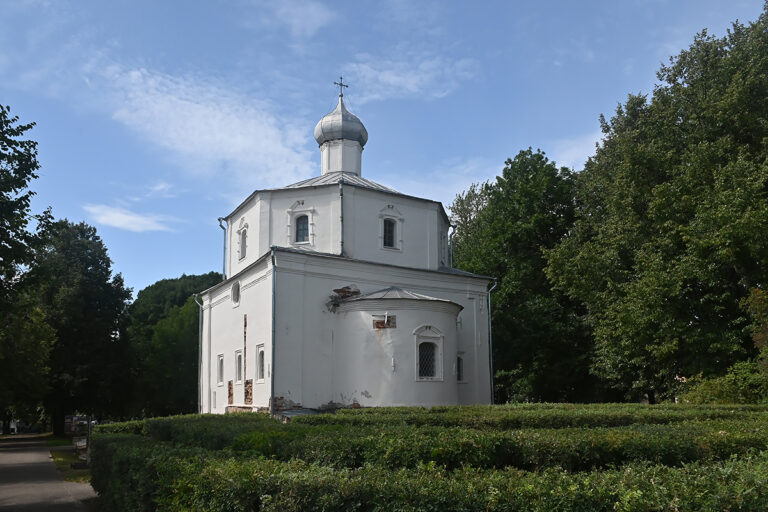
The church is a cubic, cross-domed building organized around four internal piers and a single dome. A cross-domed church arranges its central dome and supporting structure around a cross-shaped interior plan. The building stands at the junction of Andreyevskaya Street and Fyodorovsky Brook Street. Its facades, especially the dome drum and apses, carry numerous decorative elements, while some niches once held frescoes. The founder’s plan also conceived the church as a stone safe, giving the building a protective function alongside its religious purpose.
Church Structure and Later Additions
Main Church
The main church retains its compact cubic form, four supporting piers, central dome, apses, and decorated exterior surfaces. The dome drum, the structure supporting the dome, and the apses contain particularly rich ornamental treatment. The facade niches and reopened windows form part of the building’s restored exterior appearance.
Western Annex and Bell Tower
A western annex and a bell tower were added in the seventeenth century. The upper portion of the bell tower was later restored after wartime damage in the 1940s, preserving the later addition as part of the church’s present architectural form.
Frescoes and Wall Inscriptions
Fourteenth-Century Paintings
The frescoes date approximately to the second half of the fourteenth century. A fresco is a wall painting made on plaster, and here the surviving decoration extends across parts of the walls, vaults, arches, and supporting piers. The paintings were uncovered beneath whitewash in 1910 and now survive in fragmentary form. Their red-brown tones distinguish them from the traditional Novgorod manner, while their compositions and figures show strong influence from Byzantine art of the thirteenth and fourteenth centuries.
The cycle includes scenes related to the life of Saint Theodore and the Passion of Christ. In the Annunciation, a vase of flowers appears as a predominantly Western artistic motif. The paintings closely resemble those in the Church of the Transfiguration of the Savior on Ilyin Street, including repeated or closely related figures and small decorative details. They have been attributed to Theophanes the Greek, but that attribution remains disputed. Another interpretation connects them with the Theophanes school, perhaps assigning them to a close disciple or to an artist who worked alongside him.
Medieval Graffiti
Medieval graffiti remain on the interior walls. They include humorous and admonitory remarks translated as “Do not make noise; walk quietly,” “I will go like a beaver beside the river,” written five times, and “This is what they sing in the lofts at Saint Intercession.” Another inscription states, “Sava walked with me from the market, struck me, and I wrote this.” The warning “Priests, avoid drunkenness” was also written several times.