Makaryev Monastery: A Russian Orthodox Monastic Complex on the Volga


Site at a Glance
- Rating
- 4.8
- Popularity
- Low
- Country
- Russia
- Primary era
- Early Modern
- External website
- Open
- Eras represented
- Early Modern
- Civilizations
- Russian
- Site type
- Religious
- Remains
- Fortified Monastery
On this page15 sections
History
Makaryev Monastery is a Russian Orthodox monastery in Makaryevo, Russia, founded by Saint Macarius of Zheltovodsk and Unzha in 1434, during the first half of the fifteenth century. Originally a men’s monastery beside Yellow Lake, it later became associated with the Volga after the river changed course and engulfed the lake. Its central altar is dedicated to the Holy Trinity, giving the monastery its alternative name, the Zheltovodsky Makaryev Holy Trinity Monastery.
Foundation and destruction
In 1439, Ulu Mukhammed, the fifteenth-century khan of Kazan, attacked and burned the monastery. Most of the monks were killed, and Macarius was taken captive. The khan eventually accepted Macarius’s innocence and piety and released him. At Macarius’s request, 400 captives, including women and children, were freed as well.
During the return journey, Macarius chose a hill on the right bank of the Sviyaga River near its mouth as a possible site for another monastery. The group was not permitted to remain in the territory of the Kazan khanate, however. Macarius then settled near the Unzha River and founded the Unzhensky Makaryev Monastery. He died there on 25 July 1444, aged 95, after instructing his disciples to establish a monastery at the Sviyaga site in memory of his liberation.
Rebuilding and expansion
The monastery was rebuilt on its original site in 1620 by Avramy of Murom, a monk who gathered a new community there. His work began a period of rapid growth. A written account of the rebuilding was composed after Avramy’s death in 1640, and a rotunda-shaped ciborium now marks his grave. A ciborium is a domed canopy erected over a grave or other sacred feature.
Nikon, who later became Patriarch of Moscow, spent eight years at Makaryev as a novice and remained there until 1624. Old Believers, Orthodox Christians who rejected seventeenth-century reforms to Russian liturgical practice, maintain that Macarius also founded the Olenyovsky skete on the route to Unzha. A skete is a small, relatively secluded monastic settlement. According to this tradition, the settlement later entered the seventeenth-century church schism.
The monastery’s position beside the navigable Volga helped a large fair develop on its lands. The abbots encouraged its growth, and the Makaryev Fair became one of Russia’s largest, with a reputation as possibly the largest in Europe. Trading duties provided income for rebuilding the monastery in stone. After the church schism of 1653 to 1656, the nearby Kerzhenets River region also became an important center for Old Believer communities.
Decline and restoration as a women’s convent
The fair burned in 1816 and was moved to Nizhny Novgorod in 1817 for political reasons, although it retained the name Makaryev Fair. This relocation removed the monastery’s principal source of income. Its revenues declined, it was placed outside the regular establishment, and it later suffered a major fire. Changes in the Volga caused erosion and spring flooding around the complex, while the central dome of the Trinity Cathedral collapsed in 1859.
The monastery was dissolved in the late 1860s. Icons, bells, liturgical objects, and other valuables were sent to other churches, especially the Alexander Nevsky Cathedral in Nizhny Novgorod. Residents of Makaryevo secured the retention of the principal icon of Saint Macarius.
The community was restored in 1882 and 1883 as a women’s convent. Repairs and restoration continued before the 1917 Revolution, including work on the Trinity Cathedral, whose central dome was reconstructed before that year. About 300 nuns lived at the convent by 1917.
Soviet use and renewed religious life
After the October Revolution, the convent’s property was nationalized and the nuns were expelled in 1927. The buildings housed an orphanage in 1928 and 1929, an evacuation hospital during the Second World War, and, from 1943, the Lyskovo College of Animal Husbandry and Veterinary Medicine. The churches were converted for use as barns, stables, and storage areas for animal fodder, changing the religious function of the historic complex.
The buildings were transferred to the Nizhny Novgorod Eparchy in 1991 or January 1992, and the Holy Synod reopened the women’s convent in 1991. About 25 nuns lived in the restored community at first. The convent had 22 nuns in 2006 and more than 25 in 2019. In 2005, Archbishop George performed the Great Consecration for an altar dedicated to the Great Martyr Catherine in the Dormition Cathedral. A Great Martyr is a saint traditionally understood to have died for the Christian faith after severe persecution.
On 7 August 2007, the head relic of Saint Macarius was transferred to the monastery from the Pechersky Ascension Monastery in Nizhny Novgorod. Archbishop George also consecrated the Trinity Cathedral. Makaryev Monastery is an active federal-level cultural heritage property of the Russian Federation.
Remains
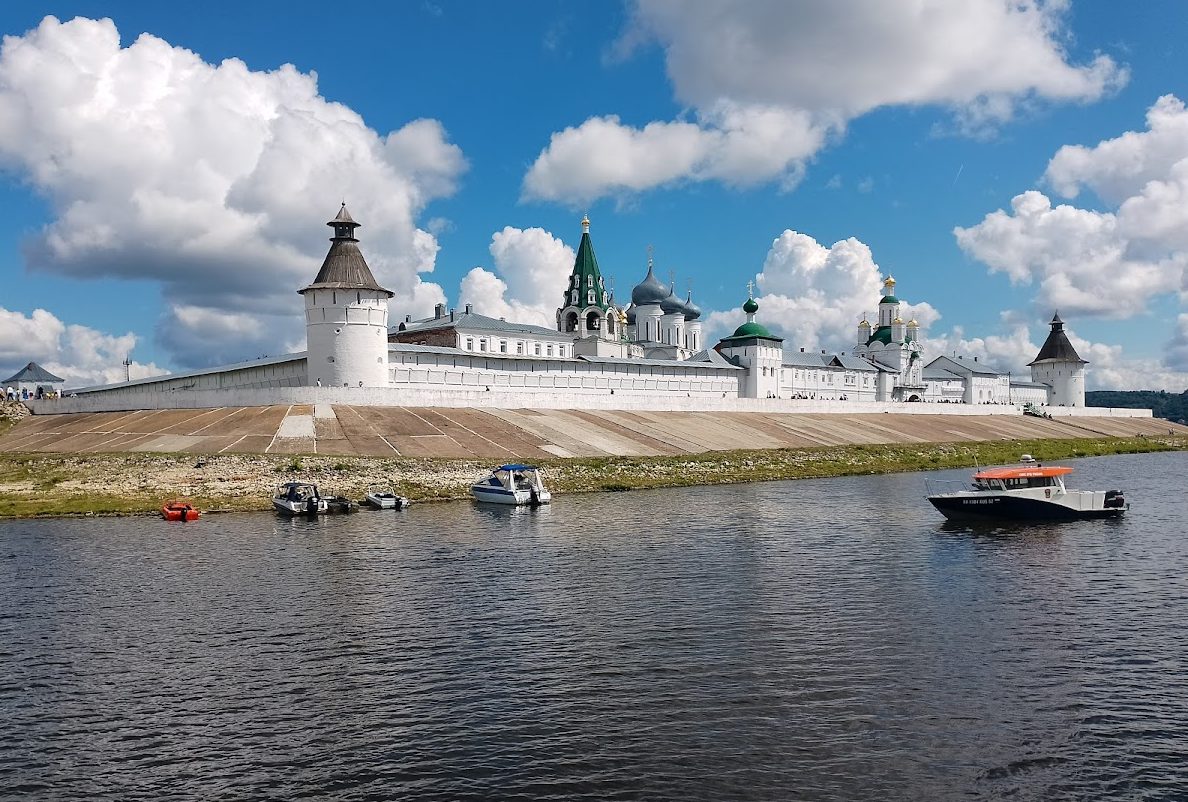
The monastery occupies the left bank of the Volga near Makaryevo. Its buildings form an approximately square enclosure, about 200 metres on each side, surrounded by fortified stone walls with towers. The complex first stood beside Yellow Lake, but the Volga later absorbed the lake and brought the river close enough for erosion and spring flooding to threaten the walls. The river subsequently moved almost a kilometre away, reducing the immediate danger.
Cathedrals and churches
Cathedral of the Holy Trinity
The Cathedral of the Holy Trinity was built in the mid-seventeenth century in the architectural tradition of the Assumption Cathedral of the Moscow Kremlin. Its central dome collapsed in 1859 and was reconstructed before 1917. The cathedral was consecrated again by Archbishop George in 2007.
Church of the Dormition
The Church of the Dormition of the Mother of God dates from the mid-seventeenth century. It is joined to a large refectory, a communal dining hall for the monastic community, and to a bell tower. The two-storey refectory covers approximately 420 square metres. Dormition, also called the Assumption, refers to the Orthodox feast commemorating the death and glorification of the Virgin Mary.
Gate church of the Archangel Michael
The gate church dedicated to the Archangel Michael was built in the seventeenth century above the southern entrance to the monastery. Its position makes it part of the complex’s entrance architecture as well as a place of worship.
Church of Saint Gregory of Pelshma
The church dedicated to Saint Gregory of Pelshma was built in 1786. Saint Gregory of Pelshma is venerated as an Orthodox monastic saint.
Church of Saint Macarius of Zheltovodsk
The church dedicated to Saint Macarius of Zheltovodsk was built in the early nineteenth century in the Classical style. It forms part of a complex that eventually contained seven churches and one cathedral.
Church of Saint Anthony the Great
A further church dedicated to Saint Anthony the Great is associated with the monks’ building. Saint Anthony the Great is an Orthodox monastic saint. Together, the surviving named churches and the cathedral reflect the successive expansion of the monastery’s religious buildings.
Sacred and commemorative features
A well within the monastery is traditionally attributed to Saint Macarius. The grave of Avramy of Murom is marked by a rotunda-shaped ciborium, a domed canopy over a sacred feature. These elements preserve associations with the founders and revival of the monastic community.
Later physical changes
During the Soviet period, the churches were physically adapted as barns, stables, and storage spaces for animal fodder. This reuse altered the buildings before the women’s convent was reopened. The walls, towers, churches, communal buildings, and commemorative features now form the material remains of the monastery’s successive religious and institutional phases.