Annunciation Monastery: An Orthodox Monastic Complex in Nizhny Novgorod


Site at a Glance
- Rating
- 4.7
- Popularity
- Low
- Country
- Russia
- Primary era
- Early Modern
- External website
- Open
- Eras represented
- Early Modern, Modern
- Civilizations
- Russian
- Site type
- Religious
- Remains
- Fortified Monastery
On this page18 sections
History
Annunciation Monastery is an ancient Orthodox male monastery in Nizhny Novgorod, Russia, traditionally founded in 1221 near the establishment of the city. Its early history remains uncertain, although tradition connects its foundation with Grand Prince Yuri Vsevolodovich of Vladimir-Suzdal and Simon, Bishop of Vladimir. The monastery stood near the Oka and Volga and later became a missionary, defensive, economic, and religious institution associated with the Nizhny Novgorod and Arzamas Diocese of the Russian Orthodox Church.
Foundation and Early History
The monastery is first securely mentioned in a record from 1229. The chronicle refers to a monastery dedicated to the Holy Mother of God, rather than naming Annunciation Monastery directly. The identification of these institutions became widely accepted in the nineteenth century, but the evidence is inconclusive because the 1229 monastery could have belonged to several establishments dedicated to the Mother of God.
According to the foundation tradition, Yuri Vsevolodovich established the monastery in connection with the founding of Nizhny Novgorod. It was also intended in part as a missionary center for the Christianization of local non-Christian populations. In 1229, the Mordvinian prince Purgas attacked and burned the monastery, killing the monks. Another historical tradition states that much of the monastery collapsed during the severe winter of 1369.
The Alexy Tradition and Medieval Development
The monastery’s revival is traditionally associated with Metropolitan Alexy, the fourteenth-century head of the Russian Church based in Moscow. In 1357, while traveling to the Golden Horde, Alexy reportedly stopped at a spring beside the ruined monastery. He is said to have vowed to restore it if he returned safely after healing Taidula, the wife of Khan Janibek, from blindness. The vow was traditionally regarded as fulfilled in 1370, and a stone church dedicated to the Annunciation was reportedly built the following year. This account belongs chiefly to hagiographic and later historical tradition, and Alexy’s involvement is not conclusively established.
From the late fourteenth century, the monastery developed several connected roles. Its position allowed warnings of approaching danger and gave people time to seek shelter behind its walls. Monks, dependents, and peasants also cultivated and settled surrounding lands. Between the fourteenth century and 1554, the monastery received fishing grounds, beaver-hunting territories, lakes, wastelands, villages, and other properties from members of the Nizhny Novgorod and Suzdal ruling houses and from private donors.
Among the recorded grants were fishing and beaver-hunting territories along the Sura River in 1393, the Spasskoye settlement and beekeeping lands in 1399, and lands near Platinsky Ravine in 1416 and 1417. The monastery later received the deserted village of Elenskoye and Zaborskaya village in 1438, the village of Migino in 1442, and the village of Gnilitsa with adjoining lands in 1554.
Ecclesiastical Status and Early Modern Growth
The monastery was attached to the metropolitan household and, after the Moscow Patriarchate was established in 1589, became associated with the patriarchal household. It therefore held stauropegia, the status of direct subordination to a patriarch or other senior church authority rather than to the local diocesan bishop. When the patriarchate was abolished and the Governing Holy Synod was created in 1721, the monastery initially remained directly subordinate to the Synod.
Osip Yermolov, a direct ancestor of General Alexey Yermolov, supported the monks with money during his visits and died in 1631. Major stone construction began in the seventeenth century. The Annunciation Cathedral initiated this building program, followed by the refectory complex and Dormition Church. Older churches were also rebuilt repeatedly during the seventeenth and eighteenth centuries.
In 1764, approximately 50 to 60 monks and novices lived at the monastery. It was classified as a third-class monastery and transferred to the jurisdiction of the Nizhny Novgorod and Arzamas bishops. During the eighteenth century, a manuscript kondakar, a medieval Eastern Christian liturgical book containing hymn texts and often musical notation, was found there. The Annunciation, or Nizhny Novgorod, Kondakar dates from the twelfth or thirteenth century and is among the oldest monuments of Russian hymnography.
Library, Suppression, and Secular Use
By the end of the nineteenth century, the monastery possessed a substantial library of manuscripts and historic books dating from the sixteenth to the nineteenth centuries. Its holdings included a Gospel book from 1575, a church rule book from 1607, an Apostle book from 1694, a book bearing the signature of Patriarch Hermogenes, and a medieval collection of kondakion and other church songs written in traditional musical notation.
The monastery closed after the Revolution and had been taken over by secular institutions by 1919. During the confiscation of church valuables, important furnishings were removed. The last monks left in 1928, although some members of the community remained after its formal abolition. The surviving parish of Saint Andrew’s Church also closed in 1928, and its furnishings became state property.
Authorities demolished the Alexy Chapel in 1923 after declaring that it had no artistic value. The Alexy Church later housed the Nizhny Novgorod Planetarium from 1948 or 1949 until 2005. The monastery was recognized as a historic monument in 1960, but its condition worsened during the following decade. Partial repairs took place in the 1970s and 1980s, and the Annunciation Cathedral was returned to diocesan authorities in 1991.
Restoration and Revival
Restoration and institutional revival began in 1993, when Metropolitan Nikolay of Nizhny Novgorod re-established the monastery. A theological school opened there and became a theological seminary by decision of the Holy Synod in 1995. Hieromonk Kirill Pokrovsky, a monk ordained as a priest, became its first rector and spiritual father.
Between 2004 and 2007, restoration included the Alexy Church, residential and hospital buildings, and the refectory. Work also continued on the Annunciation Cathedral, the Dormition Church, and the Church of Saint Sergius. A new iconostasis, the screen of icons separating the sanctuary from the main church space, was installed in the Alexy Church in 2007. At the Feast of the Annunciation in 2009, icons of Abel, Isaac, Noah, Seth, Enoch, and Abraham were consecrated for the cathedral’s ancient Russian iconostasis.
The monastery is an object of cultural heritage of federal significance in the Russian Federation and remains active. Since 2010, its community has also supported the restoration of Saint John the Baptist Church in the village of Prudishchi.
Remains
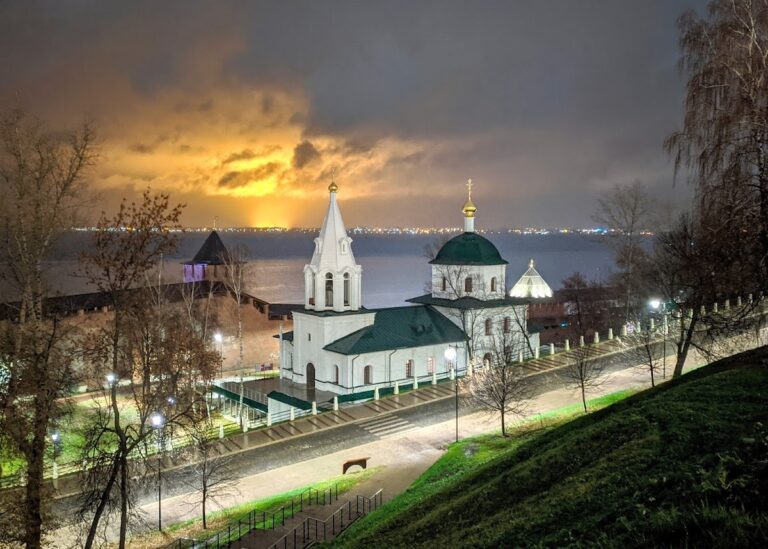
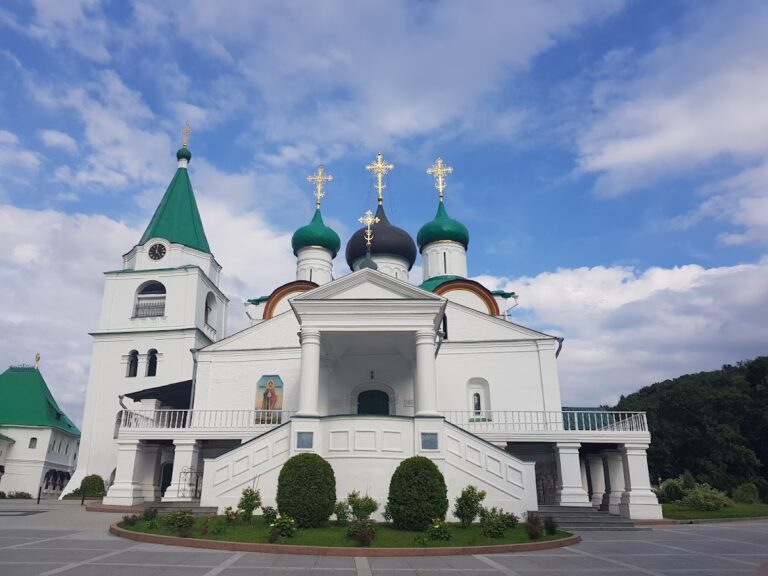
Annunciation Monastery occupies ground above the right bank of the Oka River, near the river’s confluence with the Volga. The associated Annunciation settlement developed on a hillside above the Oka estuary. The surviving complex combines seventeenth-century brick and stone buildings with later repairs, boundary structures, chapels, and reconstructed elements.
Central Churches
Annunciation Cathedral
The Annunciation Cathedral stands on the site of a fourteenth-century white-stone cathedral. Its construction began the monastery’s major seventeenth-century stone-building program. Velyamin Chertskin obtained a royal charter permitting the duty-free transport of brick from Balakhna, while iron ties came from the patriarchal storehouses of the Moscow Kremlin.
The building was designed on a six-pier plan, although its vaults and cupolas are carried by four piers. The western pair is omitted, leaving a space covered by a closed vault with lunettes. Its eastern wall rests on the altar vaults in a manner associated with churches of Yaroslavl. A central onion-shaped cupola is surrounded by four smaller helmet-shaped cupolas. The curved roof gables, known as zakomaras, have three-centered profiles that recall the barrel roofs of early Russian buildings.
A lower subchurch, or service and storage level beneath a church, has two entrances. Carts could reach it by a ramp from the north. The central cupola originally had green-glazed tile, while the smaller cupolas were covered with white iron. The open-sided porches carried fresco decoration, and the western and northern entrances had barrel roofs. Fires in the eighteenth century led to repeated repairs; in 1780 to 1785, architect Yakov Ananyin repaired the cathedral and replaced the zakomara roof with a four-sided roof.
The cathedral’s iconostasis contained many old icons decorated with jewels and pearls. They included an image of the Mother of God with attendant figures traditionally dated to 903 and attributed to the Greek icon painter Simeon, as well as a fourteenth-century image of Metropolitan Alexy surrounded by scenes from his life. In 1820, the Palekh icon painter Pyotr Korin painted new images on twelve old panels. Architect Ivan Yefimov repaired the cathedral in 1825 to 1827, and Lev Dahl restored it in 1870 to 1872, returning the building to forms considered closer to its original appearance.
Refectory and Dormition Church
The refectory, Dormition Church, and bell tower form an L-shaped complex in the southwestern part of the monastery. Built in 1649 to 1652, the group stands on a subchurch level 4.47 meters high. The Dormition Church extends along a north to south axis and is widened by a refectory chamber supported by a single pier.
The church and bell tower have two decorative tent roofs. Their cupolas originally carried green-glazed tiles and gilded forged crosses, and their similar exterior treatment indicates that they were built together. The bell tower’s ringing tier held eleven bells, including one cast in 1615 weighing 100 poods, a traditional Russian unit equal to approximately 16.38 kilograms per pood.
The lower level contained storerooms, a bakery, and a kitchen. Smoke channels from the stoves heated the rooms above, linking the service spaces with the functioning of the refectory complex.
Entrance and Monastic Buildings
Holy Gates and Saint Andrew’s Church
Brick-vaulted Holy Gates adjoined the bell tower on the north in the seventeenth century. A single-domed entrance church dedicated to Saint Andrew the First-Called formed part of the gateway. Together, the gates and church provided the ceremonial entrance from the Annunciation settlement.
Church of Saint Sergius of Radonezh
The Church of Saint Sergius of Radonezh had been built by 1690 near the southwestern corner of the Annunciation Cathedral. Joseph Bulgakov, a retired keeper of the patriarchal vestments who entered the monastery, paid for its construction. The church rises from a square base to an octagonal upper stage and originally had one cupola covered with green-glazed tile and topped by a gilded forged cross.
Its window surrounds reflect late seventeenth-century Russian Baroque. The church has a single-apse altar and once had a wooden western porch. In the 1820s, Ivan Yefimov replaced that porch with a stone structure extending across the full width of the cathedral gallery. The building was first dedicated to Saint Alexy and was rededicated to Saint Sergius after the later Alexy Church was built.
Hospital Building
The seventeenth-century hospital building formed part of the northeastern boundary together with adjoining stone buildings and the former Church of Saint John the Theologian above the gate. It originally contained two two-story chambers separated by vaulted entrance passages, and one of those chambers survives.
The lower floor is a single-pier chamber representing a modular building method used by medieval Russian builders. On the upper floor, a closed vault with lunettes spans the spaces above the openings.
Cell Building
The eighteenth-century cell building forms the southeastern boundary of the monastery. Yakov Ananyin built it during the General Survey of Nizhny Novgorod and the repair campaign of 1780 to 1786. Some rooms served as monastic cells, while others provided accommodation for visiting pilgrims.
Archimandrite’s Building
The date of the archimandrite’s building, which forms the northwestern boundary, is uncertain. Earlier one-story hospital chambers stood above the cliff toward the Oka. After a new two-story hospital was built, this structure gained another story and a high tent roof with four dormer windows and a surrounding railed gallery. It then housed the archimandrite’s quarters.
The building was structurally unsafe by 1825 and was rebuilt in 1826 to 1828 and again in 1876 to 1882.
Alexy Chapel and the Holy Spring
The Alexy Chapel originally stood above springs emerging from the mountain on the approach to the monastery. The spring beside it survives. Tradition attributes the first wooden chapel to Metropolitan Alexy in 1357. A stone octagonal chapel with a tent roof replaced it in 1725 to 1727.
During the replanning of Nizhny Novgorod from 1834 to 1839, the chapel was moved closer to the Oka, and the spring was enclosed in a collector. City architect Georgy Kizevetter designed the new structure in forms that repeated those of the earlier chapel. The Alexy Chapel was demolished in 1928. A memorial cross was erected on the site in 2007, followed later that year by a winter wooden chapel shaped as an octagon on a square base and a summer octagonal chapel beside the Holy Spring.
Annunciation Settlement and Surviving Icon Tradition
The Annunciation settlement was historically associated with the monastery and probably arose when the monastery was founded. Situated on the hillside above the Oka estuary, it was first administered through the metropolitan household and, from 1589, through the patriarchal household. Its affairs were managed from Moscow, and it functioned as an autonomous settlement within Nizhny Novgorod.
The settlement grew from 12 households in 1592 to 35 in 1622, 371 in 1646, and 353 households containing 642 men in 1665. Prosperous industrialists and merchants lived there, including members of the Kalmykov family and the merchant-industrialist Afanasy Pervov. In 1779, after the Nizhny Novgorod Governorate was created, the settlement was incorporated into the city while retaining its name. Its 547 inhabitants were registered among Nizhny Novgorod’s merchants and petty townspeople.
Before the 1917 Revolution, the monastery also housed a revered copy of the Korsun Icon of the Mother of God. Its covering bore a bilingual inscription stating that the hieromonk Simeon had painted the image in 903. The icon survived three fires and later disappeared during the dispersal of the monastery. A modern copy is displayed in the Annunciation Cathedral’s iconostasis.