Saint Simeon Church (Nizhny Novgorod): An Orthodox Church in the Kremlin


Site at a Glance
- Rating
- 4.9
- Popularity
- Very Low
- Country
- Russia
- Primary era
- Early Modern
- Eras represented
- Early Modern, Modern
- Civilizations
- Russian
- Site type
- Religious
- Remains
- Church
On this page13 sections
History
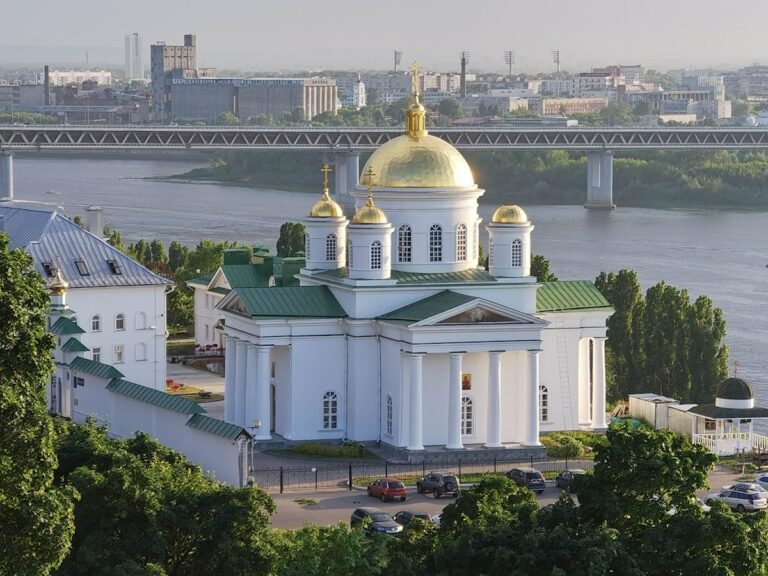
Saint Simeon Church is an Orthodox church in Russia, located in the northern part of the Nizhny Novgorod Kremlin. Associated with the Russian Baroque, the church stands in the Governor’s Garden near the Ivanovsky Descent and belongs to the Nizhny Novgorod Diocese. Its history reaches back to a monastery traditionally placed in the late fourteenth or early fifteenth century, although the exact date of its foundation is unknown.
The Simeon Monastery
The monastery’s earliest known reference appears in a property-allocation document from 1538–1539. The document mentions a place called “Old Simeon,” which may have referred to the monastery or its church. A 1621–1622 Scribe Book, a Russian administrative record describing land and buildings, placed the monastery below the hill near the Great Bridge.
At that time, the monastery included a wooden church dedicated to Simeon the Stylite, a Christian ascetic traditionally associated with long periods of prayer on a pillar. The church also had a side altar, or secondary consecrated altar, dedicated to the Presentation of the Mother of God in the Temple, a feast commemorating the traditional presentation of Mary at the Temple in Jerusalem. The complex contained a lower chapel dedicated to Saint Paraskeva, a bell tower, an abbot’s cell, three monastic cells, Holy Gates, and an almshouse.
The Eighteenth-Century Parish Church
A fire on 25 June 1715 destroyed the monastery and its wooden church. The monastery was subsequently abolished, and a new brick church was built on the site in 1743 with donated funds. Its principal dedication was to the Presentation of the Mother of God in the Temple, while a side altar honored Simeon the Stylite. The building was also known as Simeonovskaya.
For more than eighty years, the new church functioned as a parish church under diocesan administration. From 1778, it also served the Nizhny Novgorod garrison battalion. A decree of the Holy Governing Synod, the central governing body of the Russian Orthodox Church under the Russian Empire, dated 30 May 1827 transferred the church from diocesan to military administration and established it as a garrison church.
Nineteenth-Century Changes
At the end of 1837, the church was transferred to a community of Old Believer coreligionists. These communities retained older Russian Orthodox ritual practices while maintaining a recognized relationship with the established Orthodox Church. The exchange followed the transfer of the Kremlin Church of the Descent of the Holy Spirit to military administration.
Emperor Nicholas I approved a project for a new stone bell tower in October 1848, and construction was completed in 1850. Further building work continued through 1861. During this period, the earlier tent-shaped roof was replaced by a domed covering, and the wooden cupola was replaced again in 1861.
Major repairs followed in the late nineteenth century. New brick foundations were installed beneath the main building, while the roofs were repaired and the cupola reinforced. The church and bell tower were plastered, and the guardhouse and church fence were repaired. In 1899, the cupola and crosses were regilded, and new oak doors were fitted in the porch and refectory, a hall or attached space used for communal meals.
Destruction and Reconstruction
During the early Soviet period, the church received state protection as a monument of church architecture, and services continued until the end of 1923. The religious community was then dissolved and some church property was confiscated. Authorities recommended removing the building from the register because they considered it to lack architectural interest. In April 1925, they proposed converting it into a Komsomol club, the Communist Youth League of the Soviet Union.
The demolition decision was approved in early 1928, with the building material intended for construction. The church was dismantled later that year. During the 1960s, the former site became part of a pedestrian area in the reconstructed Kremlin park.
Archaeological excavations began in 2018 and uncovered approximately 900 fifteenth- and sixteenth-century burials. A decision was subsequently made to recreate the church in historical form. The foundation stone was laid on 3 June 2020. On 3 November 2020, the excavated human remains were reburied, while the cupolas and crosses were consecrated.
The reconstructed church acquired its finished appearance in 2021 and was consecrated on 31 December of that year. Eleven bells were consecrated on 7 October 2021 after being cast by the Shuvalov brothers’ bell factory in Tutayev. On 1 April 2022, Metropolitan George of Nizhny Novgorod and Arzamas celebrated a communal liturgy there. The church is currently active.
Remains
Church and Bell Tower
Earlier Monastery Church
The monastery church described in 1621–1622 was a wooden building with a tent-shaped roof and a porch. Its bell tower stood alongside the other monastery buildings and held the church bells. This earlier structure was destroyed in the fire of 1715.
Eighteenth-Century Church
The church built in 1743 was a brick structure dedicated primarily to the Presentation of the Mother of God in the Temple, with a side altar dedicated to Simeon the Stylite. An inventory from 1828–1840 describes an iron-clad cupola, an iron cross, and a roof covered with sheet iron. The bell tower had a tiled roof and a gilded iron lattice cross. Six bells hung in it, including a largest bell weighing 76 poods and 16 pounds. A pood was approximately 16.38 kilograms, while a pound was a smaller traditional unit of weight.
Nineteenth-Century Bell Tower
The stone bell tower constructed between 1848 and 1850 generally repeated the outline of its predecessor but was taller. Its quadrangular main body had attached two-tier side structures under gabled roofs. Above them stood a second level with round windows. Late-nineteenth-century repairs affected the tower’s plaster, foundations, roofs, and surrounding church fence.
Reconstructed Ensemble
The 2020–2021 reconstruction followed the church’s historical appearance without reproducing every feature visible in pre-1917 engravings and photographs. The rebuilt bell tower has two levels, while its lower side structures form a single ensemble with the church and refectory. This arrangement is closer to the appearance before the mid-nineteenth-century alterations.
Visual evidence for the reconstruction included Andrei Martynov’s 1806 painting and a landscape by Nikanor Chernetsov from the 1830s. The rebuilt church has cupolas, crosses, and an eleven-bell bell tower. It represents a new reconstruction of the former building rather than the survival of the original church erected in 1743 and dismantled in 1928.
Archaeological Evidence
Burials
Excavations carried out from 2018 revealed approximately 900 burials dating from the fifteenth and sixteenth centuries. The human remains were reburied on 3 November 2020 during the reconstruction, providing archaeological evidence for the earlier use of the monastery site.