Pechersky Ascension Monastery: A Historic Orthodox Monastery in Nizhny Novgorod


Site at a Glance
- Rating
- 4.9
- Popularity
- Medium
- Country
- Russia
- Primary era
- Early Modern
- External website
- Open
- Eras represented
- Early Modern
- Civilizations
- Russian
- Site type
- Religious
- Remains
- Fortified Monastery
On this page16 sections
History
Pechersky Ascension Monastery is an Orthodox monastery in Nizhny Novgorod, Russia, founded between 1328 and 1330 by Saint Dionysius of Suzdal. Around 1335, Dionysius established a community dedicated to the Ascension of the Lord after arriving from the Kiev Pechersk Lavra with several monks and settling in a cave near the Volga. The monastery became an important spiritual and cultural center of the Nizhny Novgorod–Suzdal principality.
Foundation and spiritual community
The monastery followed a cenobitic rule, a form of communal monastic life in which monks shared property, worked collectively, and lived under a common superior. The brothers owned no private possessions, held their goods in common, supported themselves through their labor, and could leave the monastery only with the abbot’s blessing.
Several prominent religious figures were connected with the community. The monk Lavrentiy compiled the Laurentian Chronicle there. Dionysius’s spiritual sons Euthymius of Suzdal and Macarius of Zheltovodsk later founded monasteries of their own. Pavel Vysokiy, a monk and philosopher, taught Evdokia of Moscow, who became the wife of Dmitry Donskoy, the grand prince of Moscow. Abraham of Galich, a disciple of Sergius of Radonezh, also lived at Pechersky.
A less widely accepted tradition attributes the monastery’s foundation to Grand Prince Yuri Vsevolodovich in 1219. The better-established foundation tradition connects it with Dionysius in the fourteenth century. The name “Pechersky” derives from a Slavic word for caves and reflects the community’s association with cave-dwelling monasticism.
Relocation after the 1597 landslide
The monastery reached its peak in the sixteenth century, but its original site was devastated by a landslide during the night of June 18, 1597. Almost the entire complex was destroyed, although no one was killed. Because the hillside was considered dangerous, the monastery moved about one kilometer upstream later that same year.
The landslide was interpreted by some people as an omen of an approaching disaster. In later tradition, it became associated with the beginning of the Time of Troubles, a period of political crisis, dynastic conflict, foreign intervention, and social upheaval in Russia during the late sixteenth and early seventeenth centuries. The father of Kuzma Minin was traditionally believed to have contributed to the monastery’s rebuilding. A Church of the Transfiguration was later established at the former location.
Seventeenth-century rebuilding
The present ensemble was formed mainly during the 1630s and 1640s under the direction of the Nizhny Novgorod architect Antip Konstantinov, also known as Vozoulin. The Ascension Cathedral was built in 1632, followed by the Church of Venerable Euthymius of Suzdal in 1645 and the Dormition Church with its refectory in 1648.
At different times, the monastery maintained hospitals and almshouses for elderly and poor people. It also supported the state by providing troops with money, bread, and other provisions, and by sending armed men to the tsar’s forces at its own expense. These activities formed part of the monastery’s wider religious and public role.
Later additions and Soviet closure
A stone enclosure and a small gate church dedicated to the Intercession of the Virgin were added in 1765. The Church of Saints Peter and Paul was built in 1738, while other buildings from the seventeenth and eighteenth centuries expanded the monastic complex.
The monastery was closed in 1924 by the Nizhny Novgorod provincial NKVD, the Soviet security and internal-affairs agency. During the Soviet period, its territory was used for housing, a cinema, and architectural and restoration workshops. These changes ended monastic life at the site for several decades.
Renewal since 1994
Monastic life resumed in 1994, and the complex remains an active Orthodox monastery and the seat of the bishop of the Nizhny Novgorod and Arzamas Eparchy, an ecclesiastical jurisdiction roughly comparable to a diocese. The ruling bishop serves as abbot, while the monastery governor manages the community’s daily life. Since 1999, that governor has been Archimandrite Tikhon (Zatyokin); Metropolitan George of Nizhny Novgorod and Arzamas served as abbot from 2003. The brotherhood numbered 14 members in 2004, and the monastery houses a museum devoted to the history of the Nizhny Novgorod Eparchy.
Restoration and religious renewal continued after the reopening. The Dormition Church was consecrated in 2008, and the restored Church of Venerable Euthymius was consecrated in 2010. In March of that year, a monastic tonsure, the first performed in the Dormition Church for 80 years, took place there. The lower church of the Dormition Church was consecrated in 2014 in honor of the Assembly of Radonezh Saints. In 2018, a side chapel was consecrated to the New Martyrs Lawrence of Balakhna, Alexius Porfiryev, and Alexius Neygardt, who had been executed on November 6, 1918.
The monastery is recognized as a cultural heritage site of federal significance in the Russian Federation. The monks began producing a four-part documentary about Patriarch Sergius in 2007. Patriarch Kirill visited in 2009 and presented the monastery with a Kazan Icon of the Mother of God bearing a commemorative inscription. Since 2018, three historical-park avenues beside the hillside have been under development, dedicated respectively to the Romanov dynasty, the Rurikid dynasty, and Russian patriarchs.
Remains
Churches and principal buildings
Ascension Cathedral
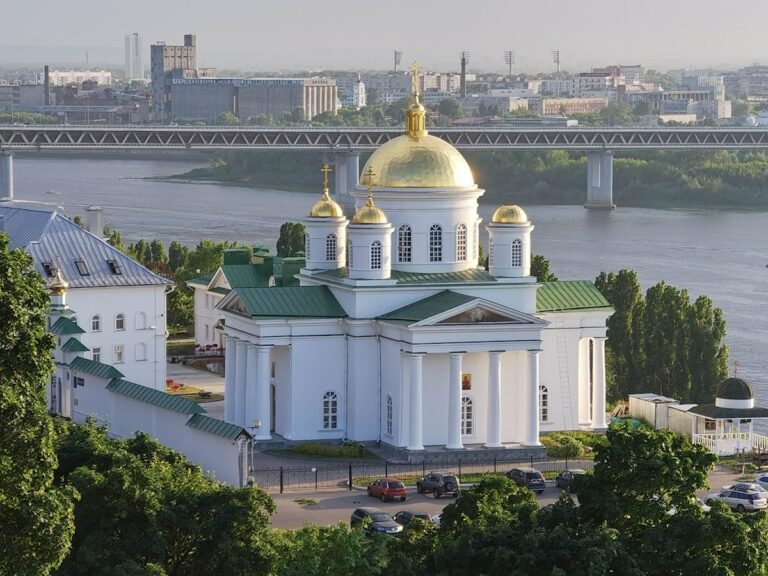
The Ascension Cathedral, built in 1630–1632, is a five-domed church with a gallery and an associated belfry. Its belfry has stood noticeably out of plumb since shortly after construction, producing a pronounced lean that has been compared with the Leaning Tower of Pisa. In 2005, mechanical musical clocks were installed in the belfry. They play “God Save the Tsar!” and “How Glorious Is Our Lord in Zion.”
Dormition Church
The Dormition Church of the Mother of God was built in 1648 as a tent-roofed church, meaning that its upper structure is crowned by a tall pyramidal roof rather than a conventional dome. It includes a refectory chamber. Its iconostasis, the screen of icons separating the sanctuary from the main body of an Orthodox church, was being assembled in 2007, and the church was consecrated in 2008. An eighteenth-century icon of the Dormition of the Mother of God was restored in 2009 and given a new decorative setting.
Church of Venerable Euthymius
The gate church dedicated to Venerable Euthymius of Suzdal was built in 1645 as a tent-roofed structure. Its restoration lasted about two years. Painters from Vladimir decorated the interior in the style of ancient Vladimir-Suzdal painting, using the Transfiguration Cathedral of the Saviour-Euthymius Monastery in Suzdal as a model. The church was consecrated in 2010.
Other churches and monastic quarters
The Church of Saints Peter and Paul dates from 1738. The ensemble also contains restored and renovated episcopal chambers, monastic cells, the abbot’s quarters, and a cell building with a church dedicated to Saint Macarius. Together, these structures preserve the residential and administrative parts of the monastery alongside its principal churches.
Enclosure, entrances, and commemorative features
Walls, gates, and towers
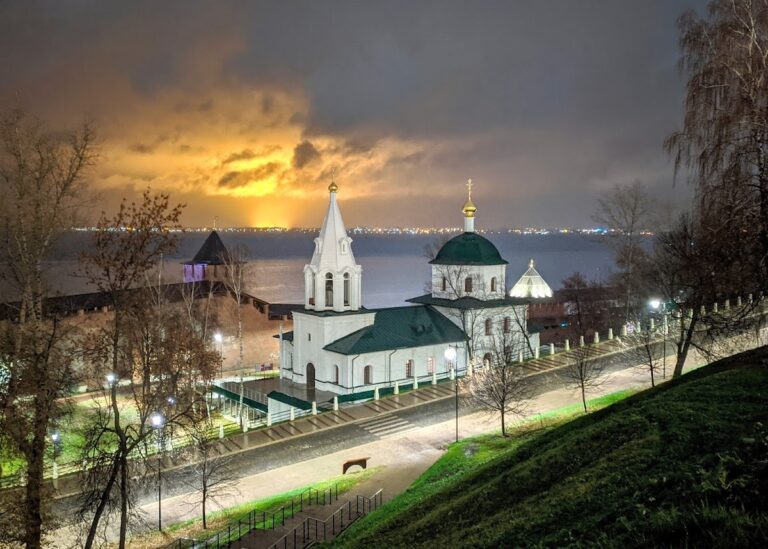
The monastery is enclosed by a stone wall added in 1765. Its surviving features include the Holy Gates, the small gate church of the Intercession of the Virgin, and northeastern and southwestern towers. The inner court, cloister buildings, and earthworks form part of the ensemble established after the 1597 relocation.
Evidence of the 1597 destruction
The landslide reshaped the earlier monastery. It destroyed the original stone Ascension Church almost to its foundations, leaving a portion above the altar, and brought down the bell tower. The warm Church of the Intercession was shifted and partly buried, while the Holy Gates, cells, kitchens, cellars, and sections of the enclosure were destroyed. A wooden Church of Saint Nicholas on the riverbank was displaced as well.
Monuments and later features
A bust of Emperor Alexander II was installed near the Church of Venerable Euthymius in May 2013. It commemorates his visit to the monastery with Empress Maria Alexandrovna in 1858. Additional busts of members of the Romanov and Rurikid dynasties were later added. An obelisk marking the 800th anniversary of Nizhny Novgorod was placed on the Rurikid avenue in 2017, and a bust of the church historian Archbishop Macarius Mirolubov was installed beside the Ascension Cathedral belfry in 2022.