Berne Abbey: A Premonstratensian Monastic Community in the Netherlands


Site at a Glance
- Rating
- 4.6
- Popularity
- Low
- Country
- Netherlands
- Primary era
- Modern
- External website
- Open
- Eras represented
- Modern
- Civilizations
- Dutch
- Site type
- Religious
- Remains
- Monastery
On this page17 sections
History
Berne Abbey is a Premonstratensian, or Norbertine, abbey in the Netherlands at Heeswijk-Dinther. Founded in 1134 by the knight Fulco van Berne, it follows the Rule of Saint Augustine and is regarded as the oldest surviving monastic community in the country. Premonstratensians combine communal religious life with pastoral work, and Berne developed this dual role through parish service, education, publishing, and missions.
Foundation at Berne on the Maas
Fulco founded the abbey at his castle in Berne on the Maas, near Heusden. A tradition places the decisive moment in 1132, when Fulco, surrounded by enemies, vowed to turn his castle into a monastery if he escaped by jumping into the river. He first invited Augustinian canons from Rolduc Abbey, but dismissed them because he was dissatisfied with the disorder within their community.
In 1134, Fulco brought an abbot and several canons from the nearby Premonstratensian Abbey of Mariënweerd. He then joined the new community himself. His wife, Bescela, entered religious life at Berne and later at the associated Norbertine nunnery of Altforst. The abbey initially stood under the protection of the counts of Cleves. The dukes of Brabant assumed that responsibility in 1248, and the counts of Holland and dukes of Guelders followed in 1399.
Medieval expansion and regional role
After about a century, Berne moved beyond a strictly enclosed monastic role. Its priests served local parishes, while the abbey became a regional spiritual and secular center. Its associated parishes and properties expanded over time. Berlicum came to the abbey in 1240, Heeswijk in 1284, and Oudheusden, Elshout, Hedikhuizen, Vlijmen, and Engelen in 1285. Bokhoven followed in 1369, Lithoijen in 1613, Haarsteeg in 1846, Middelrode in 1948, and Heikant-Quirijnstok in Tilburg in 1964. Dinther and Vorstenbosch were also linked with Berne.
The abbey administered six outlying estates, known as granges. These were farms or administrative properties operated for the benefit of a monastery. The larger estates at Altforst and Maarsbergen were donated by Fulco in 1134, while Honswijk was founded in 1265. Smaller estates lay at Bernheze, donated in 1196, and at Gaal and Mun, which date approximately from the twelfth century. Babyloniënbroek dates approximately from the thirteenth century.
Pontifical privileges and destruction
In 1534, four centuries after the foundation, Pope Clement VII granted the abbots the right to use pontifical insignia, including the mitre and crozier. A crozier is a pastoral staff, while a mitre is a ceremonial headdress associated with episcopal office. The privilege made Berne an exempt abbey, meaning that it was not subject to the ordinary jurisdiction of the local diocesan bishop.
The Eighty Years’ War, the long conflict that divided the Netherlands and opposed Spanish rule to Dutch rebels, brought severe damage. The Geuzen plundered Berne in 1572, and the abbey was burned on 25 September 1579. In 1648, following the Peace of Münster that ended the Dutch phase of the conflict, the States of Holland confiscated the remaining estates.
Dispersal and survival
After the destruction and political upheavals, the canons withdrew first to a refuge house in ’s-Hertogenbosch and later to the Rijke Fraterhuis of the Brothers of the Common Life. Following the siege of ’s-Hertogenbosch in 1629, they dispersed among parishes, the county of Bokhoven, Bedaf near Uden, the safer southern Netherlands, and Vilvoorde near Brussels. Abbot Jan Moors settled at Heeswijk in 1629, where the abbots possessed a small castle known as Slot Berne.
The community continued despite this separation. Norbertine priests served parishioners, at times clandestinely, while new postulants completed their novitiate and studies at Vilvoorde or in Belgian abbeys. The canons continued to meet, and an unbroken succession of abbots was maintained. The French Revolution ended the community’s refuge at Vilvoorde at the close of the eighteenth century. From 1797 to 1857, regular communal abbey life ceased, and Norbertine pastors lived separately in parish houses while preserving the community’s institutional continuity.
King William I confirmed the abbey’s continued existence in 1824, followed by Pope Gregory XVI in 1832. Abbot Gerardus Neefs enlarged the Heeswijk property in 1847 and worked to restore communal life there. In 1857, Berne Abbey was permanently established at Heeswijk. The abbots who guided the community at Heeswijk included Gerardus Neefs, Hubertus Manni, Andreas van Laarhoven, Henricus van den Brand, Adrianus Ceelen, Augustinus Bazelmans, Evermodus van den Berg, Henricus Stöcker, Milo Ondersteijn, Albertus Haselager, Marcellus van de Ven, Ton Baeten, Piet Al, Ward Cortvriendt, Klaas Fongers as administrator, Denis Hendrickx, and Frank van Roermund as prior-administrator from 2024.
Education, liturgy, and wider communities
An abbey church dedicated to Our Lady of Berne and Saint John the Baptist was built at Heeswijk in 1879. In 1886, the community founded Gymnasium St. Norbertus, later called Gymnasium Bernrode, and priests of the abbey staffed the school. Around 1920, Berne began producing liturgical publications through its own printing office, publishing house, and bookshop. The printing office ended operations in 2012.
Its liturgical work included The Sunday Mass, first published in 1951 and later renamed Celebrating Sunday, and the Berne Hand Missal of 1957. A missal contains the texts and directions used in celebrating Mass. In 1966, the Liturgical Apostolate became the Heeswijk Liturgical Working Group, which produced liturgical and catechetical publications and organized courses and study programs.
From the 1960s, the abbey became a center of Catholic contestation and liturgical renewal. Abbot Ton Baeten, who served from 1982 to 2000, was associated with reform movements including the Eight-May Movement. The abbey’s influence within the Dutch Catholic Church later declined, although its Norbertines continued serving numerous nearby parishes. Berne has also maintained organ concerts since 1952, known as the Organ Circle, with performances by prominent foreign organists.
Berne established or re-established Premonstratensian communities in the Netherlands and abroad. These included De Pere in Wisconsin in 1893, Jamtara in India and Windberg in Bavaria in 1923, Rot an der Rot from 1948 to 1959, De Essenburgh in Hierden in 1950, Hamborn in 1960, De Schans in Tilburg in 1964, and Mariëngaard in Hierden in 1992. Attempts were also made at Nogent-l’Artaud in France and in Australia.
Since 1923, approximately fifty missionaries from Berne have worked in India. The Abbey of Jamtara, founded by Berne, became an independent Indian canonry in 1984, while Berne continued to support it and related aid projects through its Solidarity with India foundation. In 2007, the community numbered 27 brothers and canons, compared with 33 in 2005. The abbey publishes the bimonthly magazine Berne, offers retreats, and maintains groups of people closely associated with the community. It commemorated 150 years at Heeswijk in 2007 and the 875th anniversary of its foundation in 2009.
The former Abbey House occupied the building of Gymnasium St. Norbertus and organized activities for education, reflection, and knowledge exchange. It closed in 2005, after which the building housed, among other organizations, the Heeswijk Liturgical Working Group and Solidarity with India. Berne also holds a substantial historical archive relating to Berne, Mariënweerd, and several parishes and monasteries of the order. Its motto, Berna ut Lucerna, means “Berne as a Light.”
Remains
The Heeswijk complex
Abbey church
The present complex at Heeswijk includes the abbey church built in 1879. Hendrik Willem Valk enlarged it in 1927 with money donated by farmers after the death of Gerlacus van den Elsen, a Premonstratensian known as the “peasant apostle” for his pastoral and social work among farmers. A cornerstone bearing Van den Elsen’s portrait was carved into the exterior wall by the sculptor Jozef Cantré as a memorial.
The interior was substantially altered in 2006. Its different floor levels were made uniform, the second organ was moved to the balcony, pews were replaced by chairs, the walls and other interior surfaces were painted in three shades of yellow, and a new lighting system was installed. The church contains the Adema-Schreurs organ in the apse, suited to Romantic and modern repertoire, and a Baroque organ built by the Gebroeders Reil in 1981 and installed on the rear balcony in 2002.
Gate and residential section
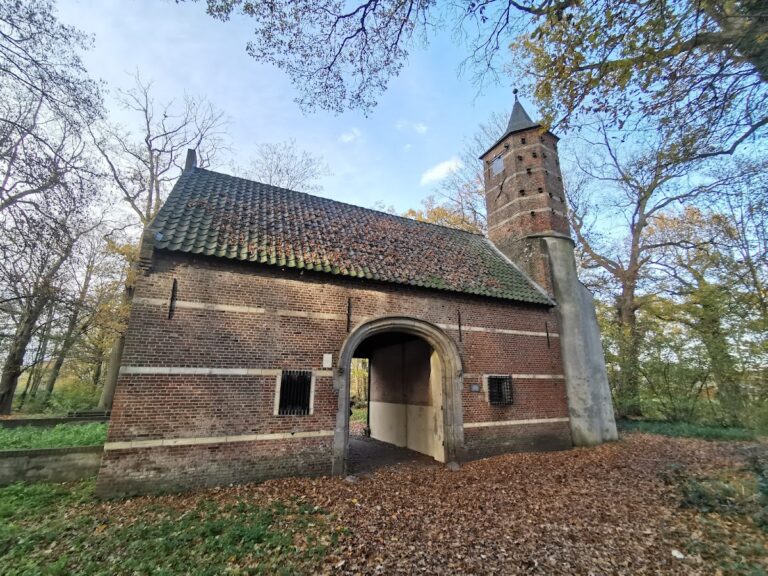
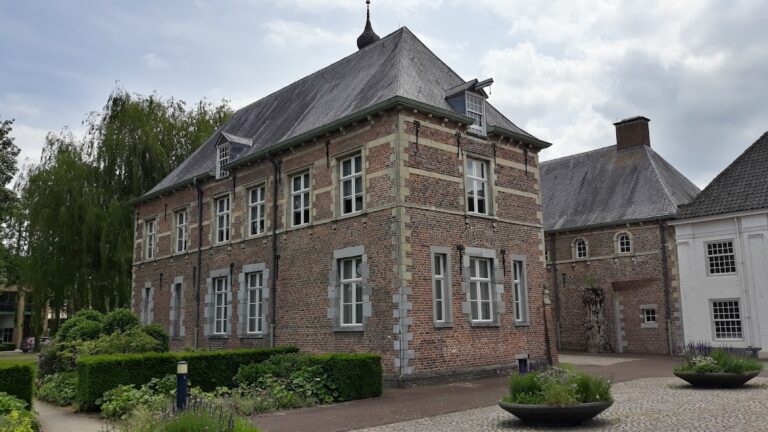
The abbey grounds also contain an entrance gate designed by Hendrik Willem Valk. A residential section was renovated in 1999 to a design by Oomen Architects. Together with the church, these buildings form the present architectural complex at Heeswijk.
Earlier Berne properties
Slot Berne
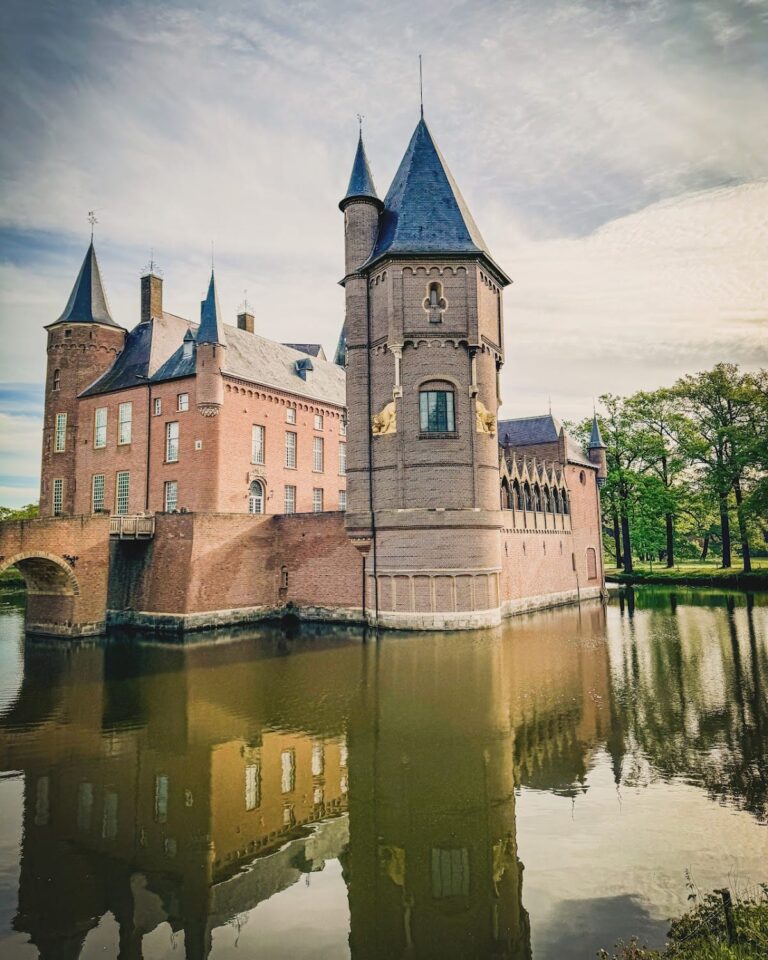
Former Slot Berne, also called Slotje, is a sixteenth-century pleasure house at Heeswijk with a twelfth-century origin. The arms of Abbot Coenraad van Malsen are displayed above its entrance. The building belongs to the physical record of the abbots’ presence at Heeswijk after Abbot Jan Moors settled there in 1629.
Former brewery house
In the hamlet of Bern, the former abbey brewery house is a Gothic building. It was rebuilt after destruction during the Second World War. Vegetation has subsequently pushed apart the walls and roofs of its outbuildings and enclosing walls, leaving the surviving structure in a deteriorated condition.
Artworks, memorials, and archive holdings
Tabletop of the Meals
The abbey possesses the medieval “Tabletop of the Meals,” whose painted medallions show biblical meal scenes including the Wedding at Cana and the Last Supper. It is the only surviving example preserved in the Netherlands. A canon discovered it in the early twentieth century beneath the top of his writing desk. The carpenter who assembled the desk had planed away half of the painting.
Abbatial objects and paintings
Berne has portraits of all its mitred abbots from 1534 onward and a heraldic board displaying the arms of its abbots from 1134. It also preserves the icon collection of Willem, Baron van den Bogaerde van Terbrugge. Until 1974, the icons hung in the Knights’ Hall of Heeswijk Castle. Another painting shows the Norbertine “ladder of salvation.” It was made by Pieter Thys and originally came from the Norbertine convent in Mechelen.
The crozier of Abbot Coenraad van Malsen dates from about 1536. Made of gilded silver by Joris Weijers of Antwerp, it is associated with the papal charter granting the abbey the right to use pontifical insignia. The charter is held in the abbey archive.
Tombstones and former library material
The tombstones of the first three mitred abbots, Coenraad van Malsen, Otto van den Boetselaar, and Theodorus Spierinck van Well, came from the former abbey at Berne on the Maas. The first two are Gothic and bear the symbols of the four Evangelists at their corners; the third is in Renaissance style. The stones are held on loan from the Rijksmuseum Amsterdam, as is the tomb of the knight Arnold van der Sluijs.
The former library holdings included a richly illuminated book of hours and prayers made shortly after 1456 in the Duchy of Brabant. Around 1886, approximately one hundred manuscripts and early printed books were sold to support the abbey’s finances, and further manuscripts were auctioned in Leiden in 1887. The Royal Library later acquired the gradual of Abbot Van Malsen.
Nearby sites