Heeswijk Castle: A Medieval Water Castle in the Netherlands
Site at a Glance
- Rating
- 4.5
- Popularity
- Medium
- Country
- Netherlands
- Primary era
- Medieval
- External website
- Open
- Eras represented
- Medieval, Early Modern, Modern
- Civilizations
- Duchy of Brabant, Dutch, Holy Roman Empire
- Site type
- Military
- Remains
- Castle
On this page14 sections
History
Heeswijk Castle is a medieval water castle near Heeswijk in the Netherlands, in the municipality of Bernheze, North Brabant. An earlier motte-and-bailey fortification, combining a fortified mound with an adjoining enclosed court, was established around 1080, and the present castle developed through later medieval and early-modern phases. Its position beside a meander of the River Aa gave it both economic and strategic value. The river carried heavy goods between the Peel region, ’s-Hertogenbosch, and Helmond, while also creating a barrier to east-west military movement.
Medieval lordship
Amelricus van Heeswijk is the first recorded lord, mentioned in the twelfth century, followed later in that century by Hubertus van Heeswijk. In the thirteenth century the Heeswijk family was succeeded by Walraven of Bentheim. Count Jan of Megen became lord in 1308, and after his death around 1346 the lordship passed to Jan van Bentheim.
An act of 1359 by Wenceslaus I, Duke of Luxembourg, and Joanna, Duchess of Brabant, placed Heeswijk and part of Dinther within Brabant. Jan van Bentheim voluntarily joined the war against Flanders, an action that confirmed his allodial status, meaning that he held his land outright rather than as a feudal loan. It also exposed the castle to attack. Forces from Guelders and Jülich assaulted it in 1371 and 1372.
During the 1370s the lordship passed through Dirk de Rover and Walraven of Bentheim before Willem van der Aa acquired it. Willem was a knight, a municipal magistrate of ’s-Hertogenbosch, and lord of Nieuw-Herlaer. He had fought at Baesweiler, been captured, and been ransomed. In 1387 he made Heeswijk and part of Dinther a fief of Brabant, meaning that the land was held in return for obligations to an overlord. He later acquired the remaining part of Dinther and sold the lordship in 1405.
Hendrick van der Lek, a knight and Hofmeister of John IV, Duke of Brabant, bought the lordship in 1405. A Hofmeister was a senior court official responsible for managing a ruler’s household and court. Hendrick held Heeswijk and Dinther until his death in 1427. His daughter Jeanne inherited them, but when she died without children in 1454, the estate passed to her sister Elselina and her descendants.
Pieter de Bousies later inherited the combined estates. He led the militia of ’s-Hertogenbosch in wars against Guelders and died from wounds received near Heerewaarden on 22 April 1479. In 1485 the Count of Oettingen became lord of Heeswijk through his marriage to a daughter of Isabella, one of Pieter’s sisters.
The sixteenth century and the Dutch revolt
Cornelis of Glymes, known as “De Berges,” purchased Heeswijk in 1499. He served as Hofmeister to Philip the Fair, became a Knight of the Order of the Golden Fleece in 1500, and was appointed governor of Grave in 1513. His son Maximilian succeeded him, followed by Leonard de Glymes in 1521 and Corneille of Berghes, prince-bishop of Liège, in 1523. A prince-bishop was a bishop who also exercised secular authority over a territory.
Corneille of Berghes sold Heeswijk and Dinther in 1555 to Johan I of East Frisia for 60,000 guilders. The transaction included a watermill at Middelrooy, a windmill at Schijndel, the Veerdonc farm, and other lands and buildings. Johan’s wife was Dorothea of Austria, an illegitimate daughter of Emperor Maximilian I.
During the Eighty Years’ War, the long conflict in which the Dutch revolt against Spanish Habsburg rule developed into the independence of the Dutch Republic, a Republican garrison of 20 men under Jaques de Wale occupied the castle in 1578. After ’s-Hertogenbosch joined the Spanish side in 1579, Heeswijk also changed allegiance and remained under Spanish control until the truce of 1609.
Maximilian of Ostfriesland, lord from 1574 and governor and captain-general of Luxembourg, organized the castle’s defense. His son Werner succeeded him, but in 1599 the governor of ’s-Hertogenbosch assumed command. On 1 November 1601, the army of Maurice of Nassau, a leading commander of the Dutch Republic, besieged Heeswijk Castle. The garrison initially refused to surrender, but secretly abandoned the castle several days later. The fortress nevertheless remained Spanish until the 1609 truce.
Seventeenth and eighteenth centuries
Werner of Ostfriesland died in 1620, and ownership passed in 1621 to Jan Werner ’t Serclaes, Count of Tilly, Bannerman of Marbaix, and Lord of Montigny. Werner’s illegitimate daughter Maria retained a share. In 1629 Frederick Henry, Prince of Orange and another leading commander of the Dutch Republic, captured Heeswijk Castle in conjunction with his capture of ’s-Hertogenbosch. Maria’s share eventually passed to Jan Werner, but the Tilly family sold the estate in 1647.
On 20 April 1647, Dirk van Cattenburgh and Joost van Hedickhuysen bought the lordship of Heeswijk and Dinther. After Joost’s death in October that year, Jonkheer Matthijs van Asperen purchased it in 1649 and was recognized as lord in May 1650. He later became a colonel and commander of ’s-Hertogenbosch. In 1655 he pledged the castle to the jeweller Geraert Maes. Maes’s widow, Elisabeth Lasson, became proprietor in 1679. Jacobus van der Hoeven succeeded her in 1684, followed by his widow in 1691, their son Jacob in 1699, and his son Jacob in 1719.
Cornelis Speelman became lord in 1740 through his marriage to Agatha van der Hoeven. Jacob Speelman succeeded him in 1746, followed by Cornelis Jacob Speelman in 1788. During Cornelis Jacob’s tenure, the French Revolutionary general Pichegru used the castle as his headquarters. The French period also brought the abolition of feudal rights. The Speelman family sold the estate in 1834.
Restoration, collections, and public ownership
Baron Andreas van den Bogaerde van Terbrugge, governor of North Brabant, bought the neglected castle in 1834 and carried out extensive restoration and enlargement. He and his sons, Louis and Donat, installed a growing collection of paintings, medieval sculptures, art objects, and curiosities in the castle. In 1836 Andreas and six others founded the Provincial Society of Arts and Sciences, which later developed into the Noordbrabants Museum.
After Andreas’s death, his sons continued to enlarge the collection and added the Armory and Iron Tower for museum purposes. Donat’s will required the castle to remain uninhabited and open to the public, but much of the collection was sold in ten auctions from 1899 onward.
Baron Willem van den Bogaerde van Terbrugge later planned a major restoration of the castle and gardens. Joseph Cuypers and his son Pierre Cuypers Jr. prepared two designs in 1932 intended to return the castle to a late-medieval appearance, accompanied by a garden plan by Lodewijk Copijn. Financial and legal difficulties prevented the project. Willem lived in the carriage house on the outer bailey until his death in 1974.
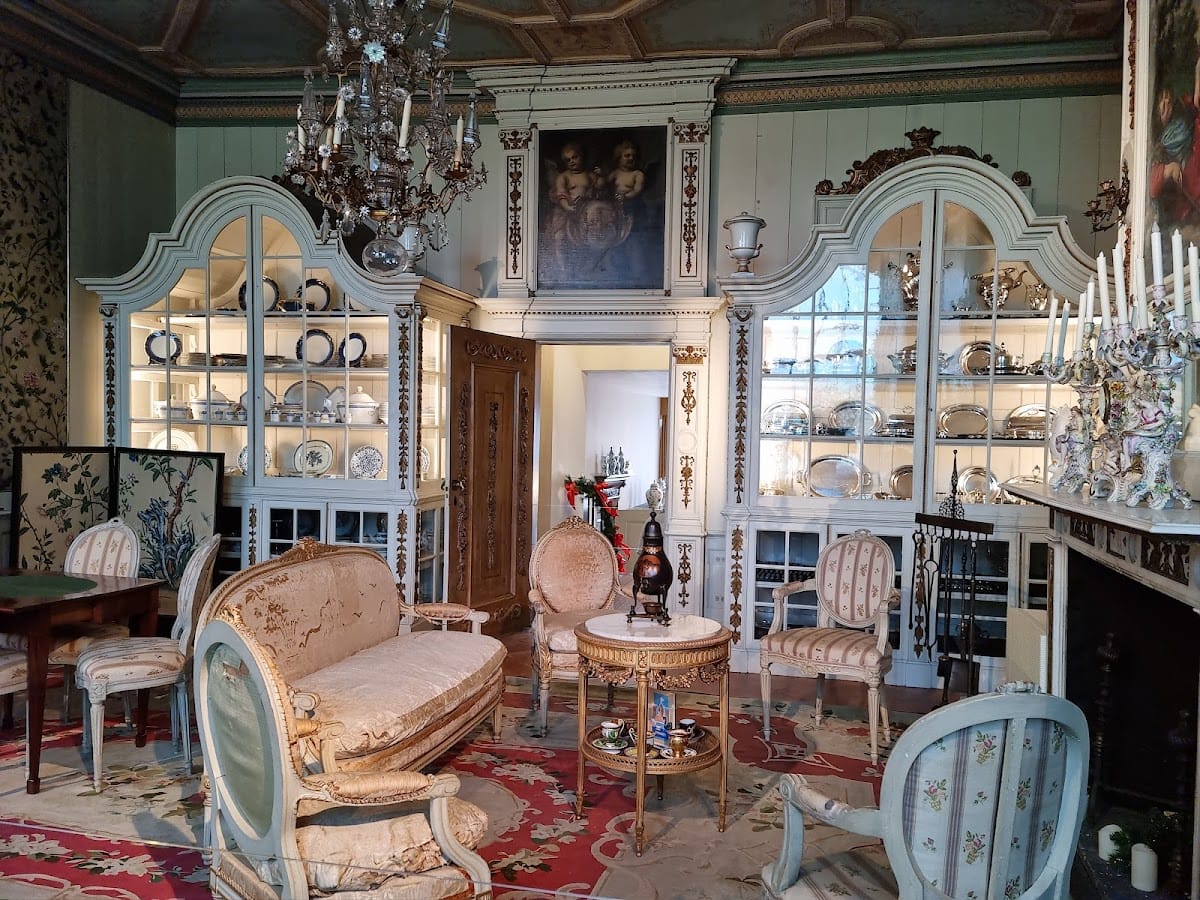
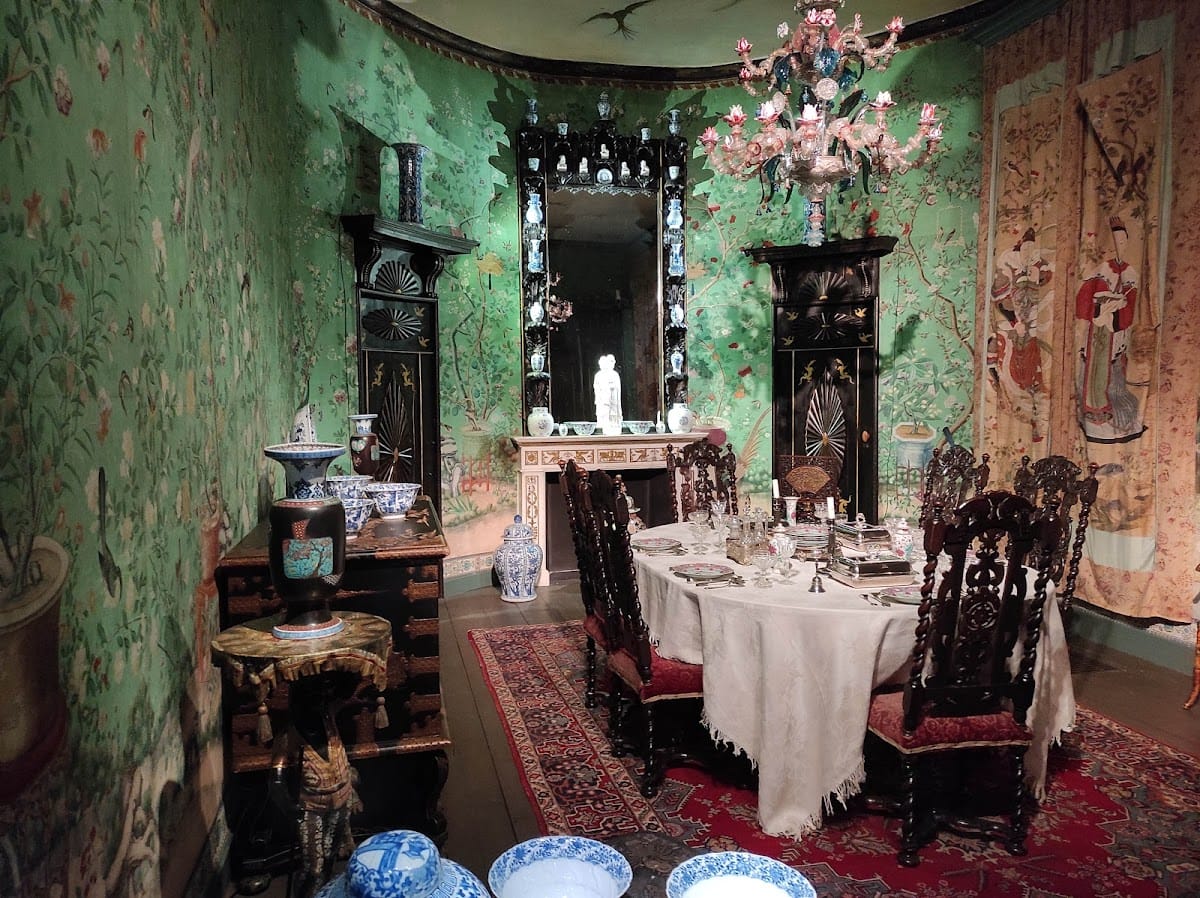
His widow, Albertine van den Bogaerde van Terbrugge, established the Heeswijk Castle Foundation in 1976. The foundation became the full owner of the complex in 1987. The castle was last restored in 2005 and now houses a museum presenting nineteenth-century domestic life, collecting traditions, art, curiosities, and weapons.
Remains
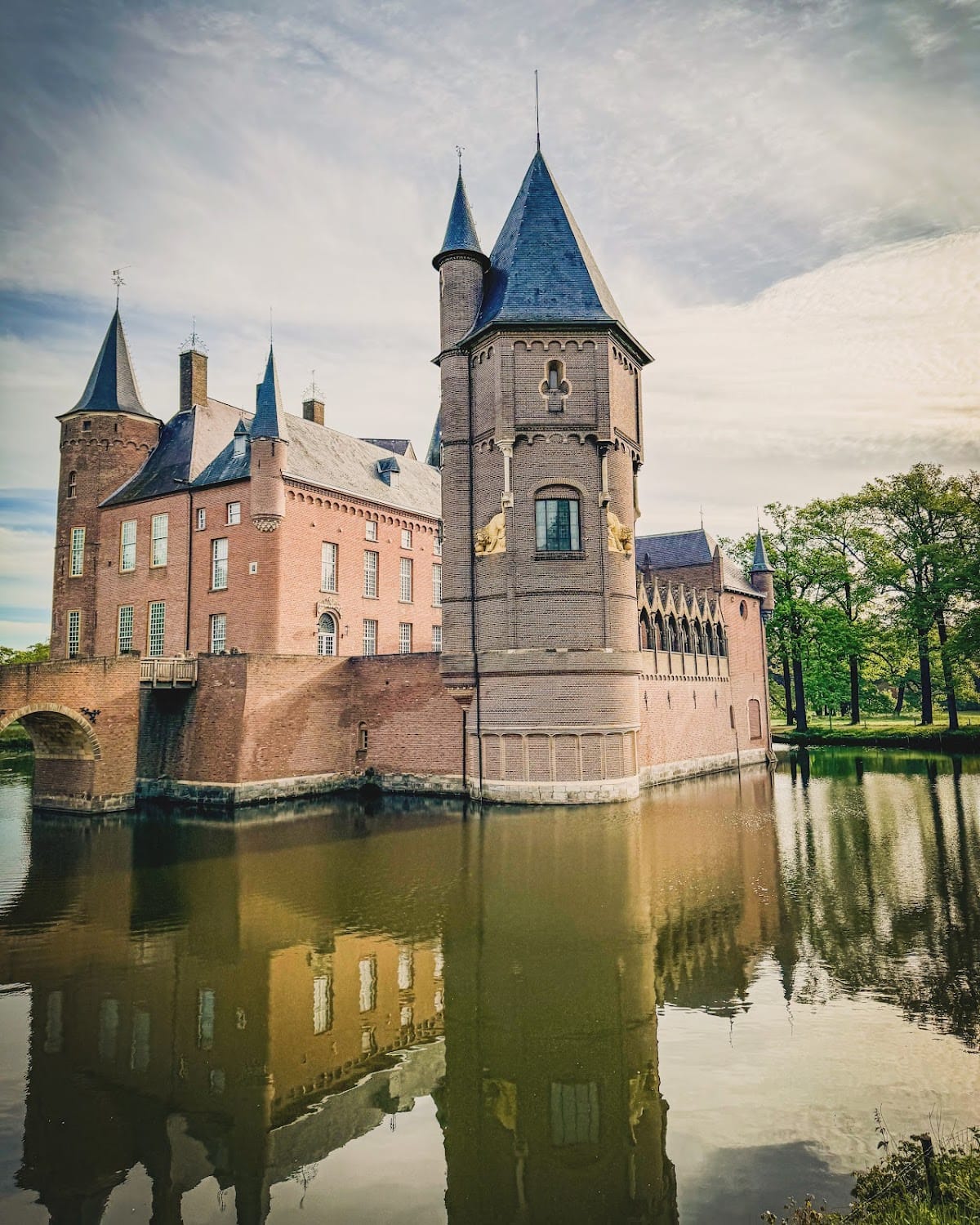
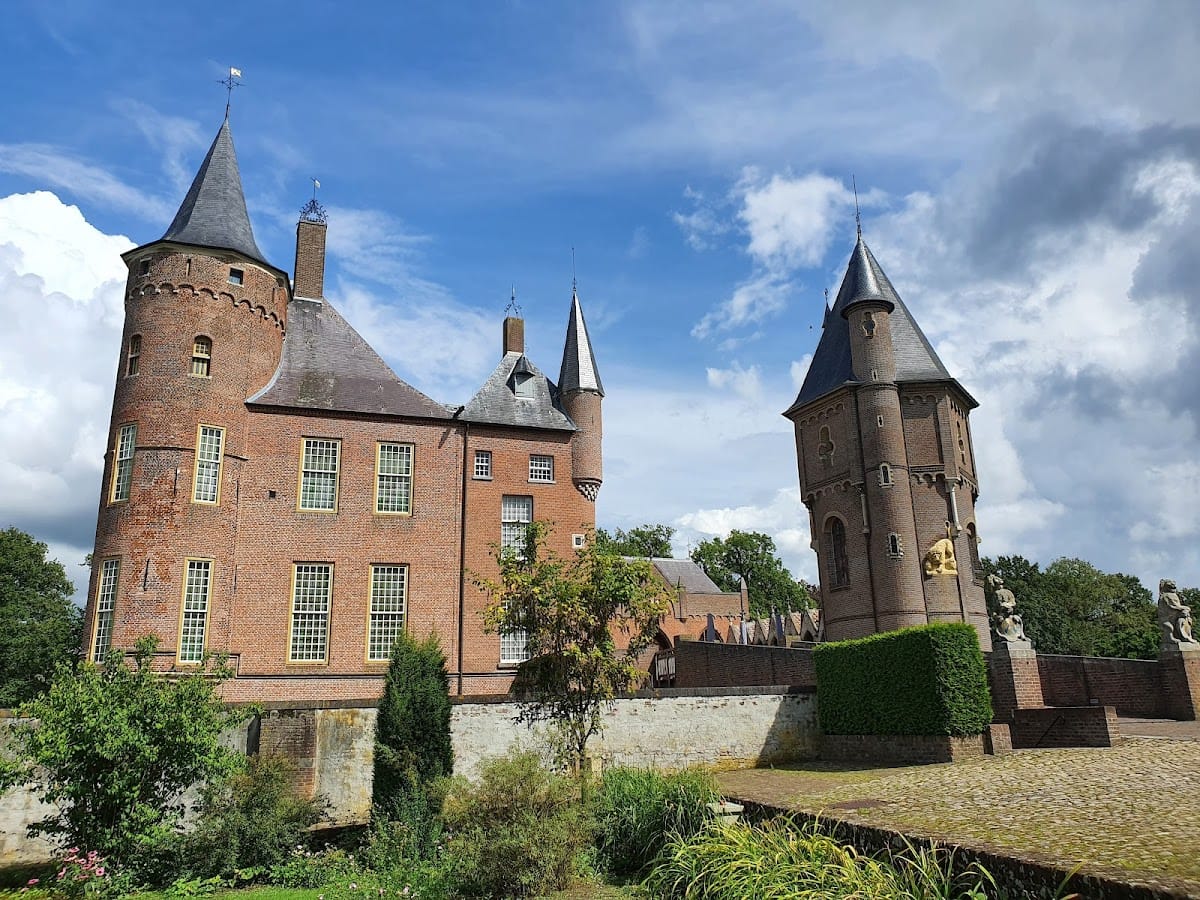
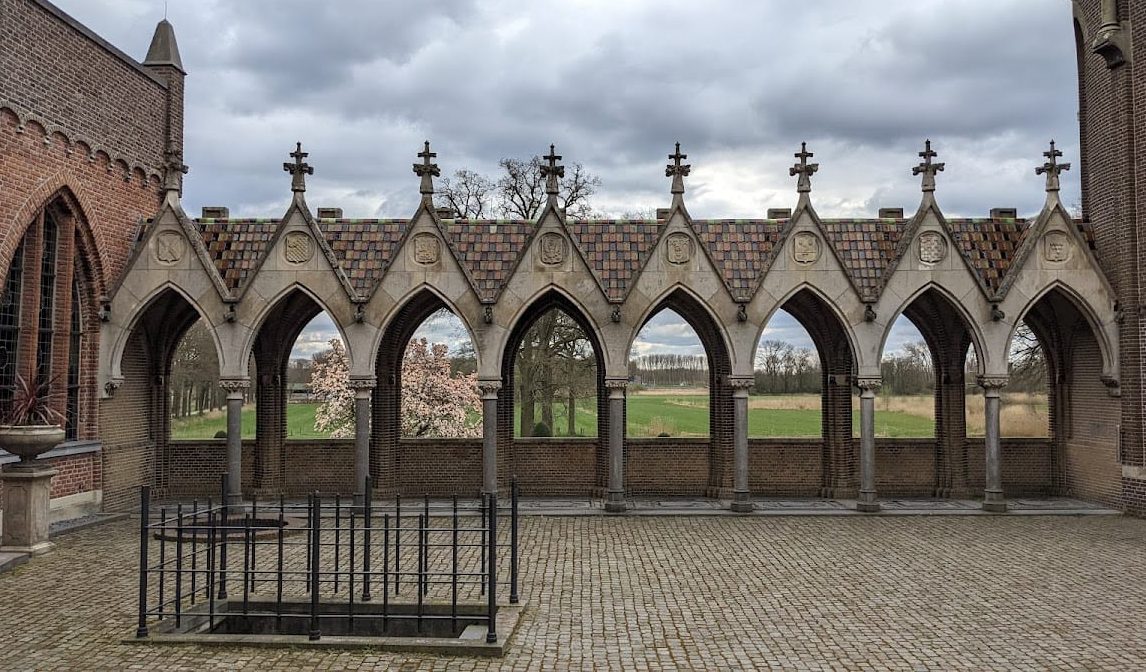
Heeswijk Castle is a water castle surrounded by water and built on an artificial mound formed from an earlier motte. The mound was later flattened as the medieval castle developed. Its surviving layout includes the main castle, an outer bailey surrounded by its own wall and water, bridges, gardens, parkland, and a group of associated historic buildings and landscape elements.
Main castle
Medieval core
The older semicircular plan preserves the shape of the original mound. Two round corner towers and an old overhanging gate tower belong to this arrangement. The principal above-ground fabric is predominantly fifteenth- and sixteenth-century, while the outer walls reach approximately three metres in thickness. Excavation in the cellar revealed a loam layer containing bog iron and fragments of tuff from the earliest fortified residence. Fragments of fourteenth-century walls remain visible in the cellars.
Bridges and later additions
The bridge to the inner courtyard ends at the foundation of a disappeared square gate tower. A separate bridge leads toward the outer bailey. The large round tower, its adjoining gallery, the Armory, and a round tower attached to the eastern facade were added in the nineteenth century. The large round tower stands on an older foundation. These additions enlarged the ground plan only modestly while giving the castle a more square appearance.
Outer bailey and estate features
Sixteenth-century outer bailey
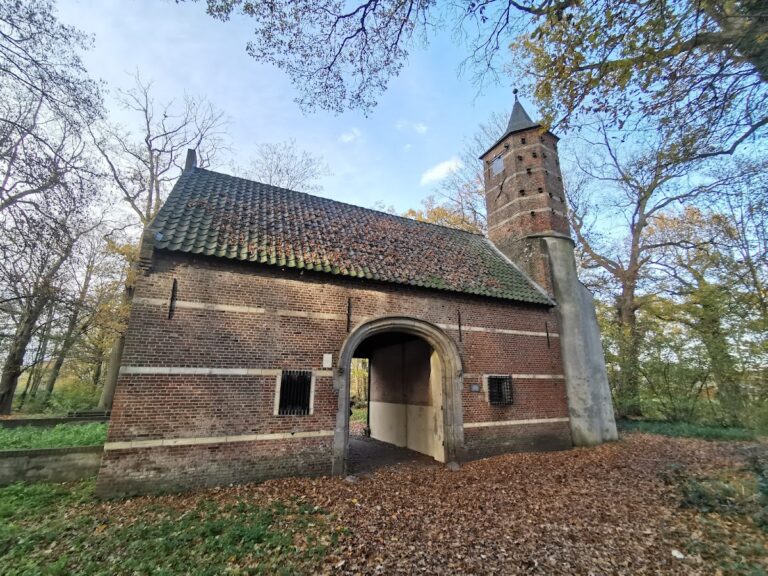
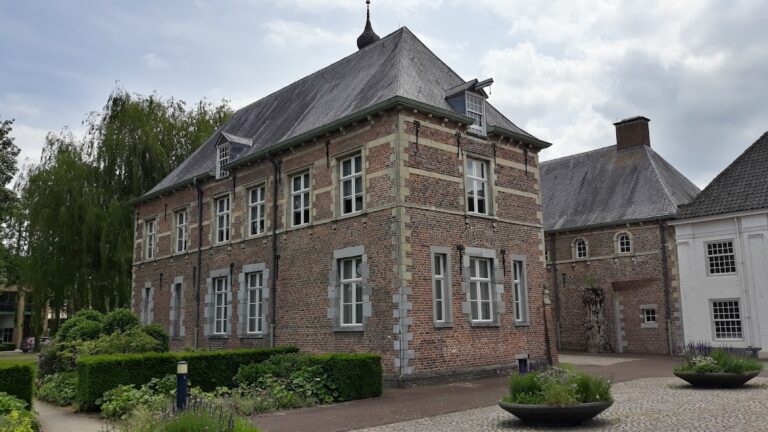
The outer bailey is a sixteenth-century complex enclosed by its own wall and water. Its buildings use alternating courses of brick and natural stone, creating striped facades. Stepped gables and cross-windows survive as notable architectural details, and the west and south wings of the brick outer bailey with stone bands remain preserved.
Armory and Iron Tower
The nineteenth-century Armory, also called the Weapons Hall, was built to house the van den Bogaerde collections. It now serves as an official wedding venue of the municipality of Bernheze. The Iron Tower was added during the same nineteenth-century enlargement to store the family’s art collection and curiosities.
Gardens and associated structures
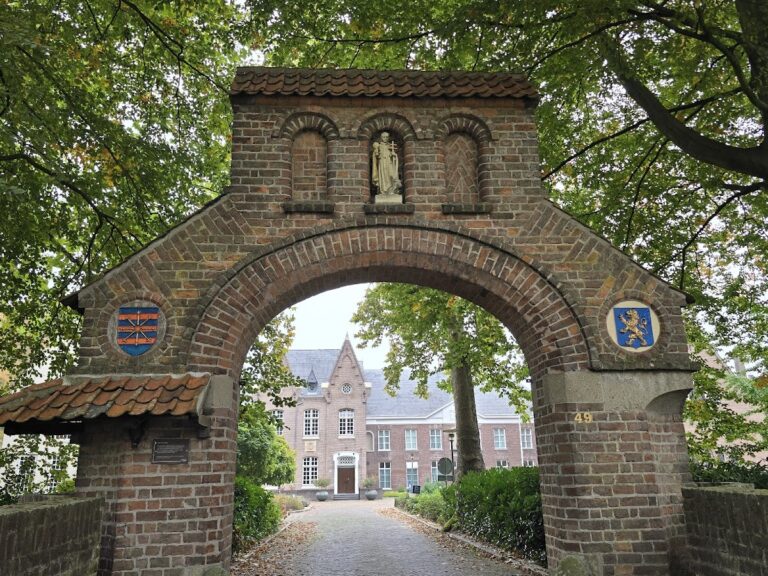
The complex includes a historic garden and park, a gamekeeper’s house, and a hunting lodge with an adjoining residence. Other surviving elements include a greenhouse in the former kitchen garden, access gates and gate pillars, fencing, stone columns and pedestals, cannon barrels, memorial or boundary elements, an orchard gate, and a bridge between the castle and the Zuid-Willemsvaart.
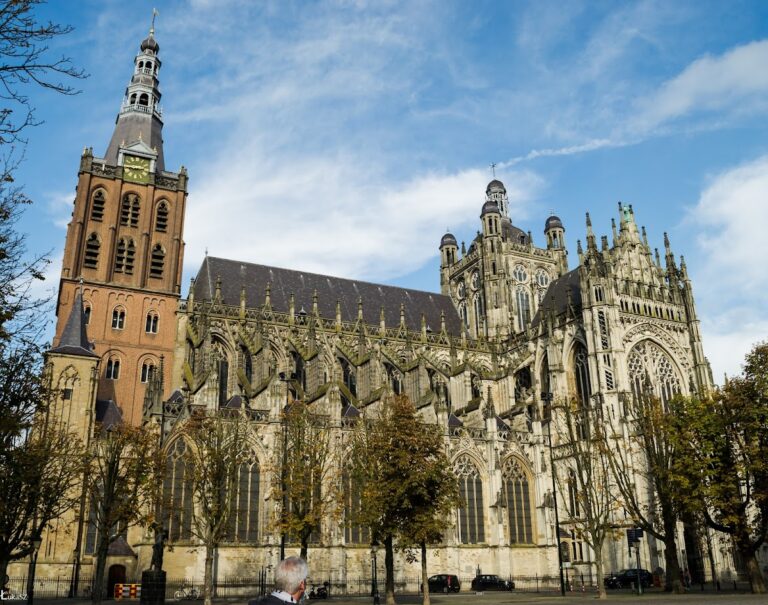
Four marble column shafts from the altar of Saint John’s Cathedral are associated with the complex. The grounds also contain brick pedestals, masonry pillars with natural-stone lions, and other historic elements along the access paths.
River setting
The River Aa’s original channel had been displaced from the castle by twentieth-century works. It was restored close to the castle in the early twenty-first century and now carries sufficient water, re-establishing part of the historic relationship between the castle and the river.
Nearby sites