Kasteel Maurick: A Moated Historic Residence near Vught, Netherlands


Site at a Glance
- Rating
- 4.5
- Popularity
- Medium
- Country
- Netherlands
- Primary era
- Early Modern
- External website
- Open
- Eras represented
- Medieval, Early Modern, Modern
- Civilizations
- Duchy of Brabant, Dutch, Holy Roman Empire
- Site type
- Military
- Remains
- Castle
On this page17 sections
History
Kasteel Maurick is a historic moated residence in the Netherlands, near Vught, whose present form developed from an early fifteenth-century site and a major rebuilding phase of 1504 to 1509. Standing on an island in a former channel of the Dommel, it occupied a strategic position opposite Vught’s former harbor, once an important trading station in Brabant before the foundation of ’s-Hertogenbosch. The Lords of Vught are identified as the site’s earliest founders.
Early ownership and the first stone buildings
In 1312, the site was recorded as a hill owned by Jan Liescep, a landowner and city official from ’s-Hertogenbosch. Later descriptions mention a hill, a house, a fishery, and an adjoining meadow. These references point toward an earlier motte-and-bailey settlement, consisting of a defended mound and an enclosed outer area, although the exact form and position of that settlement remain uncertain.
Ownership passed through the Liescep family, Catherina Liescep, and Catherina van Aelst to Hendrick van Maurick, a knight from Maurik in Gelderland. In 1421, their daughter Katheline held the hill and house at Vught. The property was sold in 1429 to Godscalc Roesmont, a member of the ’s-Hertogenbosch council. He probably commissioned a first stone keep between 1430 and 1436, when he ordered large quantities of bricks, although some of those bricks may have been intended for the nearby Muizerik manor. Hendrick van Vladeracken acquired the property in 1443, and his son Deynalt sold it to Goessen Heym in 1464.
The Heym family and the sixteenth century
The Heym family retained Maurick for several generations, and the property was once known as Heym Manor. Goessen Heym served on the ’s-Hertogenbosch council and as receiver of the States in the ’s-Hertogenbosch quarter. After his death, his widow Liesbeth de Cock van Neerijnen and later their son Jan Heym continued the family’s ownership.
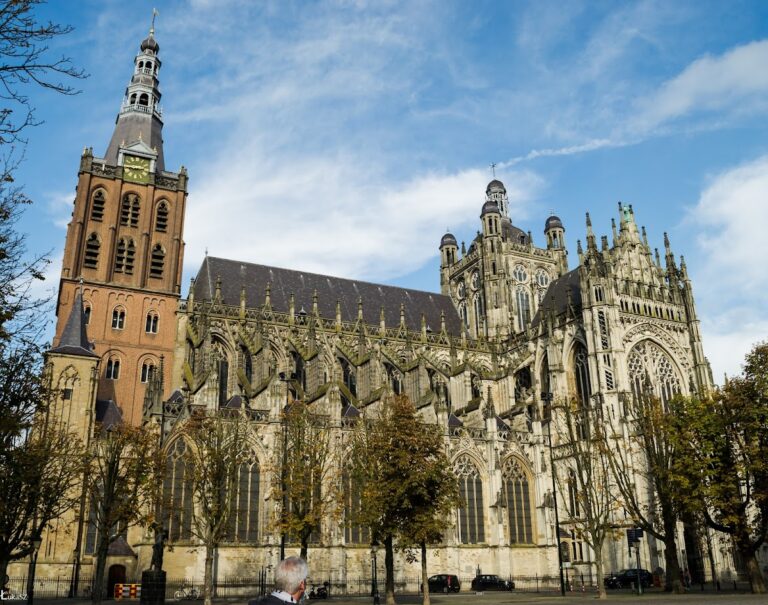
Between 1504 and 1509, Maurick underwent substantial alteration, probably under Jan Heym. Jan Heyns, one of the master builders associated with St John’s Cathedral in ’s-Hertogenbosch, was involved in this work. The evidence supports his participation in the alterations, but does not show that he designed or built the entire castle.
During the Gelderland invasion of Brabant in the 1540s, Vught was burned while Maurick was spared. Aert Heym, who led the defense of ’s-Hertogenbosch, was suspected of having a private agreement with the Gelderland commander Maarten van Rossum. Another explanation holds that he protected Maurick by placing soldiers from the city there.
Sieges and the Dutch Republic
Maurice, Prince of Orange, used Maurick as his headquarters during his unsuccessful sieges of ’s-Hertogenbosch in 1601 and 1602. These operations forced the later Aert Heym to leave the castle. Frederick Henry, Prince of Orange, used it as his headquarters during the successful siege of 1629. Constantijn Huygens, a Dutch poet, diplomat, and statesman, stayed at Maurick during the campaign and described the castle and its grounds in a poem. A tradition also says that a cannonball struck Frederick Henry’s dining table while he was eating.
The capture of ’s-Hertogenbosch in 1629 brought Maurick under the control of the Dutch Republic, the seventeenth-century state formed by the northern Netherlands during the Dutch Revolt. The Catholic Heym family kept the property, but its income declined as Catholics were excluded from public office and faced unfavorable economic conditions. The family also permitted Catholic practices that were prohibited elsewhere in the Meierij of ’s-Hertogenbosch. Hendrick Heym was compelled to sell Maurick in 1680.
The Van Beresteyn period
Jacqueline Brouart, the widow of Christiaen van Beresteyn, acquired Maurick around 1680. The Van Beresteyn family held the estate until 1884 and used the castle as a summer residence. They belonged to the Protestant landowning elite, and several family members gained wealth through trade or official positions connected with the Dutch East India Company, commonly called the VOC.
Thomas van Beresteyn succeeded Jacqueline in 1691. Later owners included Maarten Cornelis van Beresteyn, Christiaan Paulus van Beresteyn, Catharina Wilhelmina Bruhl, Gijsbert van Beresteyn, and Jonkheer Gijsbert van Beresteyn, who died in 1884. After his death, the castle and its contents were prepared for auction. Two portraits then attributed to Rembrandt were withheld from the 1884 sale, sold in 1887, and eventually entered the Metropolitan Museum of Art. Other contents were dispersed, including an armorial board, a heraldic display bearing a coat of arms, associated with Maarten Tromp and purchased by King William III.
Restoration and changing uses
In 1883, Adolph Joannes Mathias Mulder measured and drew Maurick. His drawings are regarded as particularly reliable. During the Van Beresteyn period, the Gothic tower was shortened, an extension over the moat was removed, the southern facade of the western wing was regularized and plastered, and the western wing was altered again, probably after 1840.
Augustinus J. A. van Lanschot bought Maurick in 1884. A member of the banking family Van Lanschot, he used it as a summer residence and commissioned a renovation in 1891 and 1892 from the restoration architect Lambertus Christianus Hezenmans. His son, August W. J. van Lanschot, mayor of Vught from 1899 to 1923, inherited the property, which was partly used as Vught’s municipal hall. Eduard Cuypers prepared a further alteration plan in 1920, while August’s widow, Gertrude Lagasse de Locht, continued to live there.
During the German invasion of 1940, Maurick sheltered the standard, weapons collection, library, and musical instruments of the Third Hussar Regiment after the May days. The Van Lanschot family later sold the property. It was first operated as a hotel-restaurant and subsequently as a restaurant, while from 1963 it was leased to the Dutch Association of Road Builders. Monumenten Fonds Brabant acquired Maurick in 2007. After a restaurant closed following bankruptcy in 2015, Klaas van Leengoed and Niek van Lieverloo acquired the castle and returned it to restaurant use in September of that year.
Remains
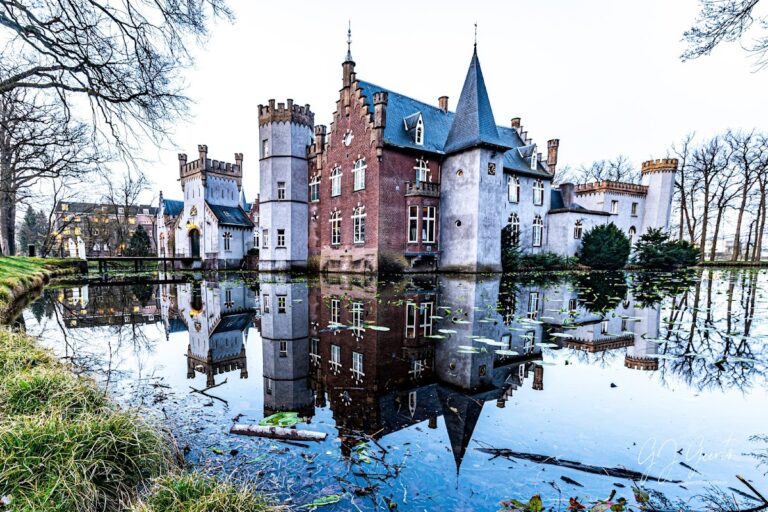
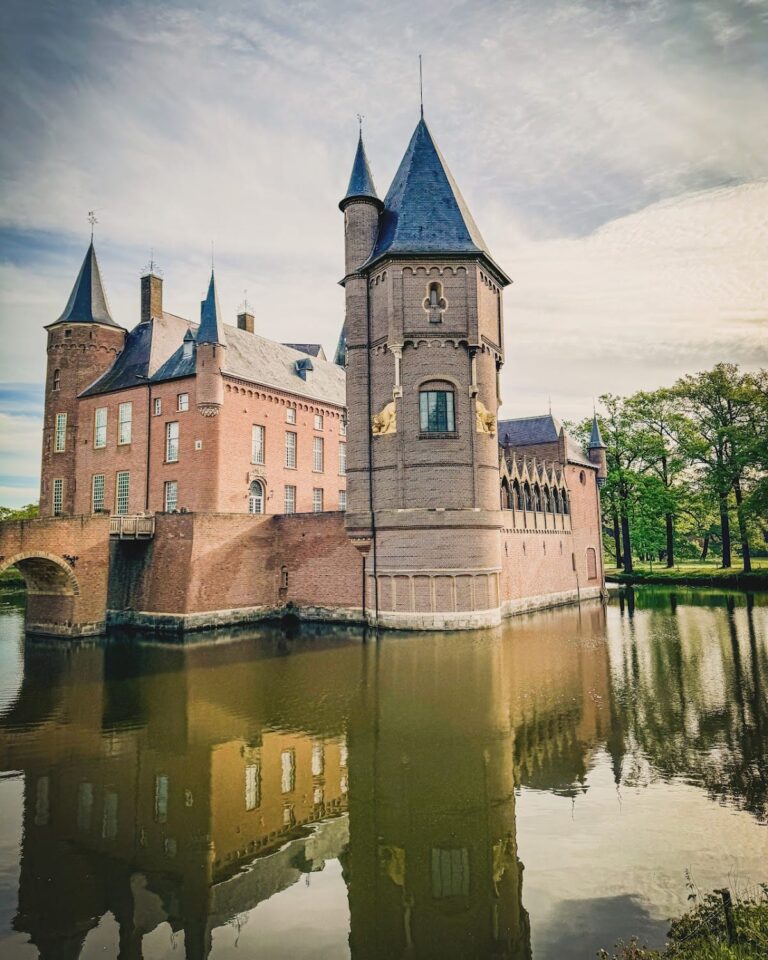
Kasteel Maurick occupies an island within a dead meander of the Dommel. Its unusual plan combines a large main building with a gate building of approximately equal height, additional wings, and a courtyard. The island is larger than would have been required for a purely defensive site. Broad water and substantial buildings offered limited protection against attackers without siege weapons, but the walls, no more than about 60 centimetres thick, could not withstand a formal siege. The site is therefore best understood as a moated residence rather than a structure designed to resist a full siege.
Medieval and early sixteenth-century buildings
Gate building
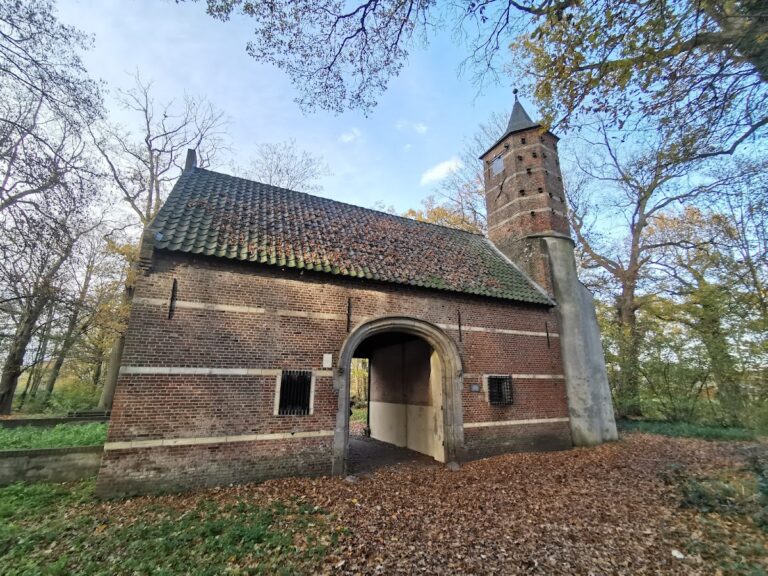
The gate building probably dates from the early fifteenth century. Another dating places the entrance section between its two slender towers at approximately 1400, identifying it as the oldest part of the present castle. A pointed-arch gateway opens through the entrance, which is reached by a drawbridge. The towers were slightly heightened during the 1891 to 1892 restoration.
Main building
The main building contains two overhanging towers. The portion between and beneath them belongs to the original main building and probably dates from the 1504 to 1509 rebuilding phase. The broad section behind it and the partly octagonal courtyard tower probably belong to the same period. The southern facade carries the Heym family coat of arms, which has remained there for centuries.
Later wings and courtyard additions
Western wing
The adjoining western section is an early nineteenth-century regularization of older fabric. It incorporates part of a Gothic tower of unknown date, a fragment of which remains visible in the west-facing wall. The western wing on the north side is later. In 1891 and 1892, the wing was raised and given a stepped gable, whose sloping sides rise in a series of steps. The restoration also removed yellow plaster and altered parts of the roof.
Eastern wing and orangery
The eastern wing combines seventeenth-century fabric with additions from the late nineteenth century. Its roof and stepped gable were changed during the 1891 to 1892 restoration, and Eduard Cuypers later made minor alterations. An orangery was subsequently added to the courtyard, extending the group of buildings around the interior space.
Island landscape and associated remains
Earlier earthwork interpretation
The present terrain does not contain the high mound normally expected for a motte-and-bailey castle. One interpretation places the earlier motte on a smaller island immediately north of the present island. It may have been lowered after the current castle was built on what had formerly been the outer bailey. This proposed sequence remains an interpretation of the site’s historical and archaeological development rather than a confirmed reconstruction.
Landgoed Maurick
The adjoining estate, known as landgoed Maurick, covers 23 hectares across the transition between higher ground and the Dommel valley. Ash and elm woodland occupies the higher areas, while the lower ground contains carr woodland, including alder carr. The park woodland also includes notable trees, and the estate supports one of the largest grey heron colonies in the Netherlands.
Portraits and regimental objects
Two portraits associated with Maurick and attributed to Rembrandt probably depict Cornelis van Beresteyn and Corvina van Hofdyck. They may have entered the castle after the extinction of the relevant family branch following Agneta Deutz’s death in 1692. After their later sale, the portraits entered the collection of Louisine Havemeyer and Henry Osborne Havemeyer, who gave them to the Metropolitan Museum of Art.
The objects brought to Maurick during the 1940 evacuation comprised the Third Hussar Regiment’s standard, weapons collection, library, and musical instruments. Their temporary presence connected the castle’s later history with the preservation of military and regimental heritage during the German invasion.
Nearby sites