Royal Monastery of Saint Mary of Guadalupe: A Royal Marian Sanctuary in Spain


Site at a Glance
- Rating
- 4.6
- Popularity
- High
- Country
- Spain
- Primary era
- Medieval
- External website
- Open
- Eras represented
- Medieval, Early Modern
- Civilizations
- Crown of Castile, Spanish
- Site type
- Religious
- Remains
- Monastery
On this page24 sections
History
The Royal Monastery of Saint Mary of Guadalupe is a Christian sanctuary and monastery in Guadalupe, Spain, whose origins lie in a Marian cult associated with a statue of the Virgin of Guadalupe. Its development began in the late thirteenth or early fourteenth century and continued through the eighteenth century, producing a complex that combines Gothic, Mudéjar, Renaissance, Baroque, and Neoclassical forms. The sanctuary became a royal domain under Alfonso XI of Castile and later an important pilgrimage center, royal burial place, medical teaching center, and religious institution connected with Spain’s expansion into the Americas.
Origins and royal patronage
Tradition places the discovery of the statue in the late thirteenth or early fourteenth century. A shepherd from Cáceres was said to have found it at the place where a chapel or hermitage was subsequently built. Later foundation tradition named the shepherd Gil Cordero, although that name became attached to the legend only in 1743. The statue was believed to have been hidden to protect it from Moorish invaders.
Alfonso XI visited the sanctuary and is traditionally said to have prayed before the Virgin before the Christian victory over the Marinids at the Battle of Rio Salado in 1340. The Marinids were a North African dynasty that intervened militarily in the Iberian Peninsula. After the victory, Alfonso attributed it to the Virgin’s intercession, enlarged the church, established hospitals for pilgrims, and developed the surrounding settlement as a royal domain.
The first church known to Alfonso in 1330 was already in poor condition. Its enlargement and repair took about six years under Toribio Fernández, who acted for Cardinal Pedro Gómez Barroso, the sanctuary’s principal custodian. In 1337 Alfonso defined the boundaries of the settlement and sanctuary, and Guadalupe became independent of Talavera de la Reina.
The secular priory
An archiepiscopal document dated 6 January 1341 formally created the Priory of Santa María of Guadalupe. It recognized the king and his successors as patrons, while Pedro Gómez Barroso became the first prior. He was followed by Toribio Fernández de Mena, Diego Fernández, and Juan Serrano, the last secular prior.
From 1341 to 1389 Guadalupe was a secular priory under royal patronage. In 1345 Alfonso changed its status from a royal domain to a civil lordship held by the secular prior. During this period the sanctuary drew pilgrims from throughout the kingdom. In 1383 Archbishop Pedro Tenorio ordered a bridge over the Tagus to improve access for travelers coming from the north.
The Hieronymite monastery
On 15 August 1389, King Juan I of Castile ordered the sanctuary to be enlarged and converted into a monastery governed by regular monks. The Hieronymites were a Catholic religious order devoted to the spiritual tradition associated with Saint Jerome. Juan Serrano transferred Guadalupe to Fernando Yáñez de Figueroa, then prior of the Hieronymite house at San Bartolomé in Lupiana. Thirty-two monks from Lupiana took possession in October 1389, Fernando Yáñez was elected their first prior, and he received both ecclesiastical jurisdiction and civil lordship over Guadalupe. A papal bull confirmed the transfer in 1394.
The change provoked protests and litigation by the people of Guadalupe, particularly during the first three centuries of Hieronymite rule. The order nevertheless governed the town and monastery for 463 years, enlarged the complex, and strengthened the sanctuary’s religious importance. Devotion to the Virgin spread across the Iberian Peninsula and the Canary Islands and later into Spanish America.
The monastery retained royal protection even after the Hieronymites founded the Escorial monastery. It became closely associated with Ferdinand II of Aragon and Isabella I of Castile, known as the Catholic Monarchs, and with Christopher Columbus. Ferdinand and Isabella received Columbus at Guadalupe in 1486 and 1489, and he returned in 1493 to give thanks after his first voyage to the Americas. Indigenous Americans brought to Europe as servants were baptized at the monastery on 29 July 1496.
On 21 April 1486 Ferdinand issued the Sentencia Arbitral de Guadalupe, or Arbitration Judgment of Guadalupe, at the monastery. The decree ended oppressive customs that allowed Catalan nobles to mistreat remensa peasants and bind them to their lands. The sanctuary’s overseas associations also grew. Columbus named the Caribbean island now called Guadeloupe Santa Maria de Guadalupe de Extremadura in honor of the Virgin, and Guadalupe became connected with the Virgin’s later importance in Mexico and other parts of the Americas.
Secularization and Franciscan custodianship
The Hieronymite community left Guadalupe on 18 September 1835 during the secularization and confiscation of monastic property. The church became a secular parish dependent on the Archdiocese of Toledo. Cenón de Garbayuela, the former prior, served as parish priest from 1835 to 1856. Until 1908 the monastic buildings endured abandonment, looting, and deterioration.
Restoration and local advocacy accompanied renewed interest in the sanctuary. A regional pilgrimage on 12 October 1906 and Pope Pius X’s recognition of Our Lady of Guadalupe as patron of Extremadura on 20 March 1907 helped prepare the transfer of the sanctuary-parish to the Franciscans. The Franciscans, a Catholic order founded on the teachings of Saint Francis of Assisi, took charge in November 1908 after a royal order from Alfonso XIII and the required ecclesiastical permissions.
The Franciscans reconstructed and re-equipped parts of the complex and restored its religious and cultural functions. Pope Pius XII granted the church the status of a minor basilica in 1955, and Pope John Paul II visited on 4 November 1982. The monastery received the Medalla de Extremadura in 1992, awarded in the person of the Franciscan guardian Serafín Chamorro during celebrations of the fifth centenary of the discovery of America. It had been declared a National Monument in 1879 and was inscribed on the UNESCO World Heritage List in 1993 under criteria (iv) and (vi), as identification number 665.
Guadalupe’s hospitals also served as a medical teaching center. The monastery is associated with the practice of autopsies in Spain, while aspiring surgeons studied through clinical work, dissections, vivisections, and weekly lectures. The hospital complex included institutions dedicated to Saint John the Baptist, women, the bishop, and abandoned children.
The monastery also became a royal burial site. Henry IV of Castile and his mother, María de Aragón, are buried in the main church. Dionysius of Portugal and Juana Enríquez of Castile are buried in the Royal Chapel of Saint Catherine.
Remains
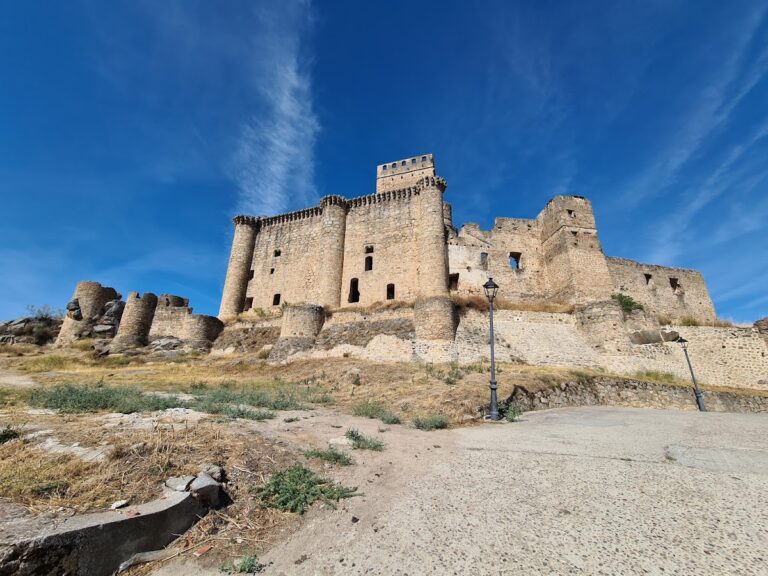
The monastery occupies approximately 22,000 square meters at the foot of the eastern Sierra de las Villuercas. Its buildings developed between the fourteenth and eighteenth centuries and form a large complex in which Gothic, Mudéjar, Renaissance, Baroque, and Neoclassical elements coexist. The main facade faces the Plaza Mayor and rises above a broad staircase. Advanced Gothic forms and Mudéjar details are framed by two solid medieval towers with a fortress-like appearance. A large rose window in the south transept dominates the upper facade, while two pointed bronze doors give access to the church.
Church and chapels
Main church
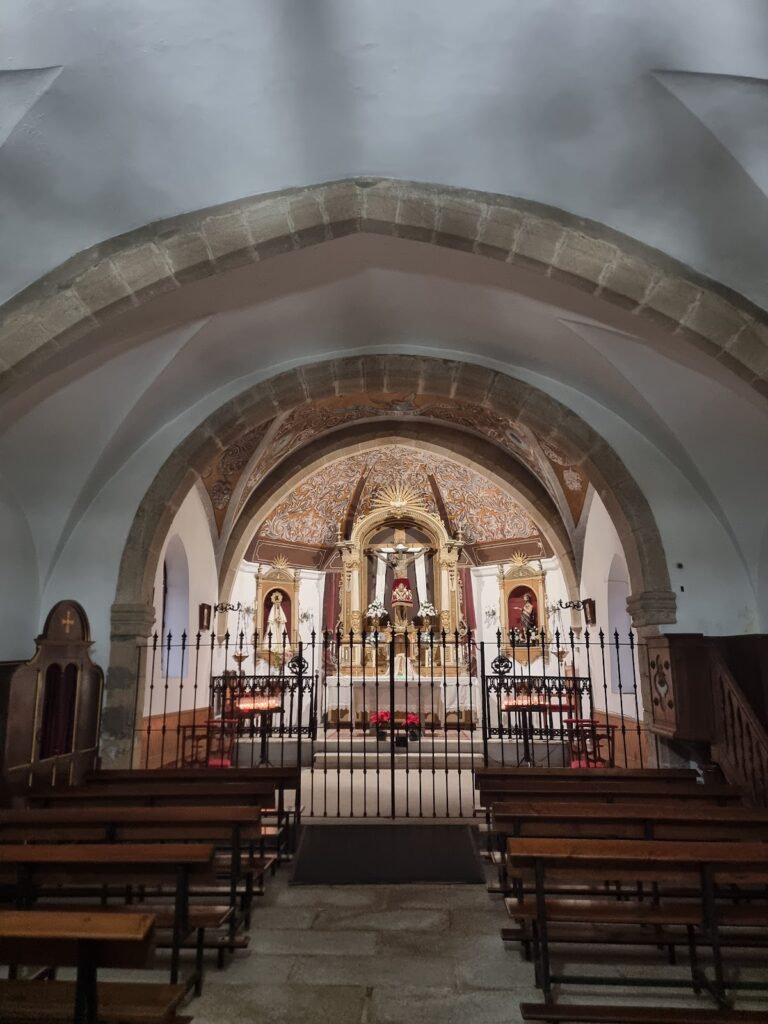
The fourteenth-century Gothic church was remodeled in the fifteenth and eighteenth centuries. It has a rectangular plan with three aisles and four bays, ribbed vaults, a central nave higher than the side aisles, an open gallery, and upper clerestory arcades. A clerestory is an upper zone of windows or arcades that brings light into the nave above the roofs of the lower aisles. The transept extends across the full width of the three naves, and an octagonal dome rises over the crossing.
The late-fourteenth-century bronze doors were made by Paolo de Colonia. Their repoussé decoration, formed by hammering designs in relief from the reverse of the metal, presents scenes from the lives of Jesus and the Virgin. They are among the oldest surviving bronze church doors in Spain.
The main altarpiece stands above a pronounced staircase. Juan Gómez de Mora prepared its initial design, while Giraldo de Merlo carried out most of the execution in the early seventeenth century. The retable, a large architectural altarpiece behind an altar, combines Romanist Renaissance and Baroque features. Its predella contains seventeen reliefs, while the main body has three vertical sections, three levels, a wider central section, two narrower intercolumns, a divided curved pediment, and a crowning crucifix. A vase of lilies, the monastery’s emblem and a symbol of Mary’s purity, occupies the pediment beside Habsburg heraldry.
Giraldo de Merlo’s sculptures include Saint Jerome in the central upper section. The altarpiece also incorporates the so-called Desk of Philip II, a Renaissance cedar-and-steel bargueño, or portable Spanish writing cabinet with drawers and compartments, made in Rome in 1561. Philip II donated it for use as a tabernacle. Paintings by Vicente Carducho show the Annunciation, Nativity, and Adoration of the Magi, while Eugenio Cajes painted the Assumption, Resurrection, and Pentecost.
The church contains the praying tombs of Henry IV of Castile and María de Aragón, together with those of Dionysius of Portugal and his wife. Its lateral altarpieces are dedicated to Saint Peter, by Manuel de Larra, and Saint Paul, by José Benito de Churriguera.
Screen, choir, and organs
A monumental Gothic-Renaissance iron screen with gilded details extends across all three naves. Made between 1510 and 1514 by the Dominican friars Francisco de Salamanca and Juan de Ávila, it has five sections and two levels. The central section is wider and contains two doors, while the cresting carries heraldic decoration. The screen was restored in 1997.
The high choir occupies the western end of the church and covers two bays of the central nave. It rests on a lowered Gothic vault, while its later vaults contain fifteenth-century frescoes of musician angels by Juan de Flandes. The Baroque walnut choir stalls, largely made by Alejandro Carnicero, provide 45 lower-level and 49 upper-level seats. Their reliefs depict female saints and full-length saints. Above the presidential seat stands a fifteenth-century polychrome Flemish-Gothic statue of the Virgin of the Choir, holding the naked Christ Child above a crescent moon.
Three organs survive in the church. Albert Mercklin built the principal organ in 1924 using the cases of two eighteenth-century instruments. The German firm Walker later enlarged its registers and electrified it. A Renaissance regal organ with four keyboards, modified in the eighteenth century and restored in 1986, and another eighteenth-century organ restored in 1987 are also preserved.
Chapel of Saint Anne
The former fifteenth-century entrance portico became the Chapel of Saint Anne. It contains a sixteenth-century Renaissance altarpiece with an oil painting of Saint Anne by Pablo de Céspedes dated 1587. The chapel also preserves alabaster tombs of Alonso de Velasco and Isabel de Cuadros, made by Egas Cueman in 1467, and a bronze baptismal font cast by Juan Francés in 1402.
Royal Chapel of Saint Catherine
The Royal Chapel of Saint Catherine was built in the mid-fifteenth century. Its square plan is covered by a ribbed vault. Two seventeenth-century Baroque altarpieces are dedicated to Saint Catherine and Saint Paula. The chapel also contains sculptures and seven Baroque paintings attributed to the Hieronymite painter Juan de Santa María, as well as the tombs of Dionysius of Portugal and Juana Enríquez of Castile.
Sacristy and devotional chapels
Sacristy complex
The sacristy complex, comprising an ante-sacristy, sacristy, and chapel, was built between 1636 and 1645 to designs by the Discalced Carmelite friar Alonso de Ávila. The large rectangular Baroque sacristy has a five-bay barrel vault supported by Tuscan pilasters. Murals on the vault depict scenes from the life of Saint Jerome.
The Gothic ante-sacristy has ribbed vaults and paintings of Charles II, Maria Luisa of Orléans, and Cardinal Saba Millini by Juan Carreño de Miranda. The works were donated to the monastery in 1683, together with Luis Tristán’s Martyrdom of Saint Lawrence.
Chapel of Saint Jerome
Eight large oil paintings by Francisco de Zurbarán line the sacristy walls. Their subjects personify virtues associated with Hieronymite monastic life, including obedience, charity, recollection, chastity, and decorum. At the end of the sacristy, the Chapel of Saint Jerome contains a terracotta statue of the saint by Pietro Torrigiano and Zurbarán paintings of the Apotheosis, Temptations, and Flagellation of Saint Jerome.
A lantern captured from the Turks by Don John of Austria at the Battle of Lepanto in 1571 hangs from the chapel’s dome. Philip II donated it to the monastery six years later.
Reliquary Chapel
The Reliquary Chapel is an octagonal late-sixteenth-century structure built to plans by Nicolás de Vergara. It contains the fifteenth-century Gothic Casket of the Enamels, made by the monk Juan de Segovia. The casket presents twelve scenes from the life of Jesus, six in enamel and six in repoussé silver. The chapel also displays the Virgin’s jewelry and clothing.
Camarín de la Virgen
The Camarín de la Virgen is a Baroque octagonal structure built between 1687 and 1696 to house the statue of the Virgin of Guadalupe. It has a drum, dome, and lantern, together with a stuccoed Chamber of the Virgin. The throne is surrounded by sculptures attributed to Pedro Duque Cornejo, and nine large paintings by Luca Giordano depict scenes from Mary’s life. Charles II commissioned the paintings, while Pedro José de Uceda executed the wall paintings between 1736 and 1741.
Cloisters and monastic buildings
Mudéjar Cloister
The Mudéjar Cloister was built between the fourteenth and fifteenth centuries, with major work dated to 1389–1405. Mudéjar describes Christian Spanish architecture and decoration shaped by strong Islamic influence. The rectangular cloister covers 1,680 square meters and has two levels. Its lower gallery contains pointed Islamic-influenced arches joined by a low arcade wall. The upper gallery has horseshoe arches resting on pillars and joined by a continuous parapet.
A square central pavilion was built in 1405. Four Gothic arches on each facade are subdivided into smaller pointed arches, and three diminishing octagonal levels rise to a pyramidal roof. Green ceramic elements reinforce its Mudéjar decoration. At the northwest corner, the lavatory used by the monks before entering the nearby refectory has Islamic-style glazed tiles and copies a fountain in the baptistery.
Thirty large paintings of miracles attributed to the Virgin of Guadalupe hang in the cloister, which is consequently also called the Cloister of Miracles. Most were painted around 1620 by the monk Juan de Santa María.
Gothic Cloister
The Gothic Cloister lies west of the monastery and was used mainly by the hospitals and pharmacy, giving it the alternative name Cloister of the Apothecary. Built between 1519 and 1533 from designs by Antón Egas and Alonso de Covarrubias, it is a square, three-level Renaissance complex that retains Gothic and Mudéjar elements and covers 840 square meters.
The lower level has round arches on octagonal pillars framed by alfices, rectangular frames around arches. The middle level contains superimposed pointed arches with Gothic tracery, while the upper level has lowered Renaissance arches.
Chapter House and later buildings
The Chapter House lies transversely behind the church and has upper and lower levels restored in 1998. The Church of the Holy Trinity, an eighteenth-century building and the newest part of the complex, was commissioned by a descendant of Christopher Columbus in 1730 and later converted into an auditorium.
A palace of Isabella I of Castile stood within the monastic complex. Built between 1487 and 1491, it was demolished in 1856.
Museums, manuscripts, and collections
Embroidery Museum
The former refectory, a fourteenth-century building, houses the Embroidery Museum. Its textiles include liturgical vestments, altar frontals, lectern cloths, processional-cross sleeves, and other works made from brocade, velvet, satin, and Moorish fabrics. The collection ranges from the fifteenth to the nineteenth centuries and includes pieces produced in the monastery workshop, which operated from the fifteenth to the nineteenth century, as well as works from workshops in Seville, Valencia, and Toledo.
The fifteenth-century Frontal Rico was embroidered by Diego de Toledo and enriched with precious stones in the seventeenth century.
Museum of Painting and Sculpture
The former fifteenth-century clothing room has a Mudéjar coffered ceiling and houses the Museum of Painting and Sculpture. Its paintings range from the Gothic period to the nineteenth century and include works attributed to or by Juan de Flandes, El Greco, Francisco de Zurbarán, Goya, Juan Correa de Vivar, and Nicolás Francés.
The sculpture collection includes a polychrome wooden Dead Christ by Egas Cueman, a large Renaissance ivory crucifix, a Baroque polychrome wooden Ecce Homo attributed to Pedro de Mena, and an eighteenth-century Neapolitan Nativity.
Codices and library
The monastery’s collections include 107 codices produced largely in its parchment, writing, illumination, and binding workshops between the fourteenth and nineteenth centuries. Eighty-six large choir books contain miniatures, decorated initials, and colored and gilded borders. Some have wheels beneath them to facilitate movement. The early sixteenth-century Book of Hours of the Prior contains 200 vellum folios and measures 26 by 18 centimeters.
The former fifteenth-century Gothic library pavilion housed the Hieronymite library until 1835, when the collection was dissolved and its books were removed to Cáceres. The Franciscans later established a new library in the southern part of the monastery. Much of the Hieronymite archive survived, including fourteenth- and fifteenth-century codices and parchments. The site also preserves the Book of the Water Channels of the Monastery of Guadalupe, dated 1507–1542, whose imitation-Gothic wooden binding was restored in 2014.
Nearby sites