Dolmen of Guadalperal: A Prehistoric Megalithic Burial Monument in Spain
Site at a Glance
- Rating
- 3.3
- Popularity
- Very Low
- Country
- Spain
- Primary era
- Stone Age
- External website
- Open
- Eras represented
- Stone Age
- Civilizations
- Unclassified
- Site type
- Burial
- Remains
- Tomb
On this page14 sections
History
The Dolmen of Guadalperal is a prehistoric megalithic burial monument in Spain, built by prehistoric communities in the late fifth to the third millennium BC. Its construction is estimated at approximately 4000 BC, while the completed dolmen dates to around 3000 BC. The monument stands in the Campo Arañuelo region, near El Gordo and Peraleda de la Mata, in an area formerly situated along the northern bank of the Tagus.
Origins and changing functions
The monument developed through several stages. It began as a burial mound, then acquired a circle of standing stones that may have served as a solar sanctuary or a cromlech, a prehistoric arrangement of standing stones often forming a circle. The proposed Celtic association of this phase remains uncertain, and the three-stage sequence suggested by Georg and Vera Leisner had not been independently confirmed by 2021.
In a later phase, upright stones and large covering slabs were added to form the dolmen, a prehistoric burial monument made from large stones enclosing a chamber originally covered by a mound. This expansion restored the monument’s funerary purpose. Its location near river crossings and watercourses gave the surrounding area religious and economic importance.
Discovery and archaeological investigation
Hugo Obermaier discovered and excavated the monument during an archaeological expedition between 1925 and 1927. A German archaeologist specializing in prehistory, Obermaier worked extensively in Spain, served as chaplain of the House of Alba, and later became a professor at the Central University of Madrid. His report, published in German, initially attracted little attention in Spain.
During the 1950s, Georg and Vera Leisner assembled dispersed documentation about the monument and published a scientific study in 1960. Primitiva Bueno Ramírez and Rodrigo de Balbín Behrmann examined and published the engravings on its standing stones in the 1990s. Further excavations took place in 2021 under the direction of Primitiva Bueno Ramírez and Enrique Cerrillo Cuenca.
Flooding and protection
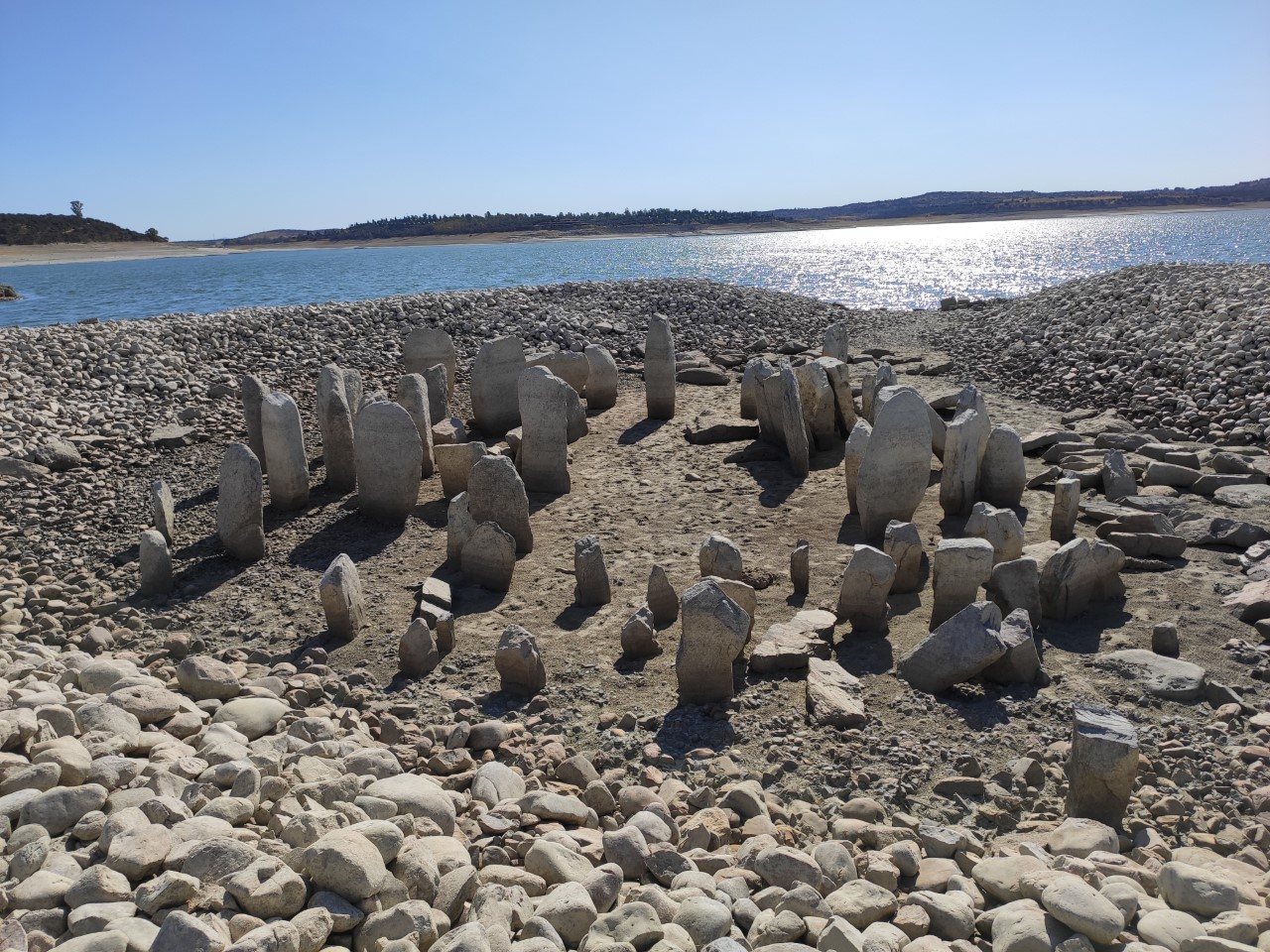
The construction of the Valdecañas Dam and reservoir separated the monument from the nearby settlement in 1963. The northern and relatively shallow part of the reservoir covering the site was flooded in 1969. Water levels fell enough to reveal the monument partially in 1992 and 2012, and completely in 2019 and 2022. In July 2019, drought conditions and satellite imagery revealed the stones after roughly five decades of submersion.
Repeated submersion and exposure may have caused erosion and other damage to the stones, carvings, and surrounding archaeological context. Since 2019, possible damage has been monitored and the site has been digitally documented. The local Raíces de Peraleda association has called for restoration and recovery. Proposals to move the monument outside the reservoir have faced opposition because relocation would sever its relationship with the surrounding landscape.
On 10 May 2022, the monument and its archaeological area were declared a Bien de Interés Cultural, Spain’s formal designation for protected cultural heritage of historical or archaeological value. The Dolmen of Guadalperal forms part of a group of several dozen megalithic sites in the Tagus basin, several of which were also inundated by reservoirs.
Remains
The surviving monument consists of approximately 150 granite orthostats, large stones set upright as part of a wall or chamber, arranged in elongated and concentric formations. At its centre, between 12 and 13 stones form an ovoid chamber about 5 metres in diameter. An access corridor, approximately 1.4 to 1.5 metres wide and more than 5 metres long, connects the chamber with an open forecourt.
Chamber and entrance
Central chamber and corridor
The chamber and corridor define the principal funerary arrangement. The corridor was repaired with concrete during Obermaier’s excavation, after which most of its stones fell or became displaced. The granite used throughout the monument came from the surrounding area, with extraction locations as far as 5 kilometres away. The entrance arrangement has notable similarities to that of the Navalcán dolmen farther upstream.
Entrance menhir
A menhir, or single upright standing stone, approximately 2 metres high stands directly at the chamber entrance. Its carved designs include a long, wavy line interpreted either as a snake or as a representation of the Tagus and its meanders. The interpretation as the river has not received scientific support. Several cup-like carvings are also present, although their possible protective meaning remains uncertain.
Mound and altered appearance
Original burial mound
The chamber was originally enclosed by a large circular mound made from earth, gravel, quartzite blocks, and sediment. The mound gave the monument the covered form associated with its earlier burial function.
Excavated outer ring
Obermaier emptied the mound during his excavations, exposing the granite uprights and leaving discarded quartzite material around them as an outer ring. This ring resulted from the excavation rather than forming part of the original monument. The intervention therefore changed the visible appearance from a covered burial mound to an exposed dolmen.
Associated archaeological remains
Dump and earlier settlement
A nearby dump associated with the monument contained 11 axes, pottery fragments, flint knives, and a copper punch. A settlement, probably earlier than the conversion of the monument into a dolmen, included houses, hearths or other traces of charcoal and ash, pottery, grinding stones, and stones used to sharpen axes.
Roman-period reuse
Roman-period activity is represented by a coin, ceramic fragments, and a grinding stone found at the site. These remains indicate that the location was reused during the Roman period.