Church of the Assumption, Banská Bystrica: Gothic Parish Church in Slovakia


Site at a Glance
- Rating
- 4.8
- Popularity
- Low
- Country
- Slovakia
- Primary era
- Medieval
- External website
- Open
- Eras represented
- Medieval, Early Modern
- Civilizations
- Hungarian
- Site type
- Religious
- Remains
- Church
On this page9 sections
History
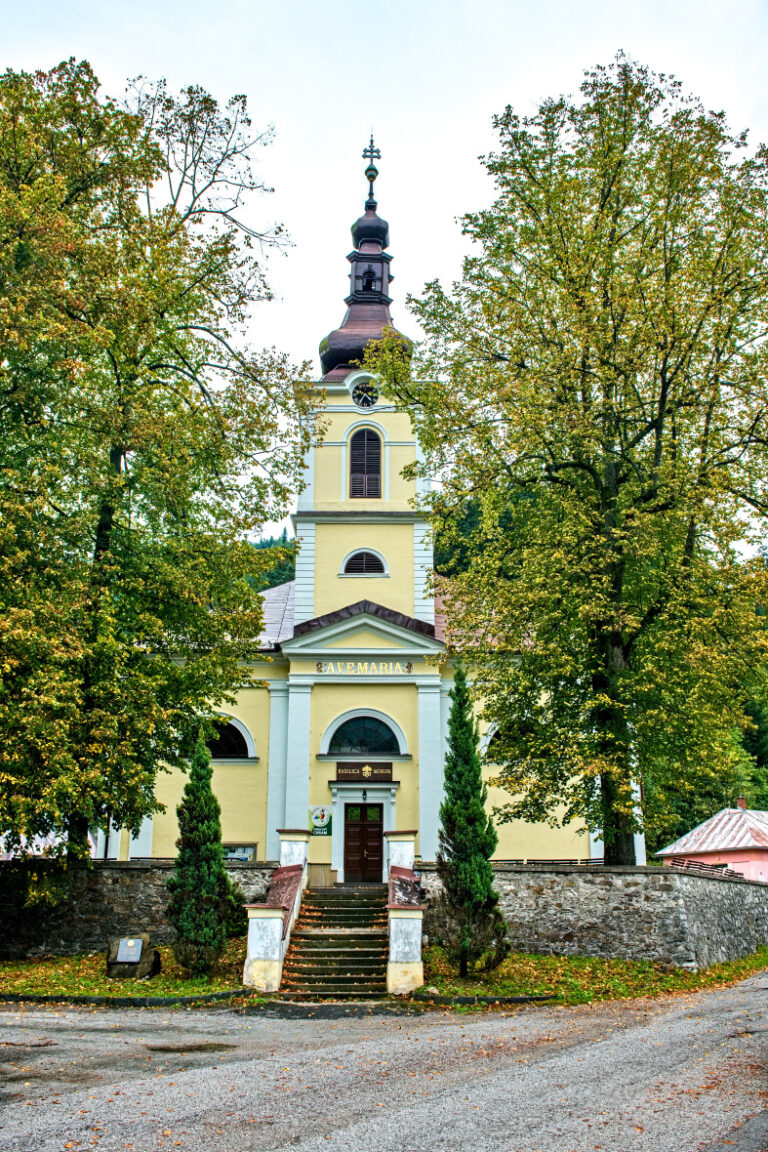
The Church of the Assumption, Banská Bystrica, is a Roman Catholic parish church in Slovakia, dedicated to the Assumption of the Virgin Mary, the feast celebrating Mary’s being taken into heavenly glory. Construction began around 1255 on the foundations of an earlier Romanesque basilica, and the church is regarded as the oldest in Banská Bystrica. It remains an active place of worship and belongs to the Diocese of Banská Bystrica.
Medieval parish church
The earlier basilica had a square sanctuary, and parts of its Romanesque phase survive in the tower and north wall. The church later became the parish church of the city’s wealthy mining community. Its association with predominantly German-speaking burghers and mine owners gave it the lasting name “German Church.”
A fortified enclosure around the church is mentioned in 1442. During the later fifteenth century, the building was expanded with the Chapel of Saint Andrew and the Chapel of the Body of Christ on the south side in 1473. The northern side aisle was converted into the Chapel of Saint Barbara in 1478, and the Chapel of Saint John the Baptist was built in 1480.
The Saint Barbara foundation
The Chapel of Saint Barbara was probably founded before 1477 and was consecrated in 1478. Its investor was Mikuláš Plath, a Banská Bystrica burgher, city councillor, and later mayor. After his death, responsibility passed to his widow, Dorota. When the Plath family left Banská Bystrica, the chapel came into the possession of the Glöcknitzer family.
The chapel’s endowment included 500 gold pieces lent to the town of Kremnica in 1479. Kremnica was expected to pay an annual charge of 25 gold florins, but the decline of mining and the town’s inability to maintain the payments caused disputes with Banská Bystrica. The chapel is also known as the Plath Chapel and, after repairs carried out by the Guthian family in 1643, as the Guthianna Chapel.
Fire, rebuilding, and later history
On 25 August 1620, the church hosted a thanksgiving Mass after the assembly in Banská Bystrica elected the Transylvanian prince Gábor Bethlen king of Hungary. Delegates and representatives of the estates paid homage to him there. The church was considered as a possible coronation church, although Bethlen was not crowned in it.
A major fire in 1500 brought extensive rebuilding in the Late Gothic period, financed through the efforts of the wealthiest mine owners. A much larger urban fire in 1761 destroyed more than 300 houses. At the church, the roof collapsed and the vaults gave way, destroying the nearly 20-metre-high medieval main altar made in the workshop of Master Paul of Levoča. The church was rebuilt in the Baroque style and restored several times afterward.
The fire also collapsed the roof of the Chapel of Saint Barbara, while its vault survived. During the Baroque rebuilding, a large pointed arch connected the chapel with the main nave, and a Baroque rectangular portal was opened in its west wall to connect it with the sacristy. Further changes took place in 1876 under Bishop A. Ipolyi. Paintings made by F. Storna in that year were removed during repairs in 1971.
The church was designated a Slovak National Cultural Monument under registration number 601-2321/8 on 18 May 1955.
Remains
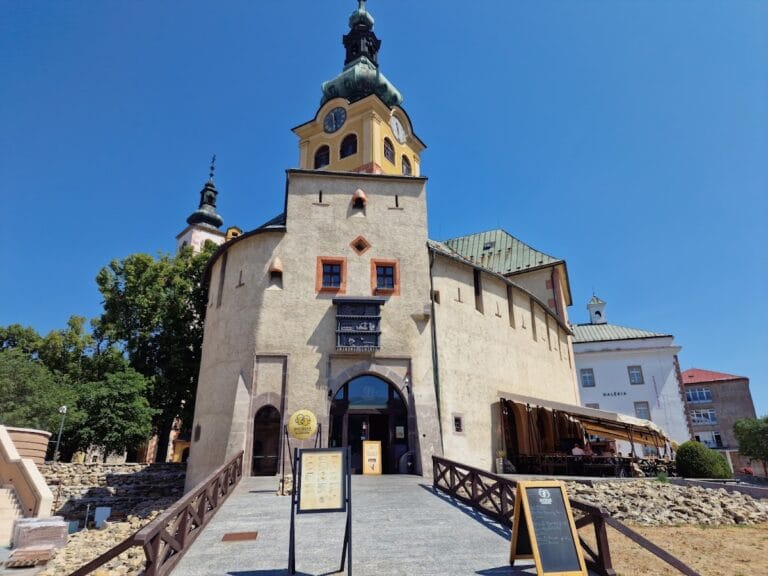
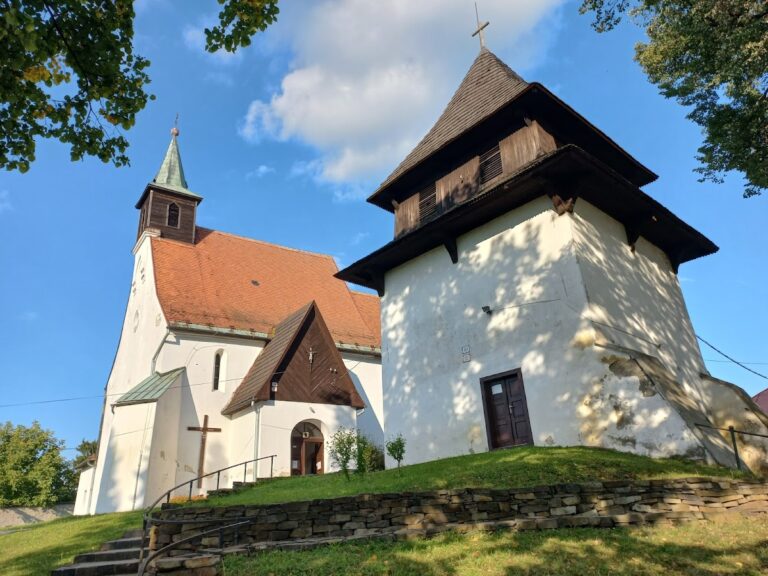
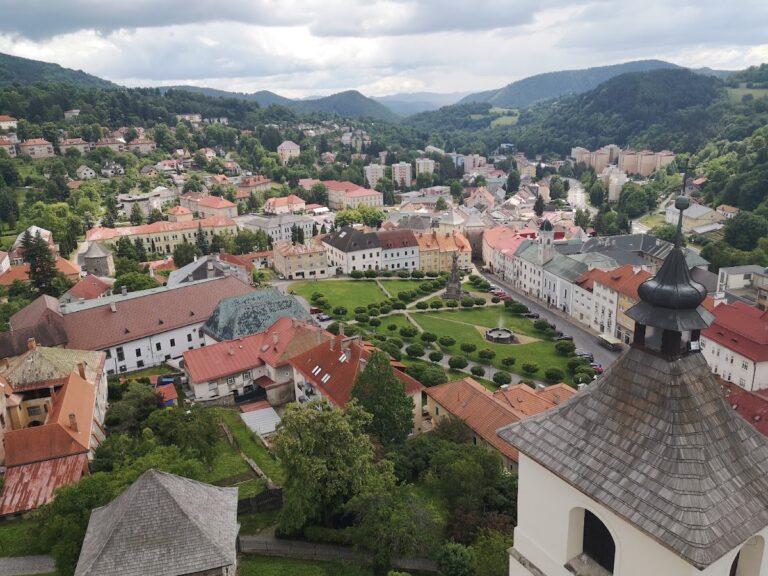
The church is a Gothic building incorporating elements of the earlier Romanesque structure. It occupies a prominent position within Banská Bystrica’s urban castle complex and retains a fortified enclosure. The surviving layout includes the Romanesque tower and north wall, the south-side chapels, the Chapel of Saint John the Baptist, and the former northern side aisle transformed into the Chapel of Saint Barbara.
Main church
The Baroque rebuilding produced the present barrel vaults, whose paintings were made by Anton Schmidt in 1770. The main altar contains paintings of the Assumption of the Virgin Mary and the Holy Trinity by J. L. Kracker, dated 1774. The late Gothic sculpture of Christ on the Mount of Olives survived the 1761 fire. It is set in a niche in the church’s south elevation and was placed on public display after restoration in 1995.
Inside the church is a bronze baptismal font made by Master Jodok and dated 1475. The church is also associated with a collection of seventeenth- and eighteenth-century liturgical objects, including a chalice made in the mid-eighteenth century by the Levoča goldsmith J. Szilassy.
Chapel of Saint Barbara
Vault and openings
The Chapel of Saint Barbara retains its original Late Gothic lunette vault, formed where smaller curved sections intersect a larger vault. Six consoles support it and bear sculpted heads of Saints Ladislaus, Adalbert, Martin, Jerome, and Emeric. A console depicting Saint Stephen was added during the 1971 repairs. The ribs have a simple pear-shaped profile with two grooves on each side. They meet at the consoles in a star-like arrangement with an extensive polygonal network.
The vault has two bays whose springing points are set at different but symmetrically aligned heights. Pairs of ribs project from the east and west walls, giving the impression that the vault continues beyond them. The position of the Saint Jerome console directly above the entrance arch shows how Late Gothic ribs could serve a decorative as well as a structural purpose. Above the original Gothic entrance is a window formed by two tracery elements supporting a floral rose, while a circular Gothic window also survives from the chapel’s earlier design.
Altars and memorials
The chapel originally held two altars. The larger was dedicated to Saint Barbara, a Christian martyr associated with protection against sudden death and with mining, and to Saint Jerome, a Christian scholar and translator of the Bible. It is attributed to Master Paul of Levoča. The surviving late Gothic altar was completed in 1509 and shows the Virgin and Child, Saint Barbara, and Saint Jerome against a gilded background.
The chapel contains a baptismal font attributed to Master Jodok and Banská Bystrica’s oldest epitaph, commemorating Klára Plathová. The epitaph was first set into the floor in front of the chapel entrance and was later installed in a wall.
Nearby sites