Ľupča Castle: A Medieval Royal Fortress in Slovakia


Site at a Glance
- Rating
- 4.5
- Popularity
- Medium
- Country
- Slovakia
- Primary era
- Medieval
- External website
- Open
- Eras represented
- Medieval, Early Modern
- Civilizations
- Hungarian
- Site type
- Military
- Remains
- Castle
On this page15 sections
History
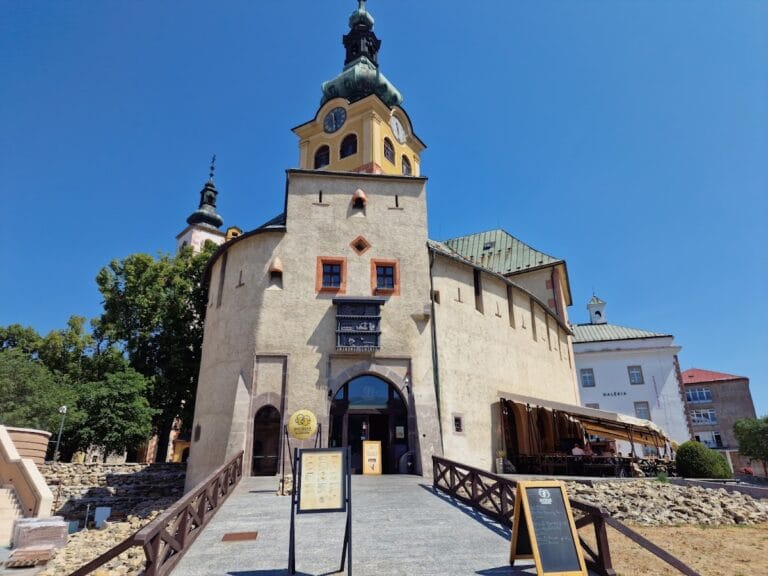
Ľupča Castle is a medieval Hungarian royal fortress in Slovakia, standing above Slovenská Ľupča in the upper Hron Valley. Built during the reign of King Béla IV, probably after the Mongol invasion of 1241–1242, it was completed in the second half of the thirteenth century and occupied a strategic position on the approach to the central Slovak mining towns.
Royal Hunting Territory and Castle Foundation
The surrounding region formed part of the Zvolen forest estate, a large royal woodland managed for hunting, forestry, and related royal interests. The territory was first mentioned in 1222 as a royal hunting area administered by a forest official and guarded by a small population of foresters and gamekeepers. The site itself appears in records in 1250 under the names Lypcsa or Liptza.
The castle was erected on an earlier hillfort during the period of extensive castle building that followed the Mongol invasion. A charter from 1255 referred to a settlement “near Lipche” and connected the castle with the foundation of Banská Bystrica. After the extinction of the Árpád dynasty, Doncs, a powerful official, probably took control of the fortress and developed it into substantially its present form.
Royal Residence in the Fourteenth Century
In 1306, King Charles Robert, also known as Charles I of Hungary, seized the castle from Demeter, the ispán or head official of Zvolen, and his nephew Doncs. The fortress then came under the control of Matthew Csák, a magnate who dominated large territories in the early fourteenth century, before Doncs recovered it in 1314.
Ľupča soon returned to royal control and became a favored royal residence. Charles Robert and his successor Louis the Great, or Louis I of Hungary, repeatedly used the area for hunting. In 1338, Charles Robert removed Doncs from the headship of the Zvolen forest estate and divided the territory into the counties of Zvolen, Liptov, Turiec, and Orava. The castle retained its importance because of its position near the routes leading toward the central Slovak mining towns.
Queens, Hussite Forces, and Royal Grants
In 1427, King Sigismund gave the castle to his wife, Barbara of Cilli, a queen from the influential House of Cilli. When Barbara opposed the succession of Albert of Habsburg, Sigismund had her arrested in 1437. She was released in 1438 but surrendered her estates, and Albert subsequently granted the castle to his wife, Elisabeth.
Elisabeth brought the Bohemian commander Jan Jiskra into Hungary in 1440 to defend the claims of her minor son, Ladislaus V, against the Polish king Władysław III. Jiskra briefly captured Ľupča Castle. His Hussite forces, followers of the religious reformer Jan Hus, strengthened the castles they occupied and used them as bases for raids in northern Hungary. Jiskra submitted to King Matthias Corvinus in 1462 and surrendered the castles still under his control.
Matthias granted Ľupča Castle to Damian and Peter Horváth in 1464, then to his treasurer John Ernuszt in 1470. In 1478, after confiscating it from Ernuszt for disloyalty, he gave it to his wife Beatrix. Following Matthias’s death in 1490, Beatrix transferred the castle to Bishop Urban Nagylucsei, also known as Dóczy, in an effort to secure support for her coronation. Dóczy instead supported Vladislaus II.
In 1517, members of the Nagylucsei family attacked Banská Bystrica during a dispute over property. The conflict led to a royal forfeiture case, which ended in 1523.
Renaissance Reconstruction and Early Modern Conflicts
In 1531, the pro-Ferdinand nobleman Christoph Turm seized the castle from the Dóczy family. Paul Rubigall, a wealthy nobleman from Banská Štiavnica, held it in pledge from 1567 and acquired it outright in 1572. Renaissance rebuilding followed from 1573.
The castle returned to the royal chamber in 1590, and Rudolf II granted it to Gaspar Triebel in 1600. Bocskai’s troops captured the fortress in 1605 during the uprising of 1604–1606, an anti-Habsburg revolt that ended with the Peace of Vienna in 1606.
George Széchy received the castle in 1621. Through his marriage to Széchy’s daughter Mária, it passed to Francis Wesselényi, the palatine of Hungary. A palatine was the kingdom’s highest-ranking royal official and acted as the king’s chief representative in major political and judicial matters. Wesselényi died at Ľupča Castle in 1667 while living in seclusion. After his death, the fortress was confiscated and administered by castellans.
Rebellions, Decline, and Institutional Use
The forces of Imre Thököly captured the castle in October 1678. Thököly led Kuruc forces, the contemporary term for anti-Habsburg insurgents, but the fortress was recovered after their defeat at the Battle of Svätý Kríž on 1 November. A plague epidemic affected the surrounding area in 1679.
After the Habsburg recovery of Buda and the liberation of Hungary, the castle chapel was remodeled in the Baroque style in 1692, and the castle became crown property. During the uprising led by Francis II Rákóczi from 1703 to 1711, Rákóczi’s forces captured the castle around 1703–1705 and assigned it to Miklós Bercsényi, Rákóczi’s leading military and political ally. Following the Kuruc defeat at Trenčín in 1708, Count Peyersberg occupied the fortress.
Ľupča gradually lost its administrative role. An eighteenth-century fire was followed by essential repairs, while administration moved to more comfortable manor houses. The castle was also used as a prison. After the abolition of serfdom, an orphanage was established there in 1873. The orphanage continued into the twentieth century, and a school and juvenile educational institution were later added.
Twentieth-Century Changes and Restoration
The castle was under Czech occupation from November 1918 to January 1919, a status confirmed by the Treaty of Trianon. It formed part of Czechoslovakia during the period between the Slovak state of 1939–1945 and the establishment of the independent Slovak Republic in 1993.
During the Slovak National Uprising, the 1944 armed revolt against the Slovak regime allied with Nazi Germany, the castle was used to intern detainees, including people accused of fascist affiliations and prisoners of war. This function was associated with the controversial wartime administration of Jozef Štaudinger. After the Second World War, the complex served successively as a vocational school, charity premises, and, during the 1980s, a site of the Socialist Youth Union. The regional heritage office administered it during the 1990s.
Železiarne Podbrezová acquired the castle in 2002 and undertook extensive reconstruction. Comprehensive restoration began in 2008, followed by support in 2015 for renovating the upper courtyard. The castle remains substantially intact and is also used as a social-care home.
Remains
Hilltop Fortress and Upper Courtyard
Ľupča Castle occupies the summit of a hill at about 440 metres above sea level, above Slovenská Ľupča on the right bank of the Hron River and at the southeastern edge of the Starohorské Mountains. Its preserved hilltop form includes an upper castle and courtyards arranged within the fortified complex. The upper courtyard retains two richly decorated stone portals, while the castle’s substantial survival reflects the rebuilding and repairs carried out over several centuries.
Deep Well and Escape Passage
A 62.5-metre-deep well in the upper castle was cut into the bedrock. An escape passage leads from the well beyond the castle walls, linking this essential water source with the defensive arrangements of the fortress.
Chapel and Interior Features
Castle Chapel
The upper floor contains the castle chapel, whose fresco decoration survives as part of the interior. The chapel was remodeled in the Baroque style in 1692, after the Habsburg recovery of Buda and the castle’s return to crown property. A sacristy adjoining the chapel has a richly painted wooden ceiling.
Lower Courtyard and Surviving Objects
Korvín Lime Tree
The lower courtyard contains the Korvín lime tree, a summer lime estimated to be more than 700 years old. It is regarded as one of the oldest lime trees in Central Europe and forms part of the surviving physical setting of the castle.
Statues from the Plague Column
The castle also preserves original statues dated 1725. They came from the plague column formerly erected in the square of Slovenská Ľupča, bringing these early eighteenth-century sculptures into the castle complex.