Hagios Spyridon, Rhodes: A Byzantine Greek Orthodox Church


Site at a Glance
- Rating
- 4.3
- Popularity
- Very Low
- Country
- Greece
- Primary era
- Early Modern
- Eras represented
- Classical, Medieval, Early Modern
- Civilizations
- Ancient Greek, Byzantine, Ottoman
- Site type
- Religious
- Remains
- Church
On this page6 sections
History
Hagios Spyridon is a medieval Byzantine church in Greece, located in the old walled city of Rhodes and belonging to the Greek Orthodox tradition. Its first church was built in the thirteenth century over the remains of an earlier Hellenistic three-aisled building. The Hellenistic period was the era of Greek cultural expansion that followed the conquests of Alexander the Great and preceded the Roman imperial period.
Early church and later reconstruction
The original dedication of the thirteenth-century church is uncertain. The building acquired its present form through construction in the sixteenth century over the earlier church, retaining parts of its earlier fabric and painted decoration. The dedication to Saint Spyridon, a Christian bishop and saint, was assigned during modern archaeological work by the Fourth Ephorate of Byzantine Antiquities, the state authority responsible for investigating and protecting Byzantine remains. This process was similar to that used for the churches of Hagios Artemios and Hagia Kyriaki.
Ottoman and modern history
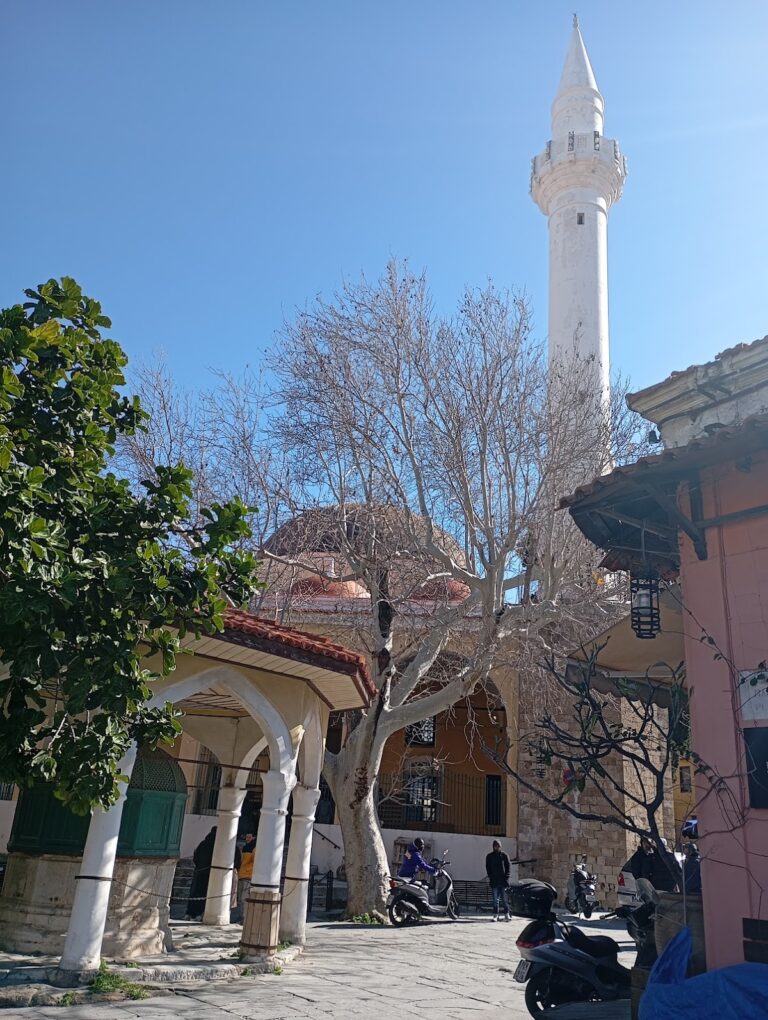
After the Ottoman conquest of Rhodes in 1522, the church was converted into a mosque called Kavakli Mescidi, or Kavakli Mosque. The name referred to the Turkish word for poplar. A minaret was added during this period. The building was later returned to Christian worship and now functions as an active Greek Orthodox church, administered through the Metropolis of Rhodes under the Ecumenical Patriarchate, the historic patriarchate based in Constantinople and the first-ranking see in the Eastern Orthodox communion.
Excavations and restoration carried out in 1984 revealed the earlier church and its construction over the Hellenistic remains. These investigations clarified the sequence of buildings beneath the present church and contributed to the modern identification of its dedication.
Remains
Church structure and earlier remains
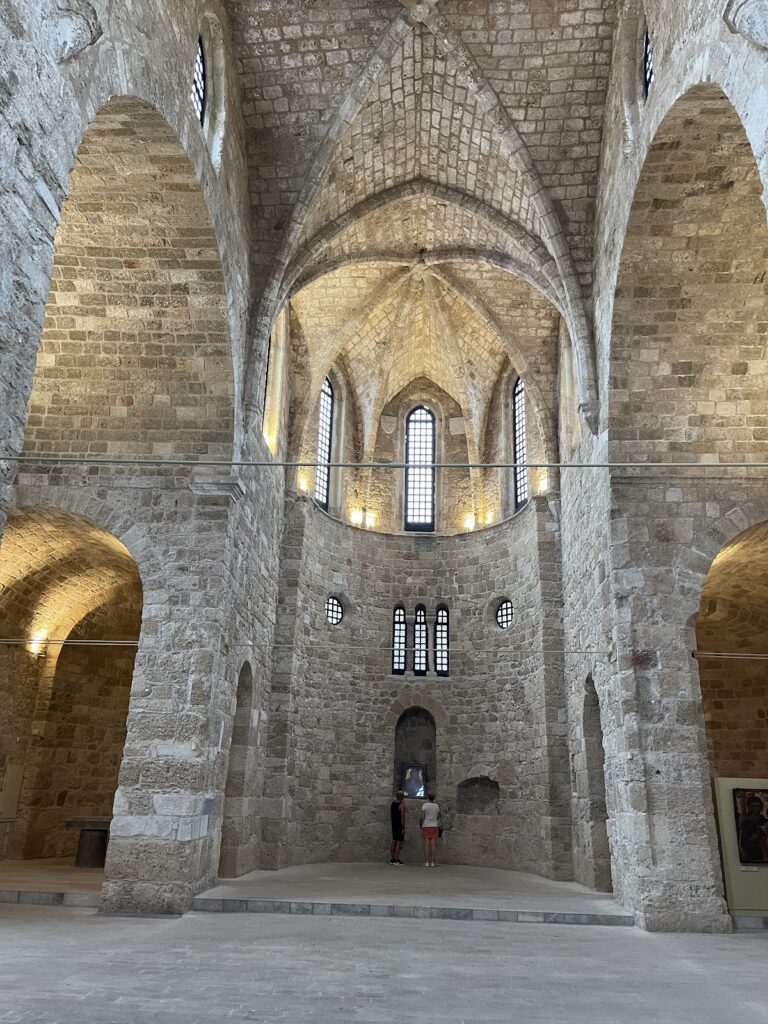
Hagios Spyridon is a Byzantine-style building constructed from brick, stone, and marble. It has one aisle, a central nave, and a dome. The thirteenth-century church had a semicircular sanctuary arch and a floor decorated with marble inlays and frescoes. The sixteenth-century construction retained the arch and portions of the earlier frescoes, preserving visible links between the two building phases.
Archaeological work beneath the present church exposed the earlier Hellenistic three-aisled building. The excavated remains establish that the thirteenth-century church was built over an older structure, while the later church continued to occupy the same historic location.
Paintings and burial crypt
Sixteenth-century wall paintings survive inside the church. Beneath the floor of the northern aisle lies a burial crypt decorated with frescoes. It contains the tombs of two church founders, a father and son. An early-sixteenth-century mural shows the Virgin Mary, the Mother of God, and Saint John the Baptist, with two praying male figures at either side. Inscriptions identify the men as Andreas and Georgios, who are considered probably to have been the father and son who financed part of the decoration and were buried in the crypt.
The murals were covered after the church became a mosque, a change that helped preserve the paintings. The minaret added at the church’s northwest corner during the Ottoman period survives intact.
Nearby sites