Monastery of Saint Roman near Ražanj: Serbian Orthodox Monastery


Site at a Glance
- Rating
- 4.9
- Popularity
- Medium
- Country
- Serbia
- Primary era
- Medieval
- Eras represented
- Medieval, Early Modern, Modern
- Civilizations
- Ottoman
- Site type
- Religious
- Remains
- Monastery
On this page8 sections
History
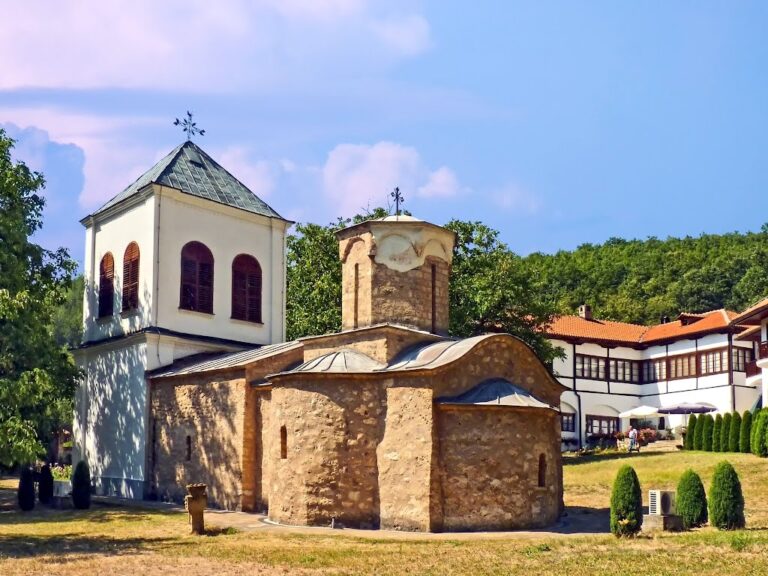
The Monastery of Saint Roman near Ražanj is a Serbian Orthodox monastery in Serbia, belonging to the Diocese of Niš, an administrative jurisdiction of the Serbian Orthodox Church. It is counted among the small group of Serbian monasteries founded before the Nemanjić period, the medieval dynasty established by Stefan Nemanja, and may date as early as the ninth century, although its exact foundation date is unknown. The monastery is dedicated to Saint Roman the Sinaite, while its church is dedicated to the Annunciation.
Early foundation and medieval references
Saint Roman the Sinaite is traditionally linked with the monastery’s beginnings. He is said to have arrived in the region in 888, lived there as a monk, and later been venerated as a saint. Two traditions describe his background differently. One identifies him as a Sinai monk who came to Serbia during the time of Prince Lazar, the fourteenth-century Serbian ruler associated with the period before the Ottoman conquest. The other presents him as a disciple of Saint Clement of Ohrid, a medieval Christian missionary, bishop, and scholar connected with the early Slavic Christian tradition.
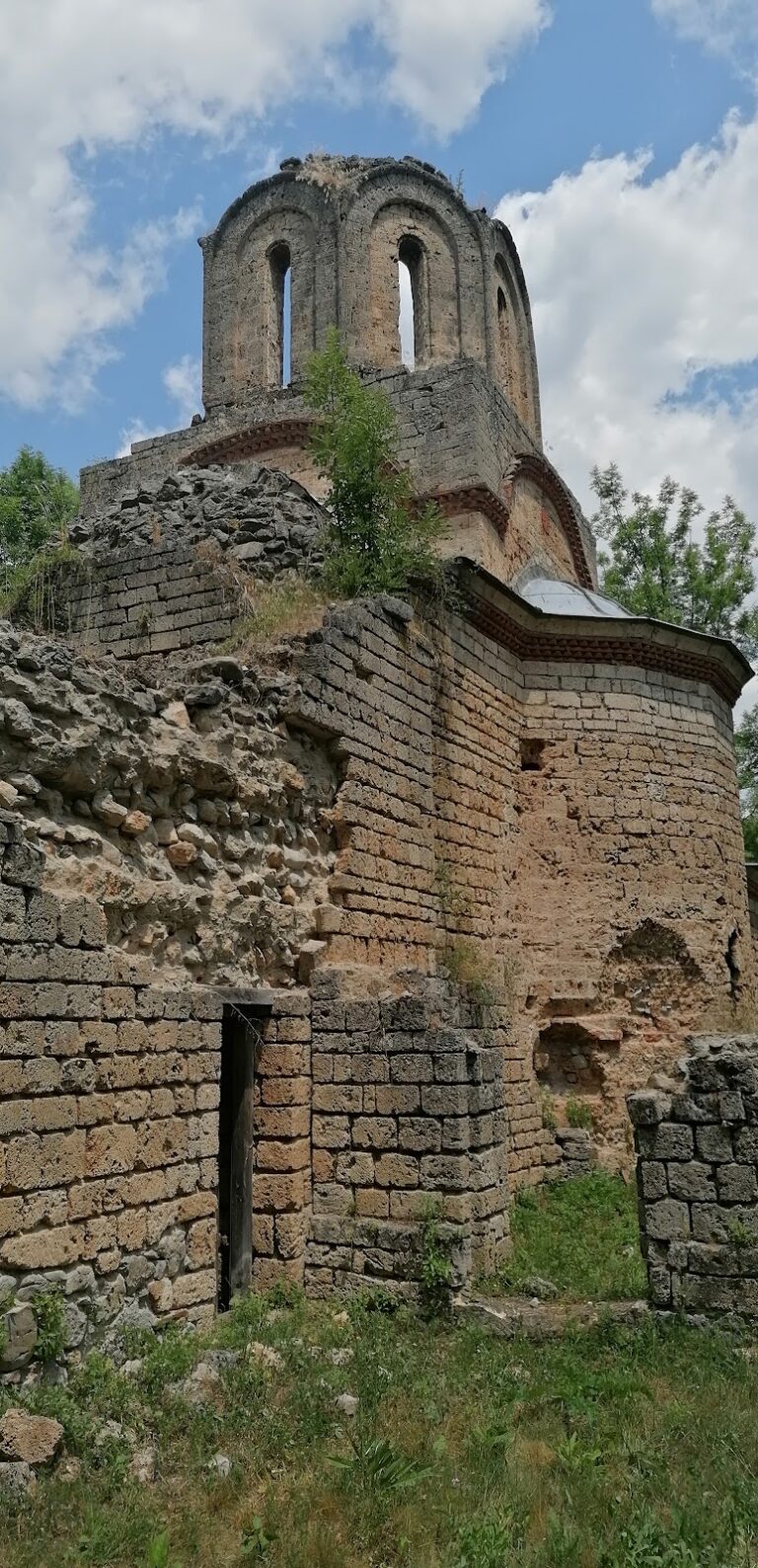
The monastery appears in a chrysobull issued by Emperor Basil II in 1011. A chrysobull was a formal imperial charter in the Byzantine tradition, and Basil II ruled the Byzantine Empire from 976 to 1025. The first official recorded mention of Saint Roman is dated 1498. The present complex is considered to stand on the foundations of an older religious centre associated with the time of Prince Lazar.
Rebuilding and religious life
The present church was built over older foundations by the manager of Prince Lazar’s stud farm. In 1795, Đorđe Pile renewed the church after recovering from an illness at the monastery. He secured a sultan’s decree permitting the restoration and paid 300 groschen for it. Further painted decoration was added in 1831. A monastery hospital also operated at Saint Roman, extending the institution’s religious role into the care of the sick.
War and remembrance
During the Serbian–Ottoman War of 1876–1878, an Ottoman shell fired from Đunis Hill struck the church’s south wall near the relics of Saint Roman. The shell reportedly did not explode. After its explosive charge was removed, it remained as a marker of the wartime impact.
Nikolay Raevsky was killed in 1876 while serving as a volunteer in the war. He was initially buried within the monastery precinct, but his body was transferred several days later to Belgrade and then to Russia, where he received a military funeral. His original grave and a memorial remain at Saint Roman. Raevsky is also associated with Count Vronsky, the fictional character in Leo Tolstoy’s Anna Karenina.
Recent community and legal status
Saint Roman was a women’s monastery from 1960 and was cared for by nuns. On 4 August 2012, it became a men’s monastery again with the blessing of Bishop Jovan of Niš. Its current activities include producing goods used to equip clergy and Serbian Orthodox churches. The monastery is classified as a Serbian immovable cultural property and a Monument of Culture of Great Importance, with protection administered by the cultural-heritage authorities.
Remains
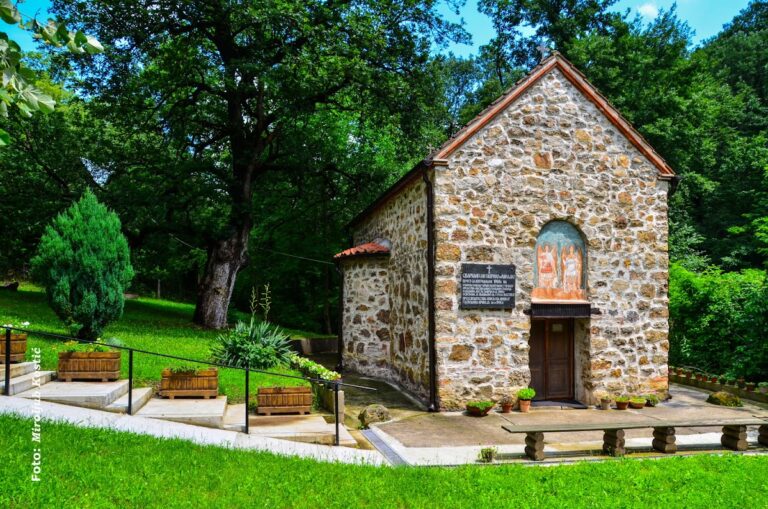
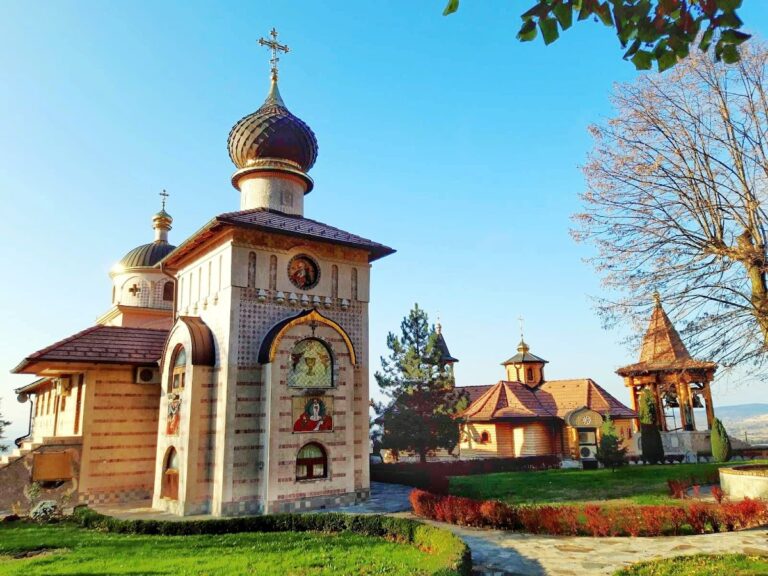
The monastery stands on the right bank of the South Morava, in the municipality of Ražanj, near Praskovče and Đunis. A road linking Ražanj and Kruševac passes beside the complex. The church occupies the site of an earlier structure and incorporates its foundations. The wider precinct includes the church, monastic residential buildings known as konaks, and the memorial area associated with Nikolay Raevsky.
Church and painted decoration
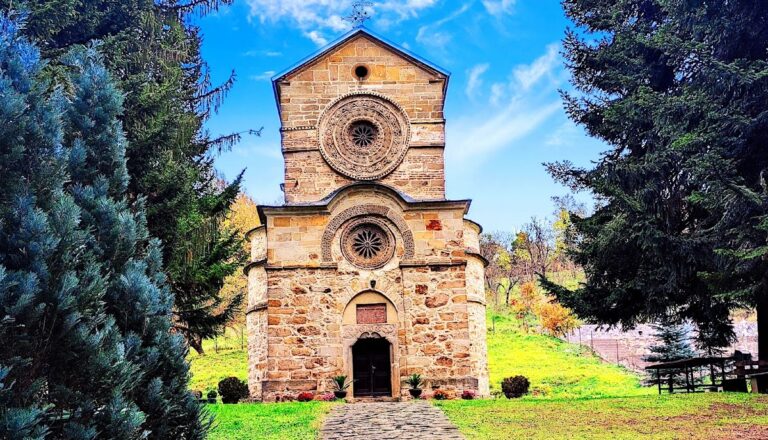
The church contains an iconostasis, the screen of icons separating the sanctuary from the main worship space in an Eastern Orthodox church. Frescoes from the 1795 renewal survive in the choir areas and beneath the domes, while additional fresco painting was carried out in 1831. Earlier paintings are thought to remain beneath a layer of lime. The building is described as being in good condition and continues to serve as the centre of the active monastery.
Relics and memorial remains
The tomb and relics of Saint Roman the Sinaite are kept inside the church. He is venerated there as a wonderworker and healer. The monastery grounds also preserve Nikolay Raevsky’s original grave and memorial. On the church’s south wall, the shell fired during the 1876–1878 war remains at the place where it struck, providing a physical reminder of the conflict.
Nearby sites