Lešje Monastery: A Serbian Orthodox Monastic and Cultural Center


Site at a Glance
- Rating
- 4.9
- Popularity
- Medium
- Country
- Serbia
- Primary era
- Modern
- Eras represented
- Medieval, Modern
- Civilizations
- Serbian
- Site type
- Religious
- Remains
- Monastery
On this page13 sections
History
Lešje Monastery is a Serbian Orthodox monastery in Serbia, above the village of Lešje on Mount Baba. Its medieval church, associated with the Serbian Orthodox tradition and dated to the mid-fourteenth century, has a triconch plan influenced by Athonite monastic architecture and is regarded as the oldest church of this type in the Pomoravlje region. Dedicated to the Protection of the Mother of God, a major Marian feast and dedication in Orthodox Christianity, the monastery is affiliated with the Eparchy of Kruševac.
Foundation and connection with Hilandar
The earliest beginnings of Lešje Monastery remain uncertain. Written records state that the župan Vukoslav and his sons Crep and Držman founded the monastic complex and donated it, together with its estate, to Hilandar Monastery on Mount Athos in 1360. Hilandar is a major Serbian Orthodox monastery on the monastic peninsula of Mount Athos in northern Greece. Through this donation, Lešje became a dependency, or estate administered by a larger monastery.
The estate and monastery later became neglected and fell into what the records describe as a final desolation. Crep and Držman, whose monastic name was Dionysius, appealed to Emperor Uroš and recovered their patrimony. After Dionysius died between 1375 and 1379 or 1380, Hilandar attempted to regain the former possession. Patriarch Ephrem ruled in Crep’s favor, and his decision was confirmed by his successor, Patriarch Spiridon, and finally by Prince Lazar.
Political turmoil followed the collapse of the Serbian state at Kosovo, and the estate apparently returned to Hilandar. Crep’s son Venedikt then brought a new legal case. In 1411, Despot Stefan ruled in his favor with the counsel of the patriarch, a council of metropolitans, abbots, and nobles. Lešje thereby ceased to be a Hilandar dependency, although the formal dispute was concluded only in that year.
Lešje in the fifteenth century
Despite the property disputes and Ottoman incursions, Lešje remained an important spiritual center from 1360 to 1456. The Ottoman capture of the nearby fortress of Petrus in 1413 formed part of the unsettled political conditions surrounding the monastery.
Venedikt served as abbot of Lešje for a very long period. In 1452, Despot Đurađ Branković appointed the “abbot of Leštije, Kir Venedikt” to a diplomatic delegation that sought permission from the sultan to transfer the relics of the apostle and evangelist Luke to Serbia. Venedikt escorted the relics from Rogos to Smederevo in early 1453. They were carried ceremonially through the Despotate and may have remained briefly at Lešje.
Under Venedikt, the monastery was a spiritual and cultural center with active connections to Mount Athos. In 1426, while Venedikt was on Mount Athos, the monk Jakov translated a work by John Chrysostom for him. Venedikt himself translated another Greek text “to the glory of God and the Most Pure Mother of God of Leštije.”
Venedikt later left Lešje after becoming metropolitan of Gračanica and Novo Brdo. Following the fall of Novo Brdo, Despot Đurađ Branković granted him lifetime administration of Vraćevšnica Monastery in 1456. After Smederevo fell in 1459, Venedikt withdrew to Saint Paul’s Monastery on Mount Athos, where he died and was buried.
Hermits and manuscript culture
Medieval records called the surrounding area the wilderness of Petrus and the Lešje wilderness. The latter name refers to hermits who lived in the area, particularly during the late fourteenth and fifteenth centuries and possibly earlier. They withdrew to nearby hermitages and came to the monastery on designated days for the Divine Liturgy.
A panegyric states that the hieromonk Jovan wrote in the Lešje wilderness at the request of Despot Stefan Lazarević. A hieromonk is a monk who is also an ordained priest. Jovan belonged to the Sinai monastic tradition, associated with the ascetic practices of Mount Sinai, and Lešje had a scriptorium, a place where manuscripts were written or copied by hand. Jovan later moved to Stjenik Monastery and continued his ascetic life in a cave. After his martyrdom in 1462, he was venerated as a venerable martyr, and his miracle-working relics were kept at Stjenik.
Crep also had a daughter, the nun Anisuja, who died in 1426 or 1427. A breviary from Great Lavra on Mount Athos identifies her as the daughter of the blessed Crep and states that she practiced monastic life in Serbia. The records do not establish whether she lived at Lešje or at another Serbian convent.
Modern reconstruction and protection
The monastery ruins are protected by the Republic of Serbia as a Monument of Culture of Great Importance and form part of the protected Petrus cultural and historical area. Lešje is now an active women’s monastery. At the beginning of the twenty-first century, a new church was built over the foundations of the medieval church, and reconstruction of the church and monastery complex began in 2004.
Remains
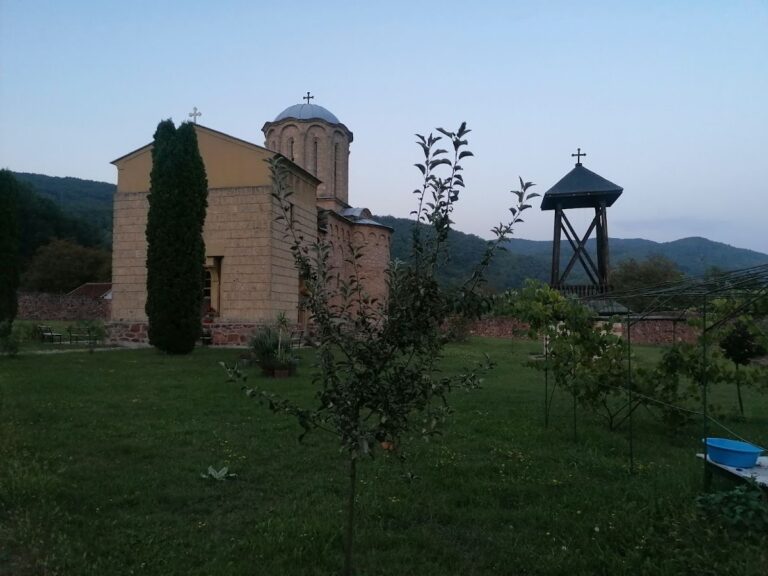
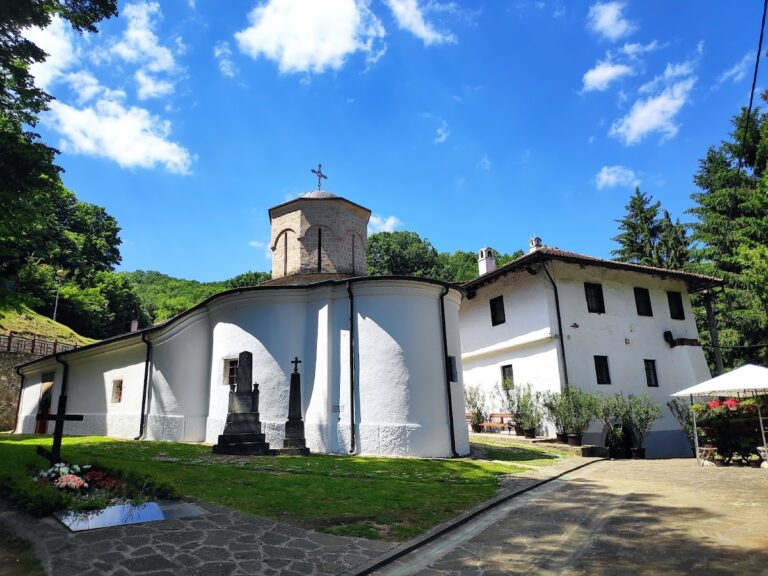
Lešje Monastery occupies approximately half a hectare on a small plateau on the slopes of Mount Baba. Steep rocks protect its eastern side. The complex combines the foundations of the medieval church with a new church, monastic corridors, a landscaped garden, water sources, a bell tower, and other features associated with its present religious use.
Churches and medieval foundations
Medieval triconch church
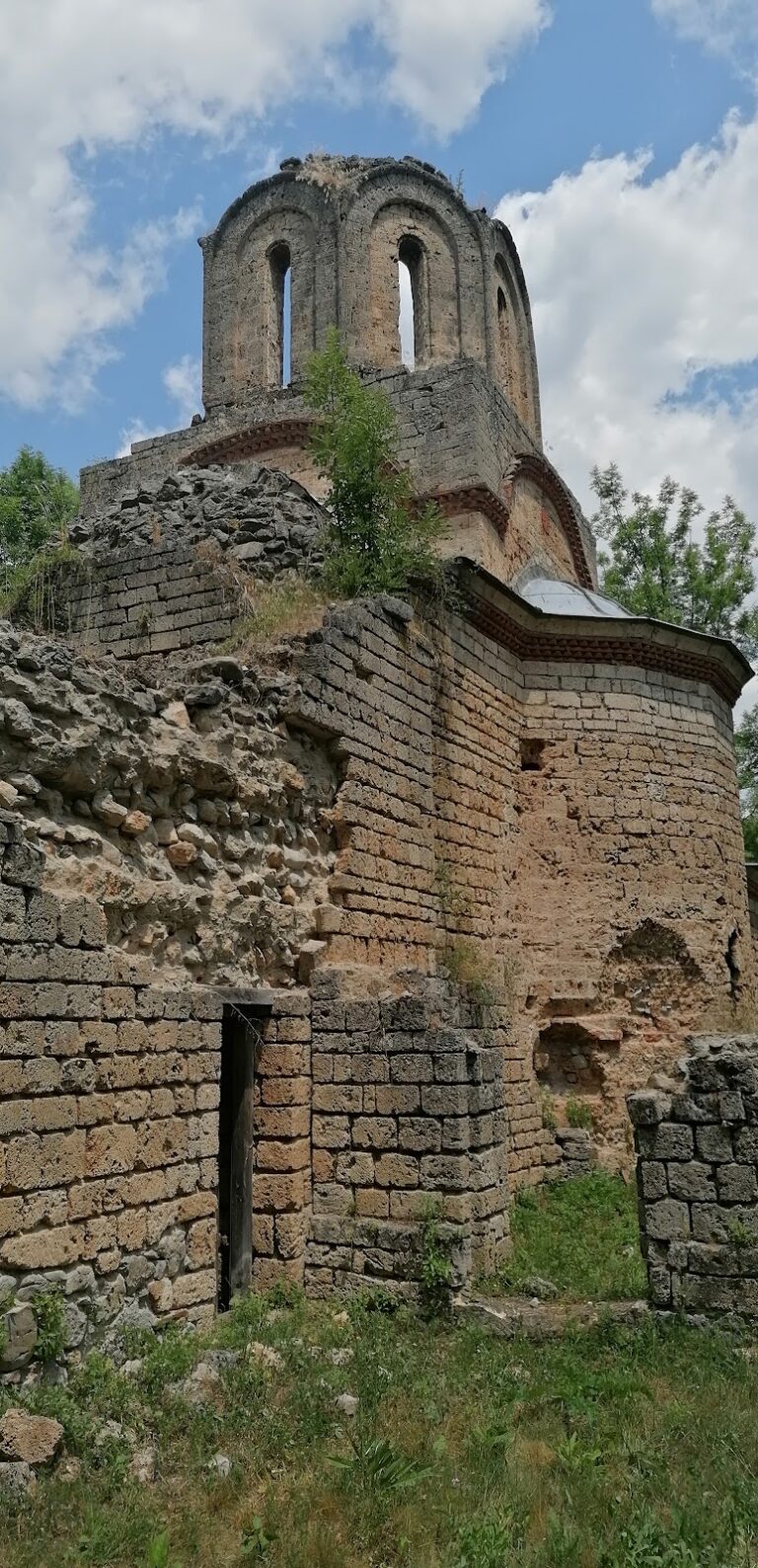
The medieval church has a triconch, or trefoil-shaped, plan with a relatively small nave. It measures 11.6 metres in length and 6 metres in width. Built of tufa, it had walls approximately 0.8 metres thick. Before restoration began in 2004, the surviving walls stood to about 0.5 metres.
The church reflects the influence of Athonite monastic architecture and represents an early anticipation of the Morava school, a Serbian architectural tradition that developed during the last third of the fourteenth century and is known for centralized or triconch church plans and elaborate stone decoration. The prothesis, the chapel where Eucharistic offerings are prepared, and the diaconicon, the service chamber for liturgical objects and vestments, each had entrances giving direct access to the altar area.
New church
The present church is dedicated to the Protection of the Mother of God and was erected on the foundations of the medieval triconch church. It has an added narthex, or entrance hall. Its construction forms part of the rebuilding of the church and monastery complex that began in 2004.
Monastic grounds and associated structures
Tower of Pavle Orlović
A structure known as the Tower of Pavle Orlović stands on the foundations of a medieval tower. It is now used as a bell tower and contains ten bells, combining the location of the earlier tower with a continuing monastic function.
Garden and water sources
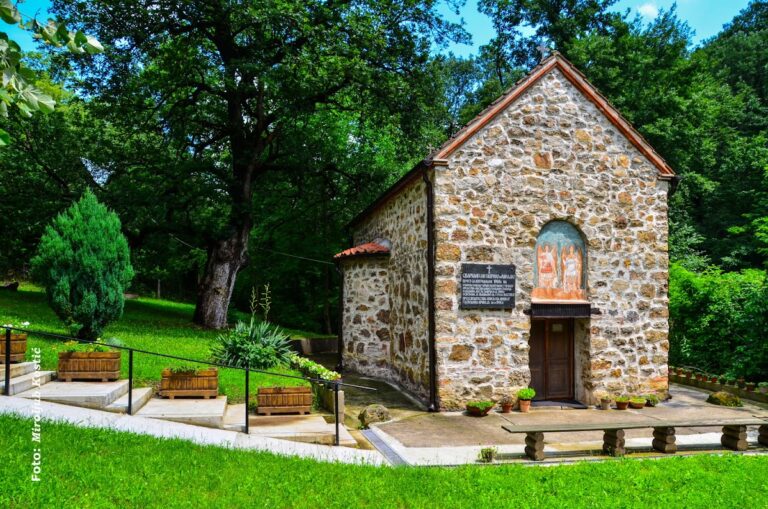
The complex includes monastic corridors and a landscaped area called the Garden of the Mother of God. Two springs have a recorded temperature of 12 degrees Celsius, and their water is used in baptismal rites. The garden is also associated with a flight of steps and a sculpture of the Mother of God.
Bridge, pond, and relics
A bridge and a pond form part of the monastery complex alongside the garden and other grounds. The surrounding area includes views toward the village of Lešje and its basin. The monastery also contains the relics of Flavian of Carthage, a third-century hieromartyr.
Nearby sites