Schloss Nudersdorf: An Eighteenth-Century Estate and Civic Building


Site at a Glance
- Rating
- 4.3
- Popularity
- Very Low
- Country
- Germany
- Primary era
- Early Modern
- Eras represented
- Early Modern
- Civilizations
- Electorate of Saxony, Holy Roman Empire
- Site type
- Domestic
- Remains
- Manor House
On this page10 sections
History
Schloss Nudersdorf is an eighteenth-century estate building in Nudersdorf, now a district of Lutherstadt Wittenberg in Germany. Its history began with the feudal transfer of Nudersdorf village and its rights in 1548, and the buildings later became a manor, bathing establishment, school, administrative seat, and community facility.
Formation of the estate
On 20 January 1548, Chancellor Gregorius Brück received Nudersdorf village, its rights, and the right to hunt hares within its boundaries as a fief from Elector Maurice of Saxony. Maurice renewed an earlier grant made by Duke Frederick of Saxony after Brück had acquired the estates from Bernhard Brambach, a citizen of Wittenberg. An enfeoffment was the formal granting of rights or property by a superior lord to a feudal holder.
The 1548 grant did not yet describe Nudersdorf as a knightly estate in the strict sense. Brück subsequently established the estate, which included a paper mill. His son, also named Gregor Brück, sold the mill to Veit Winsheim of Wittenberg in 1578. By 1592, members of the von Leipzig family held Nudersdorf, and Wilhelm Löser acquired it from the heirs of Friedrich von Leipzig in 1622.
Rebuilding and the Löser family
The estate was reportedly demolished during the Thirty Years’ War, the seventeenth-century conflict that devastated much of central Europe. In 1654, Ludomilla Löser undertook to restore Nudersdorf and transfer it to Georg Heinrich Löser of Kropstädt. From then onward, ownership of Nudersdorf and Kropstädt was linked, while members of the Löser family regularly renewed their feudal grants at the Dresden feudal court until the beginning of the eighteenth century.
After Georg Heinrich Löser died, his sons Wilhelm Heinrich, Eustachius, and Wolf Adam renewed the grant. Their cousin Magnus Löser, who died in 1693, also held a share of the Nudersdorf estate. Wilhelm Heinrich became sole owner in 1704 after renewing the buildings in the form largely preserved today. He died without children in 1709, and his brothers inherited the estate. Because Wolf Adam lived abroad, Eustachius became Nudersdorf’s hereditary and judicial lord, holding inherited authority over the estate and jurisdiction over its dependants.
The Leyser period
After Eustachius Löser died on 23 January 1732, his sons Jost Heinrich and Eustachius Friedrich von Löser inherited Nudersdorf. Both were serving in the military, so they sold the estate in 1738 to Augustin Leyser, a Wittenberg court councillor and full professor.
Leyser died in Wittenberg on 4 May 1752 without living sons and, according to his wishes, was buried at Nudersdorf on 9 May. The estate passed to Friedrich Wilhelm von Leyser, a Brunswick-Lüneburg appellate councillor in Celle. After his death on 15 July 1766, his sons Friedrich Wilhelm and Georg Ludwig inherited Nudersdorf. Georg Ludwig transferred his share to his elder brother in 1767.
Friedrich Wilhelm von Leyser died unmarried in Celle on 3 April 1784 and left the estate to his nephew August Wilhelm Friedrich von Leyser, who had been born in 1771. The younger Leyser served as a cavalry officer in the Garde du Corps. In 1803, he obtained the conversion of Nudersdorf from a male fief into an inheritable estate. An allodial estate, unlike a feudal fief, was held as free property.
Nineteenth-century ownership and the bathing establishment
By 1815, August Wilhelm Friedrich von Leyser was a Saxon major general and cavalry brigadier. After Nudersdorf had become part of the Kingdom of Prussia, he sold the knightly estate to Alexander Ferdinand von Erdmannsdorf, the Prussian chief forestry official.
On 18 November 1840, the allodial knightly estate was auctioned to Christian Meyer of Wiesenburg, an agricultural inspector who bought it on behalf of Curt Friedrich Gottlob von Watzdorf of Wiesenburg, a Saxon chamberlain and owner of knightly estates. After Watzdorf died on 14 April 1848, his widow and children inherited Nudersdorf and sold it on 4 April 1849 to Johann Friedrich Pfau, an official from Lobstädt near Borna who later lived in Anger near Leipzig.
Pfau transferred the estate on 30 September 1849 to the brothers Gustav and Karl Wilhelm Luther, both medical doctors. After a sulfur-bearing spring was discovered, enclosed, and connected to a bathing house by pipes, the brothers established a bathing establishment at Nudersdorf. The bath became well known and attendance increased, but industrial growth in Nudersdorf, including coal and clay extraction, craft production, and trade, eventually brought the bathing business to an end.
Twentieth-century and later uses
Before 1917, the Schloss was occupied by Count Schleißner and later by Count von Limburg-Stirnum. A steward was installed in the building in 1917.
Since 1945, Schloss Nudersdorf has served educational purposes. It first housed the Nudersdorf village school and later the ten-grade Nudersdorf Polytechnic Secondary School, a standardized general-education secondary school type used in the German Democratic Republic.
In 1992, the Schloss became the seat of the South Fläming administrative association, and Nudersdorf Primary School for grades 1 to 4 was incorporated into the building. The building and forecourt were renovated during this period. Nudersdorf was incorporated into Lutherstadt Wittenberg in 2005, ending the Schloss’s role as the administrative association’s seat, although the local citizens’ office remained there. In 2006, the primary school moved to the second floor and the Nudersdorf youth club moved into the south wing. A historical Schloss festival is held each summer.
Remains
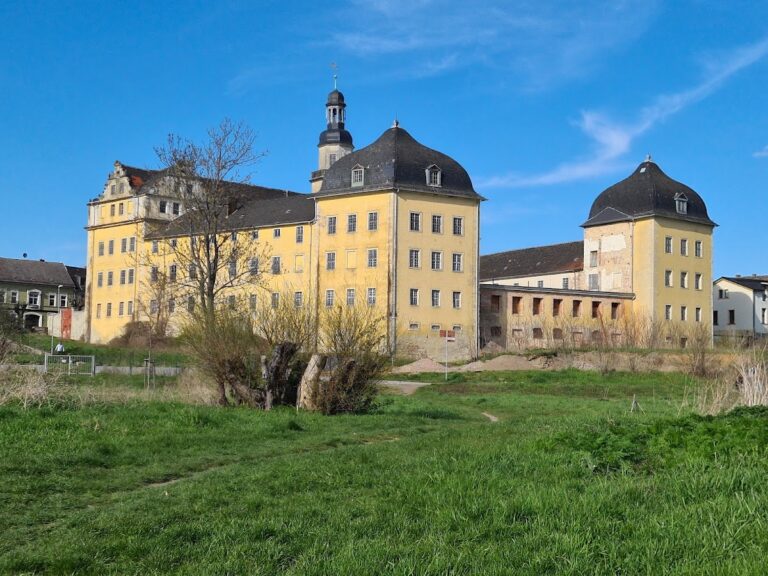
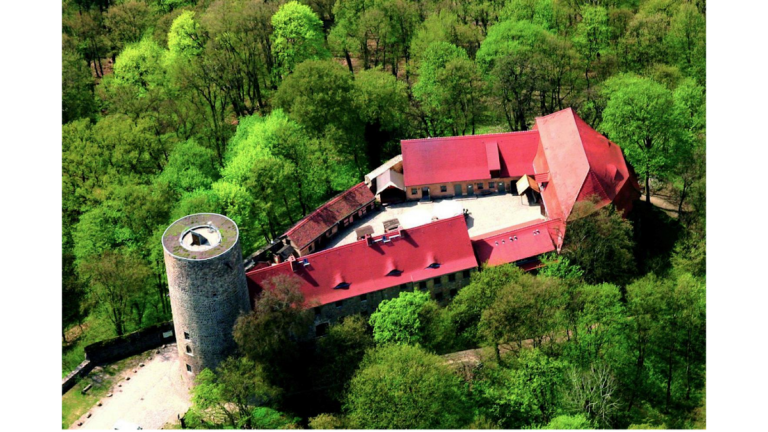
Schloss Nudersdorf survives as an eighteenth-century estate building whose outer form reflects the renewal carried out under Wilhelm Heinrich Löser. The estate established after the 1548 feudal grant consisted of two wings meeting at a right angle. A coat-of-arms stone dated 1703 is associated with the rebuilding. The forecourt and building were renovated after the administrative association took up residence in 1992.
Estate buildings
The surviving estate form is organized around the two wings meeting at a right angle. The 1703 coat-of-arms stone provides a dated physical connection with the renewal of the buildings under Wilhelm Heinrich Löser. The property’s earlier economic organization included a paper mill, which belonged to the estate before its sale in 1578.
Bathing establishment
The nineteenth-century bathing establishment comprised a bathing house supplied by pipes from an enclosed sulfur-bearing spring. The spring and its connection to the building formed the physical basis of the bath created by Gustav and Karl Wilhelm Luther. Its use ended as industrial activity in Nudersdorf expanded.
Later adapted spaces
The Schloss includes a south wing, used by the Nudersdorf youth club from 2006, and a second floor to which the primary school moved in the same year. These adaptations form part of the building’s later educational and community use.
Nearby sites