Oria Castle: A Frankish Fortress in Greece


Site at a Glance
- Rating
- 4.7
- Popularity
- Very Low
- Country
- Greece
- Primary era
- Medieval
- Eras represented
- Medieval
- Civilizations
- Crusader, Principality of Achaea
- Site type
- Military
- Remains
- Castle
On this page7 sections
History
Oria Castle, also called Estella Castle, is a Frankish fortress in Greece built in 1256 by William II Villehardouin, prince of Achaea. It occupied a strategic position on the only road linking Argolis with Laconia and connecting the coastal and central districts of Cynuria.
Frankish foundation
William II established the fortress in the mountains to subdue the Tsakonians, a distinctive population of the eastern Peloponnese associated with the mountainous and coastal districts of Cynuria. The campaign particularly concerned communities connected with Sitaina, Kastanitsa, and Prastos. The castle is generally identified with the fortress of Estella mentioned in the Aragonese Chronicle of the Morea, a medieval narrative about the Frankish principality of Achaea and other powers in the Peloponnese. The name Estella is understood as a translation of the Greek name Astros.
Byzantine and Ottoman transitions
After the successes of Andronikos Asen in 1320, the castle became part of the hinterland of the Despotate of Mystras, a Byzantine Greek state centered on Mystras in the southern Peloponnese. Venetian forces from Nafplio captured it in 1407. The Melissenos family, a Byzantine Greek aristocratic house involved in regional political and military affairs, held the castle in 1423. It was listed in the Magno catalogue, a fifteenth-century register of fortresses and territorial possessions, in 1463, before the Ottomans captured it in 1467.
The Oria tradition
During Ottoman rule, the earlier name Estella faded from use. The castle instead became associated with the widespread legend of a beautiful noblewoman called Oria, or the Beautiful Lady. In the Cynurian version, she owned the fortress, which the Ottomans took through deception after a twelve-year siege. The story ends in different ways: Oria either took her own life or was thrown from the cliffs by her father. The castle is now a historical ruin about 20 kilometres west of Astros, between Agios Ioannis and Agios Petros and approximately 2 kilometres from Agios Ioannis.
Remains
The fortress occupies a rocky hill shaped like a natural pyramid in the southwestern part of the Xerokambi plateau. Its eastern side ends at the Lepida waterfalls, while the western side provides a gentler approach. Two lines of fortification enclosed the hill, with the outer defenses extending across the more accessible western slope.
Outer enclosure and settlement
The outer wall consists of dry-stone masonry, with stones laid without lime mortar. It enclosed a large settlement containing more than 150 small dwellings. Each house measured approximately 4 by 8 metres, showing that the outer enclosure protected a substantial hilltop community rather than only a small military garrison.
Upper enclosure and summit
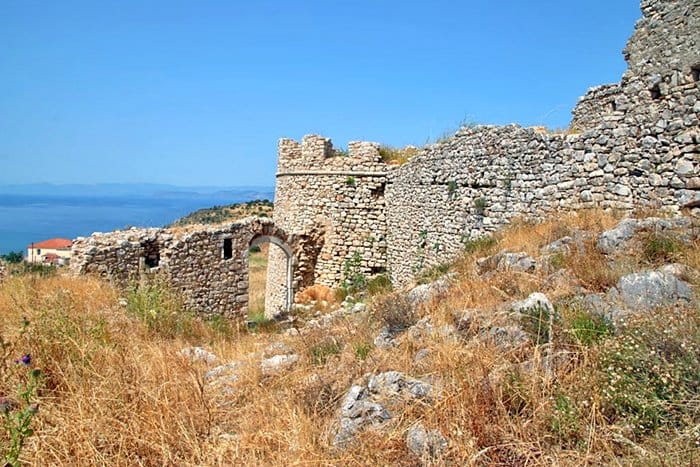
A second wall rises about 30 metres below the summit. Built from stone bonded with lime mortar, it survives for approximately 100 metres and reaches about 3 metres in height. Its narrow entrance widens inward, creating room for four or five defenders, and leads onto the broad plateau at the top of the hill.
The summit plateau retains the foundations of three dwellings and a square tower standing to a height of 3 metres. Together with the two defensive lines, these remains show the arrangement of the fortress from its outer settlement to its more strongly enclosed summit.