Kilberry Castle: A Scottish Country House and Tower House


Site at a Glance
- Rating
- 4.3
- Popularity
- Very Low
- Country
- United Kingdom
- Primary era
- Modern
- External website
- Open
- Eras represented
- Medieval, Early Modern, Modern
- Civilizations
- British, Kingdom of Scotland
- Site type
- Domestic
- Remains
- Castle
On this page8 sections
History
Kilberry Castle is a historic country house in Kilberry, United Kingdom, on the shores of the Sound of Jura. A branch of Clan Campbell, a major Scottish Highland kindred with estates and political influence in Argyll, built its original tower house in 1497. The site later developed through siege, rebuilding, and extension into a country house with a Scottish baronial character.
Medieval origins and Campbell occupation
The castle began as a fortified residence, combining domestic accommodation with defensive features in a tall masonry building. The MacMurachies are understood to have held it under the Lords of the Isles, the medieval rulers of a powerful Gaelic lordship in the Scottish Hebrides and western Highlands. Ownership later passed to the Earls of Argyll, while the Campbells of Kilberry occupied the castle from the early sixteenth century.
Royalist forces besieged Kilberry Castle between 1643 and 1645 during the civil war. The conflict formed part of the wider struggle between royalist and opposing forces in seventeenth-century Scotland, and the siege became one of the major military episodes in the castle’s history.
Rebuilding and expansion
Dugald Campbell, 6th of Kilberry, commissioned the Campbell mausoleum in 1733. The castle was accidentally burned in 1772 or 1773, but it continued to be occupied afterward. In 1844, John Campbell, 5th of Knockbury and 9th of Kilberry, commissioned a major rebuilding with David Bryce as architect.
John Campbell, 6th of Knockbury and 10th of Kilberry, commissioned further extensions in 1873. Charles Kinnear of Edinburgh designed the work, which was carried out by Harris, the builder of St Andrew’s. These changes enlarged the rebuilt house while retaining the earlier castle within the later structure.
Ownership and preservation
After Lieutenant-Colonel John Campbell, 7th of Knockbury and 11th of Kilberry, died in 1928, the house was offered for sale with an estate described as covering 7,000 acres. His daughter Marion Campbell, who later became a noted archaeologist, inherited the Kilberry Estate at the age of eight. An older cousin acquired the estate, but Marion Campbell regained possession when she turned eighteen.
Kilberry Castle was advertised for sale in 2021 and was subsequently reintegrated into the Kilberry Estate. The castle and other historic estate buildings are undergoing restoration intended to return the house to use as a private residence for the current family owners. The building is protected as a Category B listed building, a Scottish designation generally applied to structures of regional or more than local importance, granted on 20 July 1971.
Remains
Castle and country house
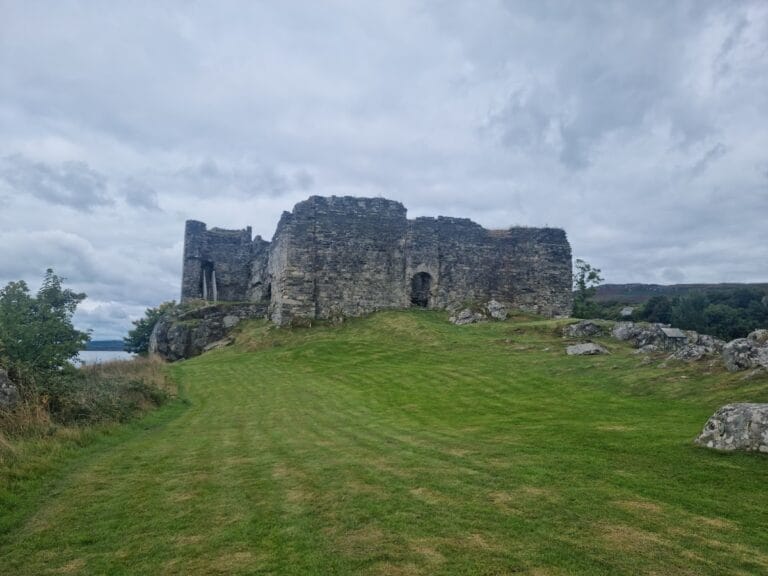
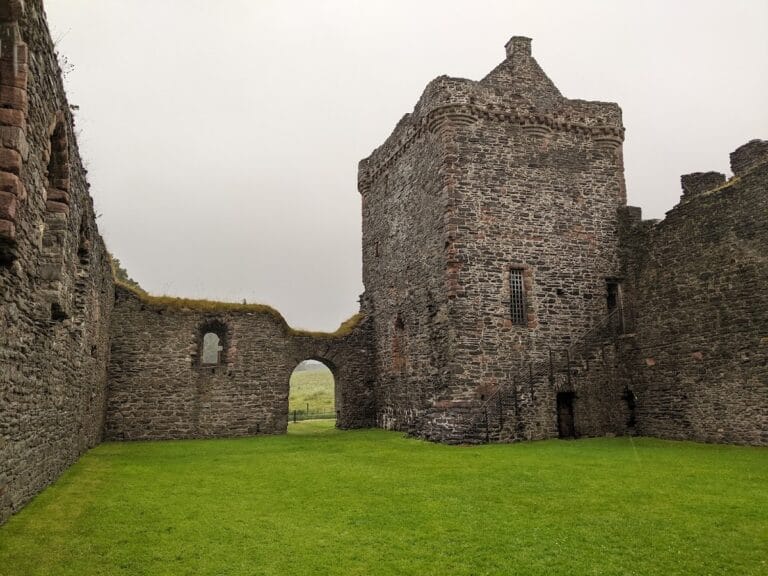
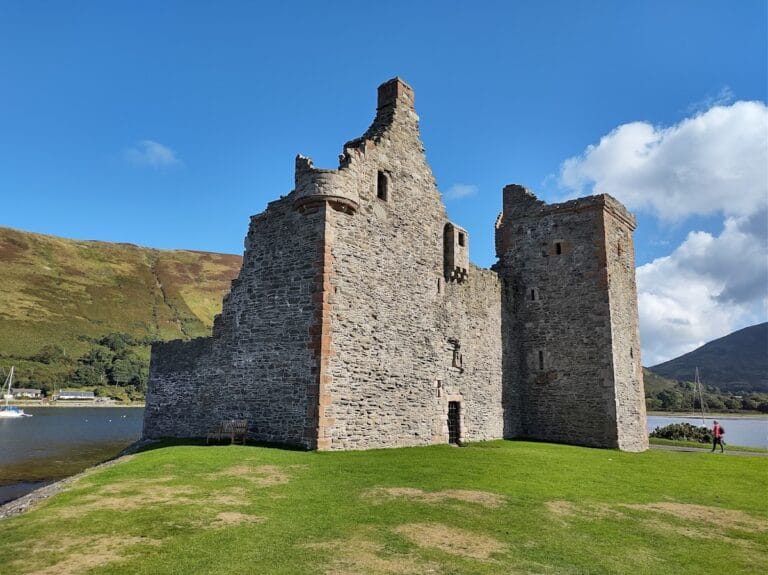
The surviving house incorporates the ruins of the original tower house, whose plan was L-shaped. Its medieval remains form part of the country house created during the 1844 rebuilding. The present structure has a Scottish baronial architectural character, a later style that revived and embellished forms associated with Scotland’s medieval castles and fortified houses. Extensions added in 1873 enlarged the rebuilt country house, preserving the relationship between the earlier tower and the later residence.
Campbell mausoleum
The Campbell mausoleum, built in 1733, forms part of the castle complex. A mausoleum is a building or chamber used for burial, and this structure was associated with the Campbell family.
Carved stones
A purpose-built shelter on the castle grounds displays a group of carved stones under the care of Historic Scotland, the public body responsible for the care and interpretation of many historic sites and monuments in Scotland. The collection includes cross stones and medieval grave slabs originally taken from Kilberry’s medieval parish church, which was destroyed in the seventeenth century.
Nearby sites