House of Scientists (St. Petersburg): Scientific and Cultural Association


Site at a Glance
- Rating
- 4.8
- Popularity
- Medium
- Country
- Russia
- Primary era
- Modern
- External website
- Open
- Eras represented
- Modern
- Civilizations
- Russian
- Site type
- Domestic
- Remains
- Palace
On this page6 sections
History
The House of Scientists (St. Petersburg) is a scientific and cultural association in Saint Petersburg, Russia, established on 31 January 1920 in the former palace of Grand Duke Vladimir Alexandrovich. It was created by decision of the Petrograd Soviet on the initiative of the Petrograd Commission for the Improvement of the Life of Scientists, headed by the writer and public intellectual Maxim Gorky. It became the first House of Scientists established in Russia and is described as the oldest creative club for the scientific intelligentsia in the former Soviet Union.
Establishment and early activities
During the 1920s and 1930s, the House of Scientists developed as a regular venue for scientific and educational work. Scientific presentations took place on Saturdays, while public lectures were held on Thursdays. Debates and concerts formed part of its wider program. Scientific sections began operating in the early 1930s, when the institution also formed its first public council, chaired by the botanist and geneticist Nikolai Vavilov.
The House of Scientists also attracted prominent international visitors. Herbert Wells visited in October 1920 and later referred to the experience in his book Russia in the Shadows. In 1932, the institution was named after Gorky. Its formal name is also given as the House of Scientists named after M. Gorky of the Russian Academy of Sciences, Russia’s national academy of sciences.
Wartime service
During the Second World War, the House of Scientists continued to function as a public and cultural center of Leningrad. In early 1942, a 50-bed inpatient facility for people suffering from starvation dystrophy was organized inside the building. A bureau for scientific and technical assistance to the city and the front also operated there under assignments from the Leningrad Front headquarters.
Staff members and members of the House gave lectures and reports in military units, on ships, and in hospitals. These activities allowed the institution to continue its educational and scientific role while responding to the immediate needs of the wartime city.
Continuing institutional role
The House of Scientists has operated as an association for employees of scientific institutions and higher education. Its scientific sections have covered fundamental and applied research, with approximately 40 sections in 1990 and 28 in 2011. They also worked with scientific and technical societies and with collectives at industrial enterprises.
The institution is governed by a public council that coordinates 13 public commissions. Its program includes lectures, round tables, discussions of current scientific and technical issues, and meetings with enterprise leaders. Concerts, art exhibitions, and presentations continue the cultural work that has accompanied its scientific activities.
Remains
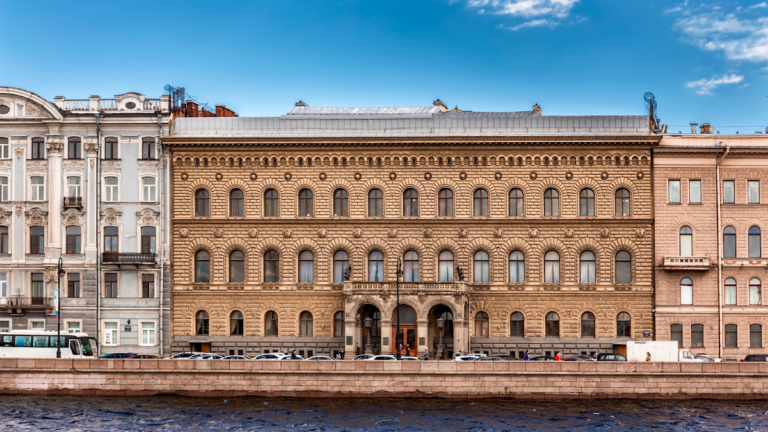
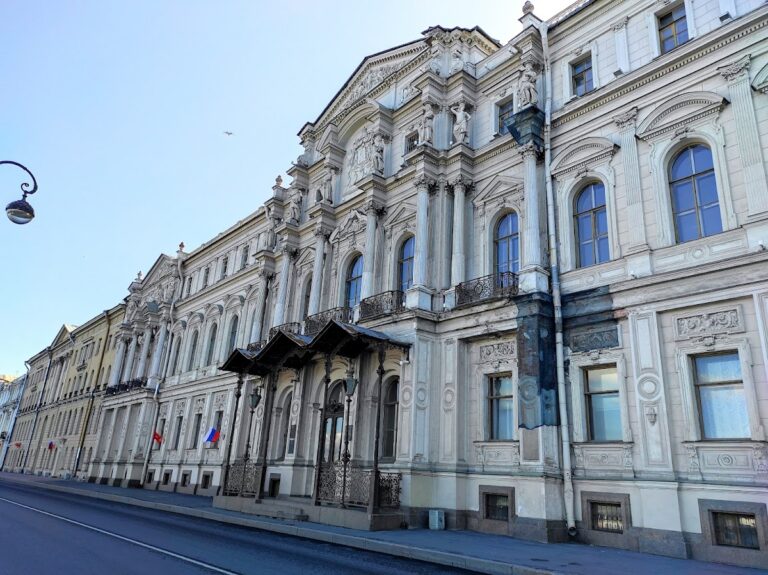
The House of Scientists occupies the former Vladimir Palace at 26 Palace Embankment beside the Neva River in central Saint Petersburg. Palace Embankment is a street built along the riverbank. The present building developed from a sequence of earlier residences on the site and was constructed as a palace for Grand Duke Vladimir Alexandrovich in the 1860s.
Palace development
From 1720 to 1862, the site held a mansion that was rebuilt repeatedly and gradually developed into a palace. Its successive residents included I. A. Musin-Pushkin, I. Osterman, N. V. Repnin, I. P. Kutaisov, D. P. Volkonsky, and Armand de Caulaincourt. From 1841, the building also housed the Company of Palace Grenadiers.
In 1862, the earlier building was scheduled for demolition and replacement by a palace for Grand Duke Vladimir Alexandrovich. The new palace was built in 1867 and 1868 to a design by the architect Alexander Rezanov. Decoration and finishing work on the interiors continued until 1874. The palace’s architecture later influenced the design of a similar building on Zhylianska Street in Kyiv.
Nearby sites