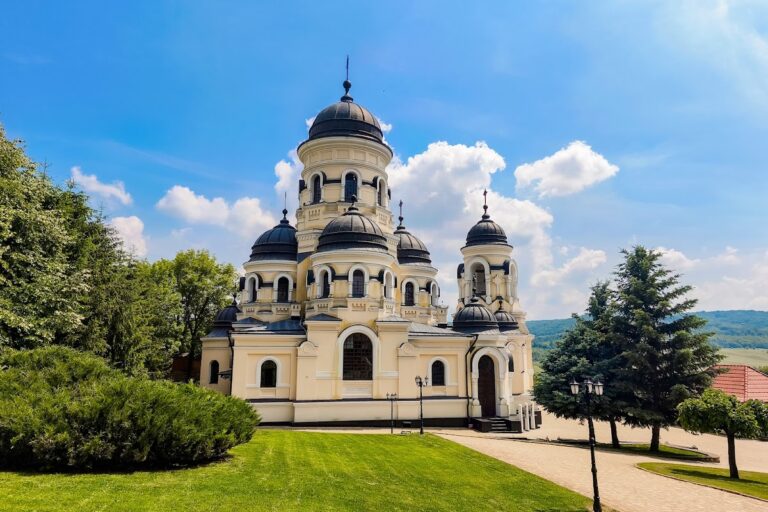
Armenian Church, Iași: An Armenian Apostolic Place of Worship in Romania


Site at a Glance
- Rating
- 4.3
- Popularity
- Very Low
- Country
- Romania
- Primary era
- Modern
- External website
- Open
- Eras represented
- Early Modern, Modern
- Civilizations
- Armenian
- Site type
- Religious
- Remains
- Church
On this page15 sections
History
The Armenian Church of Iași is an Armenian Apostolic church in Iași, Romania, dedicated to the Dormition of the Mother of God, the Christian feast commemorating the death and heavenly assumption of the Virgin Mary. Its history reflects the presence of Armenian communities in Moldavia from the late medieval period and the continuing religious life of Iași’s Armenian congregation.
Armenian communities in medieval Moldavia
Armenian religious activity in Moldavia is recorded from the second half of the fourteenth century. Armenians came through Crimea from regions affected by Seljuk, Tatar, Persian, and other invasions. They established communities in Iași, Botoșani, Suceava, and other towns, where they built or received churches for their worship.
At first, the Armenian churches of Moldavia belonged to the Armenian Diocese of Lviv, founded in 1365. On 30 July 1401, Prince Alexandru cel Bun created an Armenian episcopal see at Suceava and granted Bishop Hovhannes authority over Armenian churches and clergy throughout Moldavia. Armenian bishops later resided periodically in Iași. A manuscript from 1607 identifies Bishop Hovhannes Secvți as bishop of Iași, while Bishop Anton Serepkoienț ordained clergy in the Saint Mary church in 1646.
A stone inscription inside the church states that its foundations were laid in 1395 by the trustee Hacik, Father Hagop of Sis, Hagi Markar of Djugha, and Hagi Krikor. The inscription’s date and authenticity remain disputed. Some historians considered it a later forgery because it uses the Anno Domini dating system, which Armenians and Moldavians did not normally use at that time. The possibility of an Armenian church in Iași in 1395 has nevertheless remained open.
N. A. Bogdan accepted the date as certain in the early twentieth century. In 1929, Nicolae Iorga argued that the year had been added later, while still allowing for the existence of an Armenian church in Iași during the late fourteenth century. The inscription may have been removed from the wall during the rebuilding of 1803.
Churches, conflict, and reconstruction
A tradition recorded by N. A. Bogdan and Prince Nicolae Suțu claimed that neighboring Saint Sabbas Church had once been an Armenian sanctuary taken over by the Orthodox community. According to this tradition, Armenians received land and compensation to build a replacement church. Documentary evidence gives a different history: Saint Sabbas Church was built in 1583 by Greek monks from the Monastery of Saint Sabbas in Jerusalem, on land donated by Prince Petru Șchiopul where no earlier Armenian or Orthodox church stood.
The Saint Mary church was damaged or rebuilt several times because of earthquakes and invasions, and these successive interventions altered its original Armenian architectural character. A Catholic priest travelling through Moldavia between 1583 and 1586 recorded visiting an Armenian church dedicated to Saint Mary in Iași.
On 26 October 1594, Cossack forces led by Ataman Grigore Lobodă plundered and burned Iași. They looted the Armenian Church of Saint Mary and carried away, among other objects, consecrated myron brought from Echmiadzin, the principal spiritual center of the Armenian Apostolic Church. Bishop Hovhannes of Caffa was in Iași during the attack and was abused by the assailants.
A second Armenian church, dedicated to Saint Gregory the Illuminator, was built in Iași around 1605 at the expense of Arabgherean. It stood on Cizmăriei Street near the Old Bridge, in the Armenian quarter. Iași therefore had two Armenian churches during the seventeenth and eighteenth centuries. A Catholic visitation in 1661 described both as stone churches.
The two congregations benefited from privileges and tax exemptions granted by Moldavian rulers. In 1705, Antioh Cantemir exempted two priests and two deacons serving Iași’s Armenian churches from taxation. Mihai Racoviță, Nicolae Mavrocordat, and Dimitrie Cantemir confirmed related exemptions.
The Saint Gregory the Illuminator church received a porch in 1782. The Saint Mary church was repaired in the same year, an event recorded by an Armenian inscription in its western porch. It had reportedly reached a poor condition by the end of the eighteenth century, possibly after being partly abandoned following the construction of the second Armenian church.
In 1803, the Saint Mary church was rebuilt from its foundations through the labor and financial contributions of the Armenian community. An inscription above the southern entrance recorded both the traditional foundation date of 1395 and the rebuilding of 1803. A second inscription commemorated repairs carried out that year through the efforts of Hagi Hovhannes.
The Saint Gregory the Illuminator church burned during the Iași fire of 19 July 1827. Its walls were demolished in 1860, and rebuilding began, but the work stopped when funds ran out. The unfinished structure was finally demolished in 1899, leaving the Saint Mary church as Iași’s only Armenian place of worship.
The parish in the nineteenth and twentieth centuries
During the nineteenth century, the church was supported by income from several properties and by donations from the congregation. It had two priests around 1860 and one priest and two cantors by the end of the century. An Armenian school was established in Iași at the beginning of the nineteenth century.
An Armenian parish cemetery surrounded the church until approximately the 1870s. Another cemetery behind Vulpe Church served people who died during urban epidemics until about 1830 to 1832. In the 1870s, the community established a new cemetery and chapel near Pașcanu Hospital.
After the First World War, the creation of an Armenian diocese in Romania was debated and was achieved in 1931. In 1924, the Iași church trustees opposed the proposed change, preferring continued authority under the Armenian Patriarchate of Constantinople rather than the Catholicosate of Echmiadzin, then located in the Soviet Union. A catholicosate is an Armenian ecclesiastical jurisdiction headed by a catholicos, the senior bishop of that jurisdiction.
The church was consolidated and completely renovated in August 1929. Archbishop Husik Zohrabian, head of the Armenian-Gregorian Diocese of Romania, solemnly reconsecrated it on 15 September 1929. The ceremony was conducted in Armenian and included a communal meal for poor residents of every confession. Father Ignadios Kilimlian became parish priest in November 1930, and Father Arsen Varjabetian later served the parish.
The Armenian Atheneum was built in the church courtyard in 1932 and now serves as the parish house. Archbishop Husik Zohrabian visited the Iași Armenian community and church in 1935, 1936, and 1938. In 1935, Mihai G. Manea was reelected president of the church trustees, whose new board was formally installed on 14 November. In 1938, Father Arsen Varjabetian officiated a service devoted to peace, mutual understanding, and release from vows.
Archimandrite Vasken Balgian visited Iași in February 1944, celebrated services, preached in Romanian, and met the local Armenian community. Bombardment during the Second World War damaged the church, which was repaired in 1946.
Earthquake damage and restoration
During the communist period, emigration sharply reduced Iași’s Armenian community and weakened its ability to maintain the church. The earthquake of 4 March 1977 severely damaged the building, particularly its two towers, which were at risk of collapse. Professor Anatolie Mihul and engineer Ionel Gosav temporarily stabilized the towers with a linking system that remained in place for more than twenty-five years.
By the beginning of the twenty-first century, the community numbered approximately 150 people, most of them elderly. Donations could not meet the estimated restoration cost of US$300,000. Assistance was sought from the Romanian Orthodox Church, but the proposed support required the church to be ceded to that institution, with Armenian services held once a month.
After Zareh Nazaryan became president of the parish council in 2002, he organized efforts to secure the property title, inventory the church’s heritage, obtain technical inspections, seek state assistance, and gain support from the Armenian diaspora. Senator Varujan Vosganian supported the work through the Union of Armenians in Romania.
An inspection in 2005 identified a major risk of collapse, including during an earthquake measuring 4.5 on the Richter scale. Restoration took place between 2005 and 2008. The project was prepared by EXproCONS Gosav & Co., while Iasicon carried out the construction work. Work began on 5 December 2006 and ended in October 2008.
On 26 October 2008, Karekin II, Catholicos of Echmiadzin and Supreme Patriarch of All Armenians, reconsecrated the church in the presence of Armenian, Romanian state, local-government, and other religious representatives. Interior plaques and an exterior marble plaque commemorate the restoration. The church is listed on Romania’s historic-monument register as Saint Mary Church, under classification code IS-II-m-B-03713. The adjacent Armenian Atheneum is separately listed under code IS-II-m-B-03712.
Armenian services are currently held on the last Sunday of each month by Torkom Mandalian, the parish priest of Suceava.
Remains
Plan, entrances, and interior arrangement
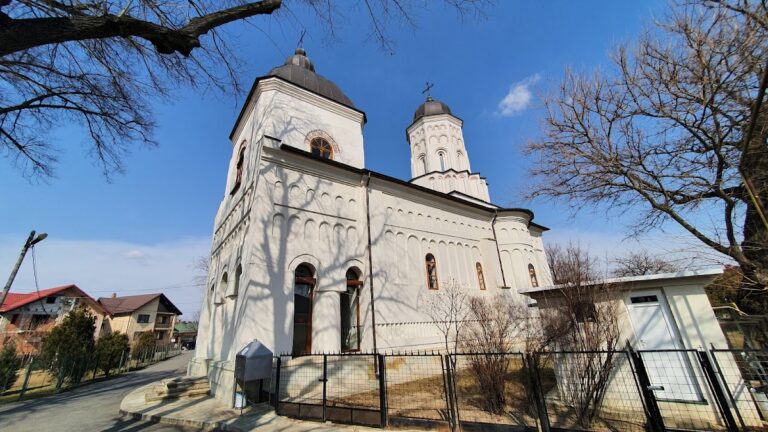
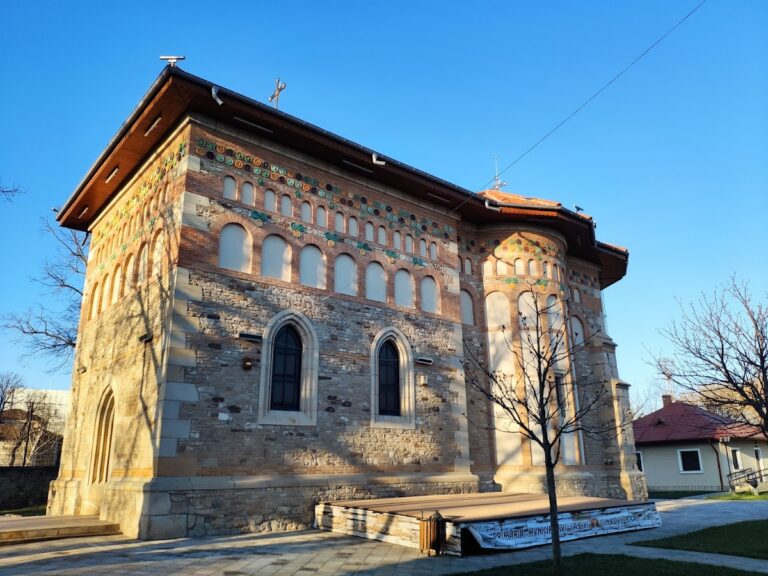
The church is built from stone and handmade brick, with exterior walls arranged in horizontal courses. Its clover-shaped plan is marked by two slender stone towers, the Pantocrator tower and the bell tower. Pantocrator refers to Christ as ruler of the universe and, here, names one of the towers.
Entrances and vaulted interior
Separate entrances open on the west and south sides. The monumental southern entrance is framed by four columns with carved capitals. Inside, broad vaults rest on oblique arches, while a gallery is supported by four columns.
Altar and icon screen
The altar stands about 0.75 metres above the nave and is reached by three steps. A simple curtain hanging from a transverse beam separates it from the main body of the church. Above the altar is a wooden icon screen, a structure carrying sacred images that marks the altar area. It contains inlays, floral motifs, and two imperial doors, but does not extend fully across the sanctuary as an Orthodox icon screen does. Two side altars stand beside the main altar, each containing an icon.
A carved floral design in white marble at the base of the main altar dates from 1817. Paintings of two evangelists decorate the interior walls of the dome in front of the altar, while icons are displayed on the other interior walls. The church preserves thirteen wooden icons painted in 1812 and eleven oil paintings on canvas. The icon screen contains fifteen icons, including an Armenian-style central image of the Virgin and Child.
Icons, bells, and ecclesiastical objects
Among the older icons associated with the church are the Beheading of Saint John and an image of Saint Mary, both donated by Hacik to his sons Acsen and Bedros in 1777. Another image of Saint Gregory the Illuminator was donated by Ohanes to his son Alecsan of Silistra in 1793. Other works depict Saint Mina, Saint Gregory the Illuminator with the Latin inscription identifying him as the Armenian patriarch, and the Virgin Mary with Jesus.
The Saint Mina icon bears an inscription attributing its production to Ovanez Sirvanți on 10 October in Armenian year 111. The recorded interpretation equates that date with AD 662, although N. A. Bogdan considered the date erroneous or possibly suggestive of an origin before the period of Byzantine iconoclasm.
Three bells of different sizes belong to the church. The smallest dates from 1607 and bears a Latin inscription. The largest dates from 1887 and carries an inscription in Old Church Slavonic. A large altar curtain, used in Armenian churches as a substitute for the icon screen, is preserved at the Armenian Diocesan Museum in Bucharest.
Cemetery monuments
The former parish cemetery survives in fragmentary form. Tombstones removed from graves around the church are stored beneath a shelter west of the building, and several funerary monuments remain on the former cemetery site.
Caramliu monument
One stone monument, surmounted by an iron cross and decorated with a bas-relief, commemorates Ghiumiusi Caramliu, who died in 1854, and his son Horiton Caramliu, who died in 1873. The relief shows an angel resting its forehead against a bronze cross.
Ioan Christe Popovici monument
A white-marble monument with a marble cross and bas-relief commemorates the merchant Ioan Christe Popovici, born in Focșani in 1795 and deceased in Iași in 1875. The relief portrays him leaning against a cross.
Additional funerary monuments
Two other surviving monuments consist of a stone structure bearing an Armenian inscription and a stone structure with an iron cross. The latter carries no inscription.
Manuscripts and the church’s written heritage
A paper Gospel associated with the church was written in Caffa in 1351 by the priest Garabet for the deacon Grigore. The manuscript has 289 leaves, or 578 pages, and measures 24 by 17 by 8. Its covers are bound in silver, and its pages include medieval Armenian marginal ornament and chapter openings in red lettering.
A colophon, a manuscript note identifying details such as its scribe, date, place, patrons, or later owners, names the Armenian Catholicos Mekhitar I of Cilicia, Bishop Stepanos, and the reigning authority of the period. A second annotation states that the brothers Agopșa and Ariudz purchased the Gospel and donated it to the Church of the Mother of God in Iași in 1451. Mekhitar I of Cilicia led the Armenian Apostolic Church from 1341 to 1355. The Gospel is now preserved at the Armenian Diocesan Museum in Bucharest and was described as poorly preserved during the twentieth century.
Other books formerly linked with Iași’s Armenian churches included a printed Life of the Saints produced at Constantinople in 1606, an Armenian Gospel dated 1841, and an undated leather-bound manuscript commentary on the lives of the saints. The commentary contains annotations connected with the former Saint Gregory the Illuminator church, including entries from 1747 and 1778.
Nearby sites