Cathedral of St Nicholas, České Budějovice: Parish Church and Diocesan Cathedral


Site at a Glance
- Rating
- 4.7
- Popularity
- Low
- Country
- Czechia
- Primary era
- Early Modern
- External website
- Open
- Eras represented
- Medieval, Early Modern, Modern
- Civilizations
- Holy Roman Empire, Kingdom of Bohemia
- Site type
- Religious
- Remains
- Cathedral
On this page19 sections
History
The Cathedral of St Nicholas in Czechia is a Roman Catholic parish church and the principal church of the Diocese of České Budějovice. Founded as the parish church of the royal town around 1265, it became a cathedral in 1785 when the Diocese of České Budějovice was established and its interior was adapted for the new role.
Medieval Parish Church
The foundation stone was laid shortly after the town was founded. The main altar was consecrated and the church opened for worship around 1297, although construction probably continued. The principal structure was most likely completed around the middle of the fourteenth century.
A cemetery beside the church served the town from the Middle Ages until 1784. Burials were then prohibited by a decree of Joseph II. A cemetery chapel dedicated to Saint James was recorded in 1370 and was later replaced by the Chapel of the Agonies of the Lord.
Late Gothic Transformation
The church underwent extensive changes in the late fifteenth and early sixteenth centuries. A southern extension resembling three transverse naves was added in the late fifteenth century, while an independent bell tower was erected northeast of the church around 1500. An inspection in 1517 led to rebuilding that began in 1518. The result was a late Gothic church with a high tent roof and two tall towers.
On 24 June 1523, the northern tower collapsed. It was not rebuilt to its original height, and a small clock tower was probably added to the southern tower during the same period. Preparatory work for the Black Tower began in 1547. Built as a watchtower and bell tower, it was completed in 1577 and continues to serve as the cathedral’s belfry. The appearance of the church and town in 1602 is preserved in a detailed town view by Willenberg.
The Thirty Years’ War and the 1641 Fire
During the Thirty Years’ War, a conflict that brought widespread military and political upheaval across central Europe, the Bohemian Crown Jewels were evacuated to České Budějovice in 1631. Thirty mounted riders and sixty infantry musketeers escorted them. A room in the church, probably in the southern tower, was secured for their storage at a cost of 29 gulden and 50 kreuzers. A military guard protected the treasury, and two nobles were made responsible for it, with at least one required to remain in the town.
The jewels were returned to Prague in August 1633 in a specially built wagon, but they came back to České Budějovice for several weeks in 1634. The church itself suffered a far greater disruption in 1641, when a major town fire destroyed the building, apparently leaving only the buttresses of the chancel.
Baroque Reconstruction
Rebuilding took place between 1641 and 1649. The church acquired the predominantly Baroque form that defines its present appearance, although the first phase combined Renaissance and Baroque elements. Giovanni Ciprian and Francesco Canevalle directed the work. Canevalle was also reconstructing and extending the town fortifications.
The reconstruction was accompanied by disputes between Canevalle, the town, masons, and carpenters. The newly built choir vault collapsed before the roof was finished and had to be reconstructed. An unsuitable roof design was criticized, and the unstable facade was demolished and rebuilt at the town’s expense after Canevalle had left. Seven years after the reconstruction, the windows were enlarged because the original openings admitted too little light.
Further alterations followed in 1686–1688 with the participation of the architect Giacomo Antonio de Maggi. The vault was repaired and the facade was rebuilt as a two-storey Italian-style composition. Its stucco decoration was made by Santino Cereghetti. The facade is described as the only surviving early Baroque architectural monument in České Budějovice.
Cathedral and Later History
When the Diocese of České Budějovice was created in 1785, the parish church became its cathedral. A cathedral is the principal church of a diocese and the seat of its bishop, while the parish function continued to serve the local congregation. The cathedral’s operation is overseen by the Cathedral Chapter of Saint Nicholas, a body of clergy that assists with the administration and worship of the cathedral.
The former cemetery was investigated by the South Bohemian Museum between 2001 and 2005, followed by further research inside the church from 2010 to 2012. These investigations uncovered a chapel, burial vaults, and graves. The cathedral was closed for comprehensive repairs from May 2011 for approximately two years, and the Monastery Church of the Presentation of the Virgin Mary served as the cathedral during the work.
The restoration of 2011–2013 renewed the interior furnishings, floors, choir steps, choir wall cladding, choir stalls, ambon, and congregational seating. An ambon is a raised stand used for readings, while a cathedra is the official seat of a bishop. On 1 June 2013, an altar containing relics of John Nepomucene Neumann was consecrated, and the ambon and cathedra were blessed. Bishop Jiří Paďour celebrated Mass after the ceremony.
In 2022, the chancel received the tapestry ensemble Scenes from the Apocalypse, made by Marko Ivan Rupnik. The cathedral is protected as a cultural monument of the Czech Republic.
Music and Church Life
At the turn of the eighteenth and nineteenth centuries, the cathedral’s regeschori included the composers Jáchym Štěpanovský and Jan Nepomuk Vocet. A regeschori was a church music director responsible for organizing and supervising liturgical music.
The church’s musical history also includes several organs. Funds for a new instrument were bequeathed in 1495–1497, and Michael Khall built an organ in 1498, although construction may have begun as early as 1495. A small choir organ was recorded in 1515. Around the end of the sixteenth century, Joachim Rudner prepared an expert report on an existing organ that was probably worn out.
The 1498 organ and most of the other musical instruments were destroyed in the 1641 fire, which entered through the organ-blower room. After the rebuilding, Ondřej Schedlich began a new organ in 1645. His brother-in-law Mathias Tretscher completed it in 1646 after Schedlich’s premature death. The instrument had one manual, a pedal, and fourteen stops. Manuals are organ keyboards, a pedal is the foot-operated keyboard, and stops control sets of pipes.
In 1727–1728, Jiří Vojtěch Dvorský and his journeyman Martin Janeček constructed a large Baroque organ with two manuals, a pedal, and twenty-four stops. In the twentieth century, smaller positive and choir organs were also associated with the church. A positive is a small organ, while a choir organ is intended for use by a choir or in the choir area.
Remains
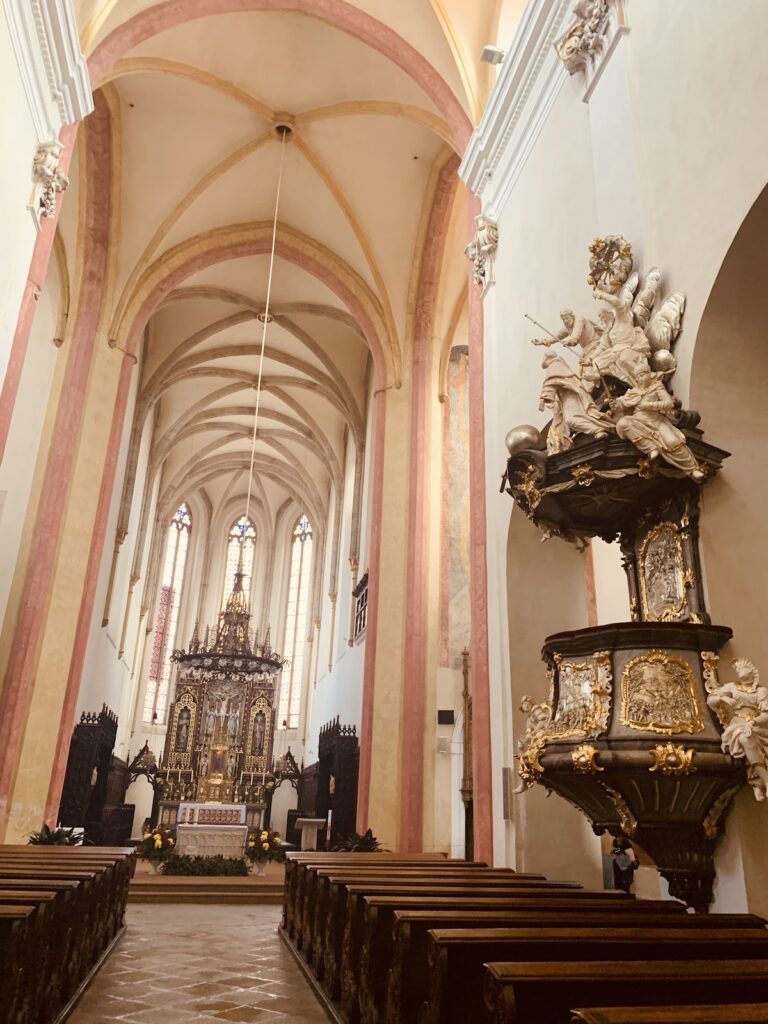
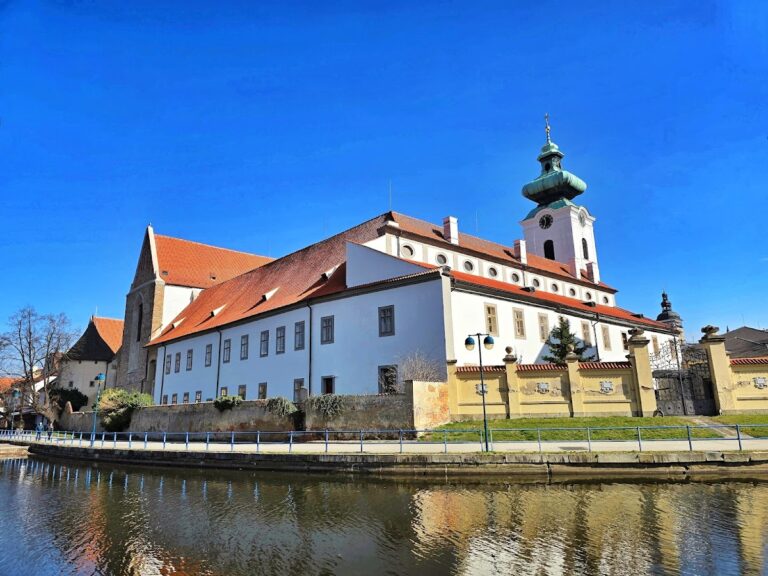
The cathedral stands in the centre of České Budějovice near the northeastern corner of Přemysl Otakar II Square. It has a triple-nave plan, consisting of a central nave with two side aisles. Its present appearance is predominantly Baroque, while the building preserves the results of early Gothic foundations, late Gothic rebuilding, Renaissance-Baroque reconstruction, and eighteenth-century interior work.
Exterior and Bell Tower
Baroque Facade
The two-storey facade rebuilt in 1686–1688 follows the Italian early Baroque manner. Its niches contain three stucco statues made by the sculptor T. Zeisl. Saint Nicholas of Myra stands between Saint Wenceslas and Saint Auracian. Nicholas was a fourth-century Christian bishop traditionally associated with charity and the protection of children, sailors, and merchants. Wenceslas is the medieval patron saint of Bohemia, while Auracian is venerated locally as a Roman martyr and co-patron of České Budějovice. The northern facade bears the coat of arms of the city.
Black Tower
The Black Tower is a separate masonry tower northeast of the church. Construction began in 1547, and the tower was completed in 1577 as both a watchtower and a bell tower. It now functions as the cathedral’s belfry. The independent bell tower that stood near the medieval church apparently disappeared in the fire of 1641. A statue of Bishop Jan Valerián Jirsík stands in front of the cathedral.
Boundary Wall
A niche on the eastern side of the outer boundary wall contains a statue of the Saviour carrying the Cross. The sculpture originally came from Pasovary. The former cemetery enclosure contained Baroque Stations of the Cross. After the cemetery was abolished, the Stations were replaced by chapels along the southern wall of the deanery, a building or district associated with a dean and the clergy of several parishes.
Interior Furnishings
Altars
The main altar is dedicated to Saint Nicholas of Myra. Its wooden architectural structure was made by Leopold Hueber in 1785. The oil painting Saint Nicholas Reviving Two Dead Children was painted in 1648 by J. Bachmann of Frymburk, and an oval image of Saint Auracian occupies the upper part of the altar.
The northern nave contains the altar of Saint Anne, dated 1771 and also made by Leopold Hueber. It holds a reliquary containing the remains of Saint Auracian and carries an altarpiece of Saint Anne by Franz Anton Maulbertsch.
Pulpit and Sculpture
The church contains a wooden sculpture of Christ on the Cross, made by Břetislav Kafka, together with a baptismal font. Its Baroque pulpit has white-painted and gilded surfaces with figural carvings dating from around 1710. The pulpit was transferred in 1784 from the dissolved Theatine church of Our Lady of Perpetual Help and Saint Cajetan in Prague. The Theatines were a Catholic religious order.
Chancel Tapestries
The chancel, the part of the church surrounding the main altar and traditionally reserved for the clergy, contains the tapestry ensemble Scenes from the Apocalypse. The ensemble was installed in 2022 and was made by Marko Ivan Rupnik.
Organs and Choir Area
Baroque Organ
The large Baroque organ built by Jiří Vojtěch Dvorský and Martin Janeček in 1727–1728 was divided between two cases. The cases were angled toward the centre of the nave so that the gable window could admit as much light as possible. Each case had a symmetrical canopy-style front with a single pipe field. The pedal compass comprised twenty-one tones, and the manuals began with a divided octave.
The organ was renovated in 1834, when the positive received a new Classical-style case placed on the choir-gallery railing. Emanuel Štěpán Petr repaired the instrument in 1912. In 1934, the Rieger company of Krnov installed a larger late-Romantic organ with thirty-five stops in new cases, retaining the Baroque fronts by Dvorský and Janeček. The cases were turned parallel to the choir-gallery railing rather than diagonally, and the instrument remains in use with partial modifications.
Archaeological Evidence
Excavations in the former cemetery and inside the church revealed a chapel, burial vaults, and graves. These remains preserve physical evidence of the burial ground that served the town from the medieval period until the prohibition of burials in 1784.
Nearby sites