Maškovec: A Gothic Castle Ruin in Czechia



Site at a Glance
- Rating
- 4.5
- Popularity
- Low
- Country
- Czechia
- Primary era
- Medieval
- Eras represented
- Medieval
- Civilizations
- Holy Roman Empire, Kingdom of Bohemia
- Site type
- Military
- Remains
- Castle
On this page8 sections
History
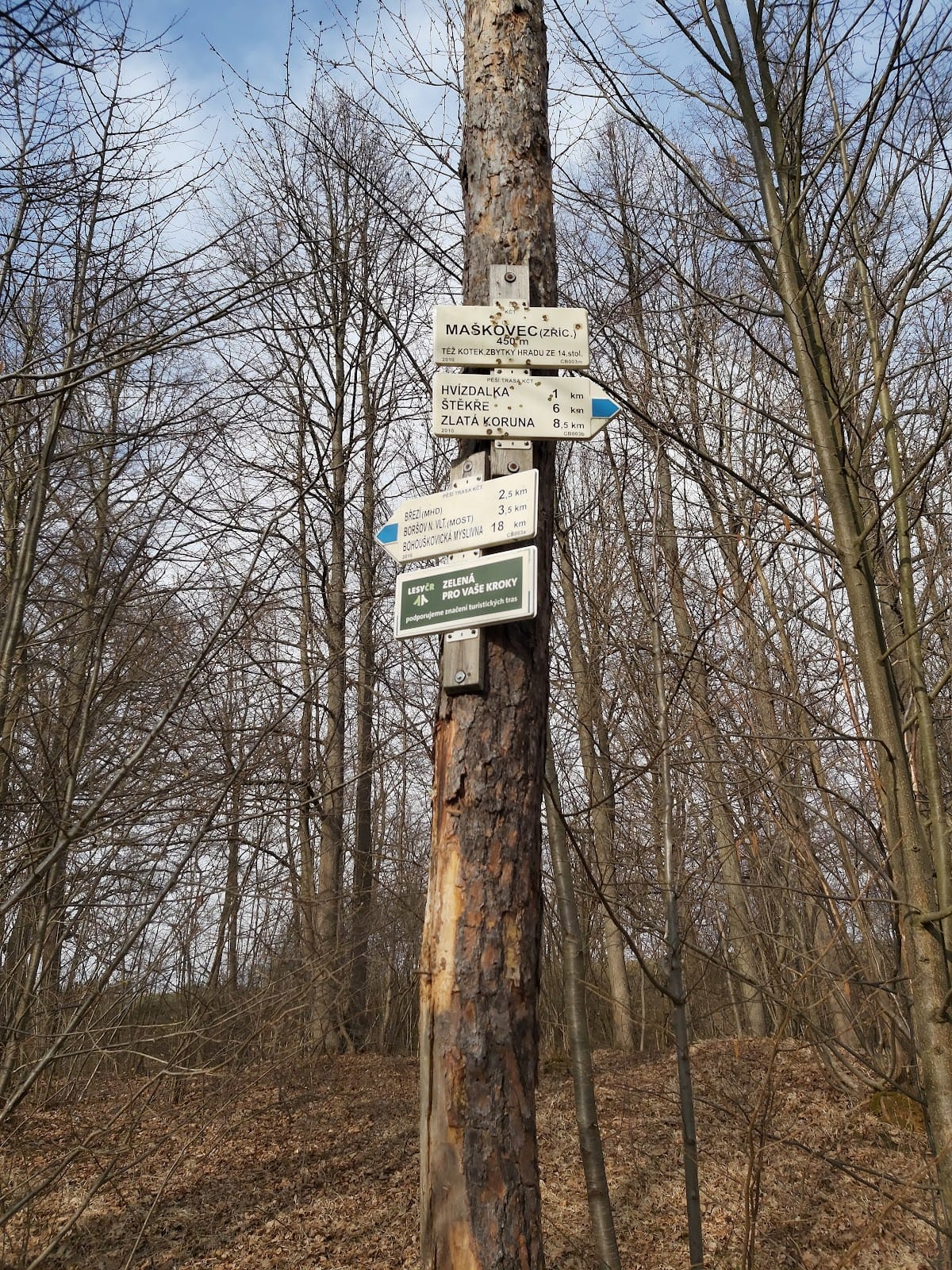
Maškovec is a Gothic castle ruin in Czechia, built in the mid-fourteenth century by members of the Lords of Újezd. Also known as Kotek or Kotkův Hrádek, it occupied a defensible position above the Vltava and controlled movement along the nearby Cáhlov Trail.
Origins and the Lords of Újezd
The castle’s builders belonged to the Lords of Újezd. Their heraldic arrow is said to indicate kinship with the Bavory of Strakonice, the Lords of Drahonice, and the Knights of Pořešín. Maškovec is first mentioned indirectly in 1380, when Buzek of Újezd used the designation “seated at Maškovec.” His son Racek was recorded as the castle’s lord in 1402.
The owners of Maškovec controlled traffic on the Cáhlov Trail. They used coercion to make merchants travelling with wagons pass through a village, increasing the income derived from the route. This role connected the castle’s authority with the movement of goods through the surrounding landscape.
The Hussite period
During the Hussite Wars, the religious and political conflicts in fifteenth-century Bohemia that followed the condemnation of the reformer Jan Hus, Racek initially supported the Hussites. He later entered the service of the Lords of Rožmberk, one of the most powerful noble families in medieval Bohemia, based in southern Bohemia.
Jan of Drahonice was recorded at Maškovec in 1425. The Lords of Újezd held the castle until the mid-1420s, when financial difficulties during the unsettled Hussite period led to their disappearance from the documentary record.
Abandonment and later dismantling
In 1427, Jan Pryndl, the parish priest of Újezd, took refuge at the abandoned castle for protection from the Hussites. While there, he completed his copy of the Golden Legend, a medieval collection of saints’ lives compiled by Jacobus de Voragine, a Dominican friar and later archbishop of Genoa.
Jindřich IV of Rožmberk purchased Maškovec in 1455. The castle was then abandoned because it was no longer needed, and a 1493 description called it demolished. Between 1823 and 1841, Pachner of Ebendorf, the owner of Poříčí Chateau and the nearby Kotek farm, had most of the remaining masonry dismantled for building material. Maškovec has been protected as a cultural monument since 1963.
Remains
Setting and defensive layout
The ruin stands at approximately 440 metres above sea level on a rock face above the right bank of the Vltava, in the cadastral territory of Kamenný Újezd. Maškovec was a single-part castle, organized around one enclosed area. The rock face above the river provided natural protection on one side, while a steep slope descended southeast into the valley of a small stream.
The accessible northwest and northeast sides were defended by a rampart and ditch. On the northeast, the defenses were duplicated. Most of the masonry was dismantled during the nineteenth century, and the ditches were partly filled in.
Surviving masonry
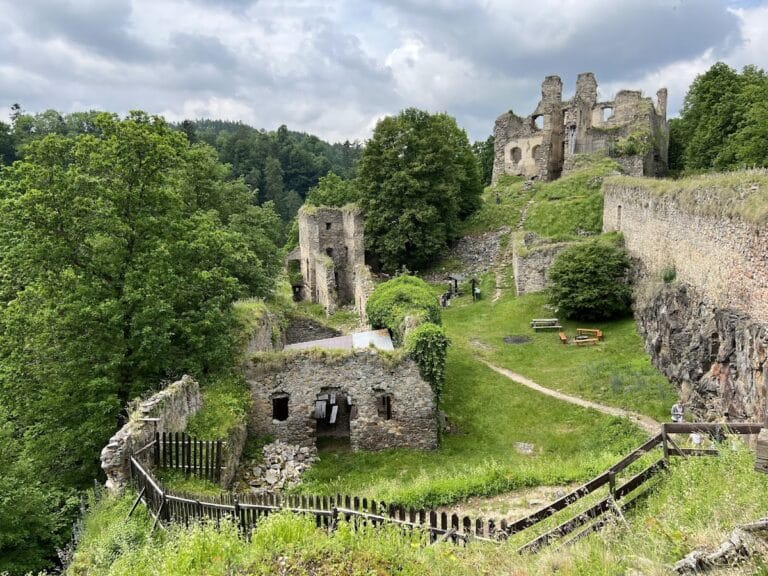
A rampart-like remnant of the perimeter wall survives on the northwest side. On the difficult-to-access rock above the river, a corner of a building remains, while a neighboring depression suggests that the structure probably included a basement. A smaller fragment of masonry survives at the western corner.
Rock face and river valley
The rock face below the ruin is approximately 35 metres high and highly fractured. It forms climbing terrain with four documented routes. From the castle site, the Vltava valley extends through an incised meander, a deeply entrenched bend in the river. About 2.5 kilometres downstream, the Vltava leaves the deep, constricted valley and enters the České Budějovice Basin. The river channel and some valley slopes are protected as the Vltava near Blanský les natural monument.