Ohrada Hunting Château: A Baroque Hunting Residence in Czechia


Site at a Glance
- Rating
- 4.6
- Popularity
- Low
- Country
- Czechia
- Primary era
- Early Modern
- External website
- Open
- Eras represented
- Early Modern
- Civilizations
- Habsburg, Holy Roman Empire
- Site type
- Domestic
- Remains
- Elite Residence
On this page8 sections
History
Ohrada Hunting Château is a Baroque hunting residence in Czechia, built near Hluboká nad Vltavou between 1708 and 1713 for Prince Adam Franz zu Schwarzenberg, later Duke of Krumlov. Its purpose combined princely representation with parforce hunting, a formal mounted pursuit in which trained hounds followed game over an extended course, as well as game hunts and hunting ceremonies near the Schwarzenberg residence.
Construction for the Schwarzenbergs
The Prague architect Paul Ignaz Bayer designed the château. Work began with the arsenal, followed by the south and north wings, and ended with the principal château building. The completed complex served the ceremonial and practical needs of the court’s hunting activities.
From hunting residence to museum
In 1842, Prince Johann Adolf II zu Schwarzenberg established the first hunting museum at Ohrada. He assembled hunting trophies, weapons, and taxidermied animals there. The château later accommodated the forest administration and military hospitals.
At the beginning of the First World War, German military authorities occupied the château. After the war, the Czechoslovak government nationalized it. In 1961, the Prague Agricultural Museum took over Ohrada and established a museum of forestry and fishing. The château now houses a museum devoted to forestry, hunting, and fishing, described as one of the oldest museums in the Czech Republic. Major restoration took place from 1986 to 1990, and Ohrada became a National Cultural Monument of the Czech Republic in 2001.
Remains
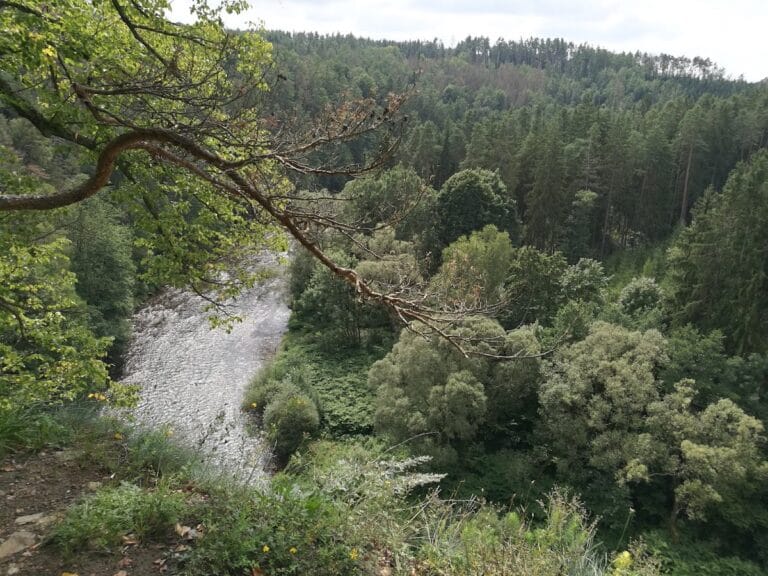
Ohrada stands on the southern shore of Munický Pond, between Munický Pond and Zvolenovský Pond, near Hluboká nad Vltavou. Its surroundings include the Ohrada zoological garden and the Vondrov farmstead. The complex is organized around a Baroque hunting residence, with an arsenal to the west, service wings to the south and north, and the principal building forming the central architectural focus.
Arsenal, stables, and kennels
The western grounds contained the arsenal, which was built first during the château’s construction. The south and north wings housed stables and kennels, linking the formal residence with the horses and trained hounds required for princely hunting. These parts formed the working setting for the ceremonies and pursuits that shaped the château’s original purpose.
Principal château building
Hunting Hall
The ground floor includes the Hunting Hall, which was decorated with large oil paintings by the Scottish painter John G. Hamilton. Hamilton served as court painter to the Schwarzenbergs from 1709 to 1718. The paintings are now kept in Austria.
Chapel of Saint Eustace
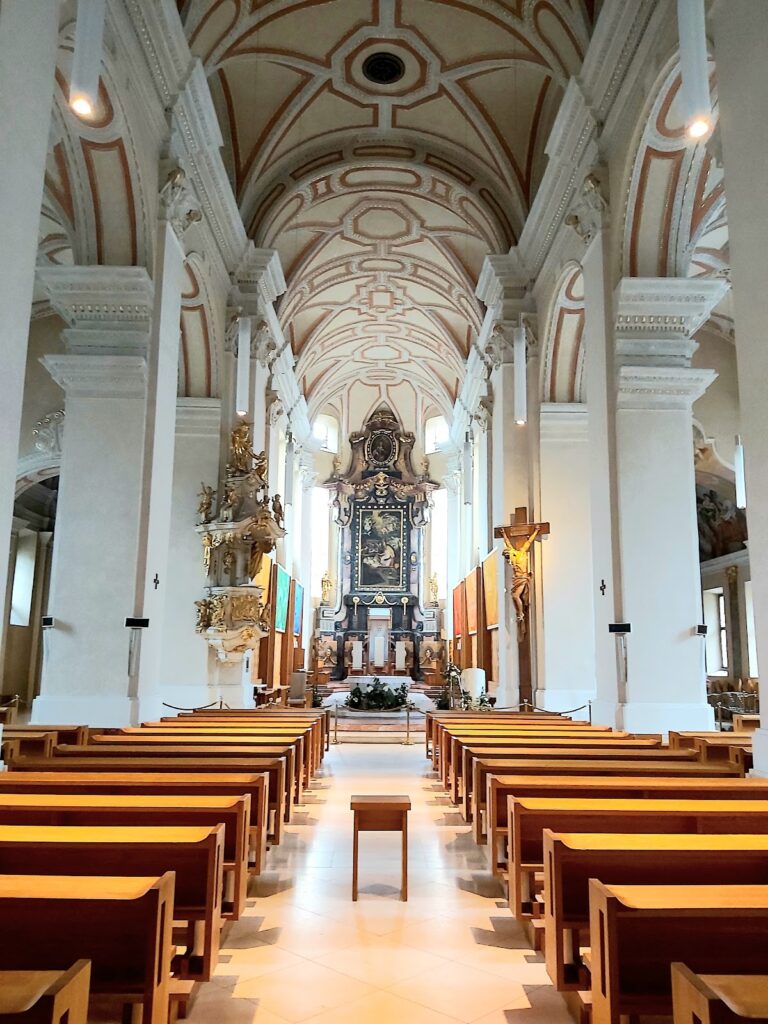
The ground floor also contains the Chapel of Saint Eustace, a Christian patron figure traditionally associated with hunters. Its altar is dedicated to Saint Hubert, another patron of hunters. Georg Werle painted the chapel ceiling with a representation of the Holy Trinity in 1715, decorated the Saint Hubert altar, and created ceiling frescoes in the château showing scenes involving Artemis, the Greek deity associated with hunting and wild nature.
J. Andre completed the Saint Hubert altar in 1720, placing the Schwarzenberg coat of arms above it. The altarpiece image was painted by the Flemish artist Pieter van Roy. Franz Carobbio carried out the stucco work, while the Prague stonemason Jan Oldřich Manes made the fireplaces and is also associated with the château portal.
Nearby sites