Hluboká Castle: A Tudor Gothic Residence in Czechia


Site at a Glance
- Rating
- 4.8
- Popularity
- Very High
- Country
- Czechia
- Primary era
- Modern
- External website
- Open
- Eras represented
- Modern
- Civilizations
- Austria-Hungary, Austrian Empire, Habsburg
- Site type
- Domestic
- Remains
- Castle
On this page12 sections
History
Hluboká Castle is a nineteenth-century Romantic Tudor Gothic residence in Czechia, near Hluboká nad Vltavou, developed from a medieval Bohemian castle founded during the reign of King Wenceslaus I. The Gothic stronghold was constructed in the second half of the thirteenth century on the site of the present castle, and its first written mention dates to 1285, when it was held by the Vítkovci, a powerful noble family of southern Bohemia.
Royal castle and changing lordships
The castle initially formed part of the royal domain, although noble burgraves, or castle governors responsible for administration and defence, sometimes held or managed it. King Přemysl Otakar II recovered it from Čéč of Budějovice. In 1290, it returned to the crown after the execution of Záviš of Falkenštejn near the castle. During its first four centuries, Hluboká changed owners 26 times.
In the fifteenth century, Emperor Sigismund granted Hluboká to Mikuláš of the Lobkovic family. George of Poděbrady acquired the castle from Lobkovic’s descendants in 1454, and after George’s death it was used by his widow. The medieval stronghold later became a Renaissance residence when Ferdinand I transferred it to the Hradec-Neuhaus family in 1562. An extensive rebuilding campaign followed between 1571 and 1587 under the direction of the Italian architect Balthasar Maggi, with Vincenzo Vogarelli and Domenico Benedetto Cometa also taking part.
Seventeenth- and eighteenth-century changes
After the Battle of White Mountain, the defeat of the Bohemian revolt against the Habsburg monarchy in 1620, the estate was confiscated in 1622. Baltasar Marradas, an imperial field marshal and Spanish aristocrat, acquired it and ordered the outer castle to be rebuilt in the early seventeenth century. After his death, the estate passed to his nephew Francesco de Salant y Marradas.
Johann Adolf I of Schwarzenberg purchased the castle and estate in 1661. The Schwarzenbergs established a South Bohemian branch and lived at Hluboká for nearly three centuries. At the beginning of the eighteenth century, Adam Franz Karl of Schwarzenberg commissioned a Baroque reconstruction based on designs by Paul Ignaz Bayer and Anton Erhard Martinelli.
Hluboká was occupied during the Franco-Bavarian campaign of the War of the Austrian Succession, a mid-eighteenth-century conflict over the Habsburg succession. Austrian forces besieged the castle in 1742. The attack destroyed the bridge and damaged the tower clock, while the garrison capitulated after its food supplies were exhausted. Soon afterward, the obsolete fortifications were demolished and replaced with farm buildings.
The Tudor Gothic reconstruction
In the 1830s, Johann Adolf II of Schwarzenberg decided to replace the Baroque castle with a Romantic residence in the Tudor Gothic manner, a nineteenth-century revival of forms associated with Tudor England. After attending Queen Victoria’s coronation in 1838, he drew inspiration from English Gothic architecture and Windsor Castle. Franz Beer designed the project in 1839 and directed construction from about 1840 until his death in 1861. The interiors were completed in 1871, and the initiative was also associated with Duchess Eleonore Schwarzenberg.
Some contemporaries criticized the reconstruction as an imitation of English Gothic architecture. The Czech painter and art critic Eduard Herold judged it a “forgery.” The Schwarzenberg connection with Hluboká ended when Adolf Schwarzenberg and his wife emigrated in 1939 after refusing to cooperate with Nazi Germany. In 1940, the Gestapo seized the castle. After the Second World War, the Czechoslovak government confiscated the estate under the 1947 Lex Schwarzenberg law, which concerned the seizure of Schwarzenberg property. The family did not regain the castle during the restoration of nationalized property in 1989.
The castle is now owned by the Czech state and houses a public museum. It is listed among the Czech Republic’s National Cultural Monuments and forms part of a national cultural heritage site.
Remains
Castle, grounds, and surviving complex
The present castle is a Romantic Neo-Gothic residence designed in the Tudor Gothic manner and modeled on Windsor Castle. It stands on an 83-metre-high rock above the Vltava River near Podhradí. The complex contains 140 rooms, 11 towers, two courtyards, a glazed orangery, and former stables. An English park surrounds the castle across approximately 190 hectares, or 1.9 square kilometers, with rare tree species and a system of ponds. The former military fortifications survive in transformed form through the farm buildings that replaced them after the 1742 siege.
Interior furnishings and collections
Rooms and decorative woodwork
Interior walls and ceilings are covered with valuable woods, while hunting trophies, weapons, and the heads of hunted animals contribute to the decoration. Ceilings, doors, and picture frames carry elaborate wood carving. The furnishings include Schwarzenberg knightly armor, historical weapons, porcelain, faience, glass dating from 1604 onward, eighteenth- and nineteenth-century furniture, and old tapestries. These interiors are described as reflecting the late phase of the English Renaissance.
Reception rooms and private apartments
The breakfast room contains the most valuable furniture. Eleonore’s bedroom and dressing room, the Hamilton study, and the reading room contain European paintings from the sixteenth to the eighteenth centuries, chandeliers, stained glass, and Delft faience. Portraits of important Schwarzenberg family members hang throughout these rooms.
Library and armory
The largest room is the library, whose coffered ceiling, divided into recessed geometric panels, was brought from Stammberg in Schwarzenberg. The armory contains a substantial collection of weapons and armor.
Chapel
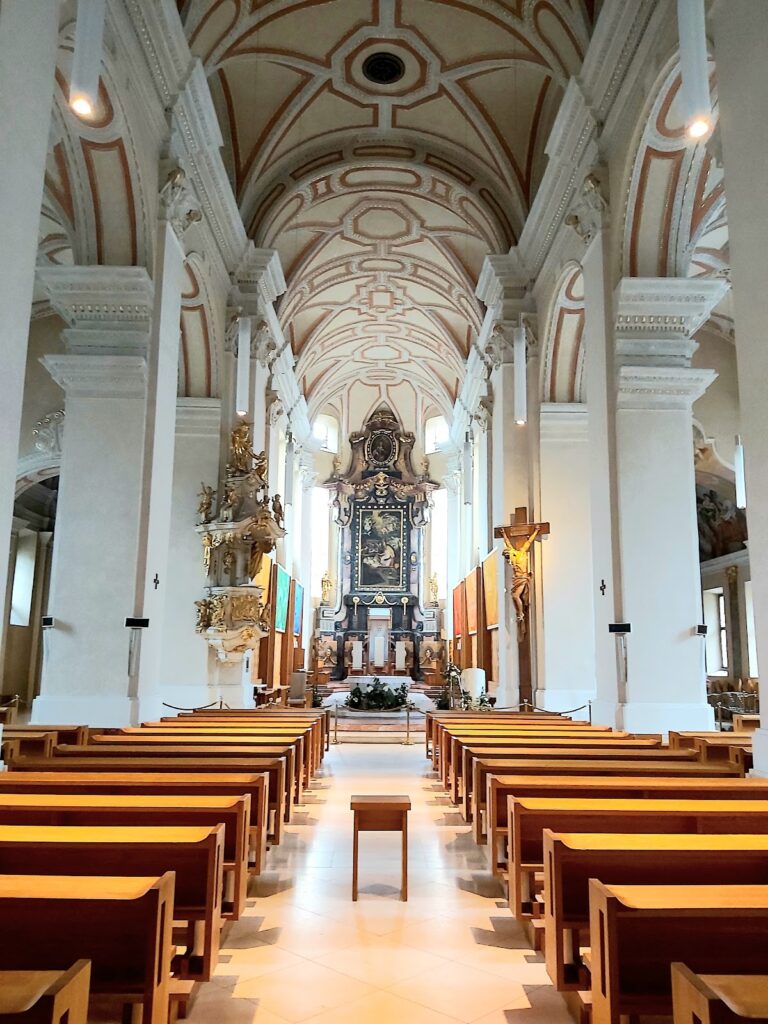
The Neo-Gothic chapel contains an altar framed by a large Late Gothic arch, combining the nineteenth-century chapel interior with an older architectural form.
Gallery buildings
The former stables and orangery, a glazed garden building traditionally used to protect plants from cold weather, have housed the Aleš South Bohemian Gallery since 1956. The gallery presents paintings by Dutch and Flemish artists of the seventeenth and eighteenth centuries, together with sculptures.
Nearby sites