St. George’s Cathedral, Wiener Neustadt: Castle Chapel and Military Cathedral


Site at a Glance
- Rating
- 4.7
- Popularity
- Low
- Country
- Austria
- Primary era
- Medieval
- External website
- Open
- Eras represented
- Medieval, Early Modern, Modern
- Civilizations
- Habsburg, Holy Roman Empire
- Site type
- Religious
- Remains
- Cathedral
On this page15 sections
History
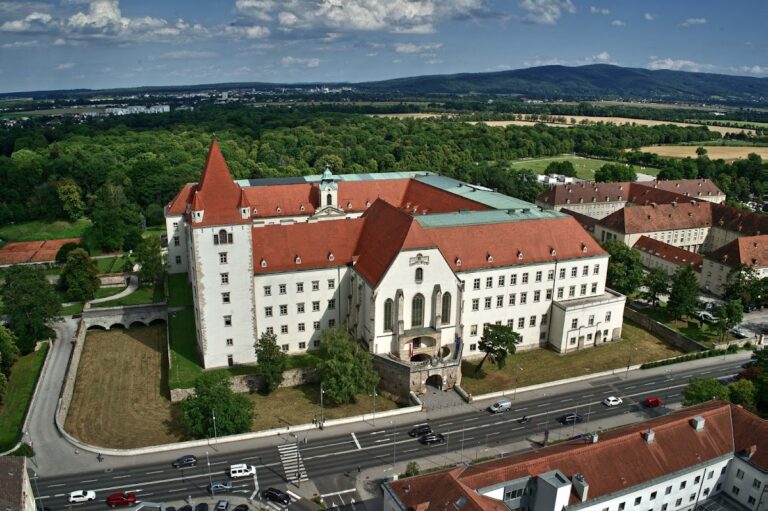
St. George’s Cathedral in Wiener Neustadt, Austria, is a Gothic castle chapel built for the Habsburg rulers on the west side of Wiener Neustadt Castle around 1440 to 1460. Frederick III commissioned the building, and the master builder Peter von Pusica carried out its construction. Originally dedicated to Saint Mary, the church was completed and consecrated in 1460. Its position within the castle and its dynastic imagery reflected the close connection between worship and Habsburg rule.
Habsburg Chapel and the Order of Saint George
The chapel was intended in part to serve as a Habsburg burial place. Maximilian I, the son of Frederick III and a future Holy Roman Emperor, was born in Wiener Neustadt Castle. In accordance with his testament, he was buried beneath the former high altar in 1519, seven steps above the present floor level. He was placed there as a penitent but wore the vestments of the Order of Saint George.
The Order of Saint George, a religious-military order, transferred its headquarters to Wiener Neustadt in 1479. The chapel’s dedication consequently changed from Saint Mary to Saint George. The order’s presence strengthened the church’s military and dynastic associations, which continued long after the order itself was suppressed by the pope in 1600.
The church suffered during the Turkish siege of Wiener Neustadt in 1529, when the castle was damaged. After the suppression of the order, pastoral responsibility passed first to the Jesuits, and later to the Cistercians and Piarists. Fires in 1608 and 1616 caused further damage to the castle and church. Archduke Maximilian III initiated repairs, and the bells were later recast or replaced. In 1659 the bell installation was moved to the castle’s northwestern tower, known as the Rakoczy Tower.
The Theresian Military Academy
St. George’s became closely associated with the Theresian Military Academy after Empress Maria Theresa established the Noble Military School, or academy, at Wiener Neustadt on 14 December 1751. The academy cemetery was laid out in 1753, followed by its cemetery chapel in 1754. The academy came under the jurisdiction of the Bishop of Wiener Neustadt while remaining separate from the city parish. A severe earthquake in 1768 destroyed three castle towers, and the castle’s west wing was built between 1769 and 1777, obscuring the church’s southern window. The main entrance was also given its present double staircase in 1777.
The church was restored between 1936 and 1938, when frescoes above the main entrance were uncovered. Bombing on 12 March 1945 largely destroyed the castle and church. Reconstruction began in 1946 and was completed in 1951, after which Archbishop Theodor Innitzer reconsecrated the building. The reconstructed church incorporated surviving elements, including the original baptismal font and the Cherry Madonna, while many furnishings had to be remade.
Military Cathedral
When the Theresian Military Academy resumed operations in 1958, the church returned to military chaplaincy. It became the seat of the Austrian military vicar in 1963 and was elevated to a minor basilica and a daughter church of the Lateran Basilica in 1967. On 1 July 1987 it became the cathedral of the Austrian Military Ordinariate under Austria’s first military bishop, Alfred Kostelecky. The ordinariate is the Roman Catholic jurisdiction responsible for pastoral care of Austria’s armed forces, so the cathedral serves a military ecclesiastical jurisdiction rather than a territorial diocese.
The interior was refurnished in 1986, with further changes between 1988 and 1990. These included new chandeliers, a raised floor, an altar accessible from all sides, and electric heating beneath the pews. An anteroom was converted in 1990 into the burial place of Bishop Alfred Kostelecky, who was buried there in 1994. For the 2019 Lower Austrian State Exhibition, held to mark the five-hundredth anniversary of Maximilian I’s death, the interior was altered again. A competition produced five designs, and the jury selected the proposal by the Tyrolean artists Martin and Werner Feiersinger. Military Bishop Werner Freistetter consecrated the new altar on 11 January 2019.
The church continues to serve both as the cathedral of the Austrian Military Ordinariate and as the church of the Theresian Military Academy. Its present form therefore combines a fifteenth-century Habsburg foundation, the legacy of the Order of Saint George, and its later role in Austria’s military pastoral structure.
Remains
Building and Spatial Arrangement
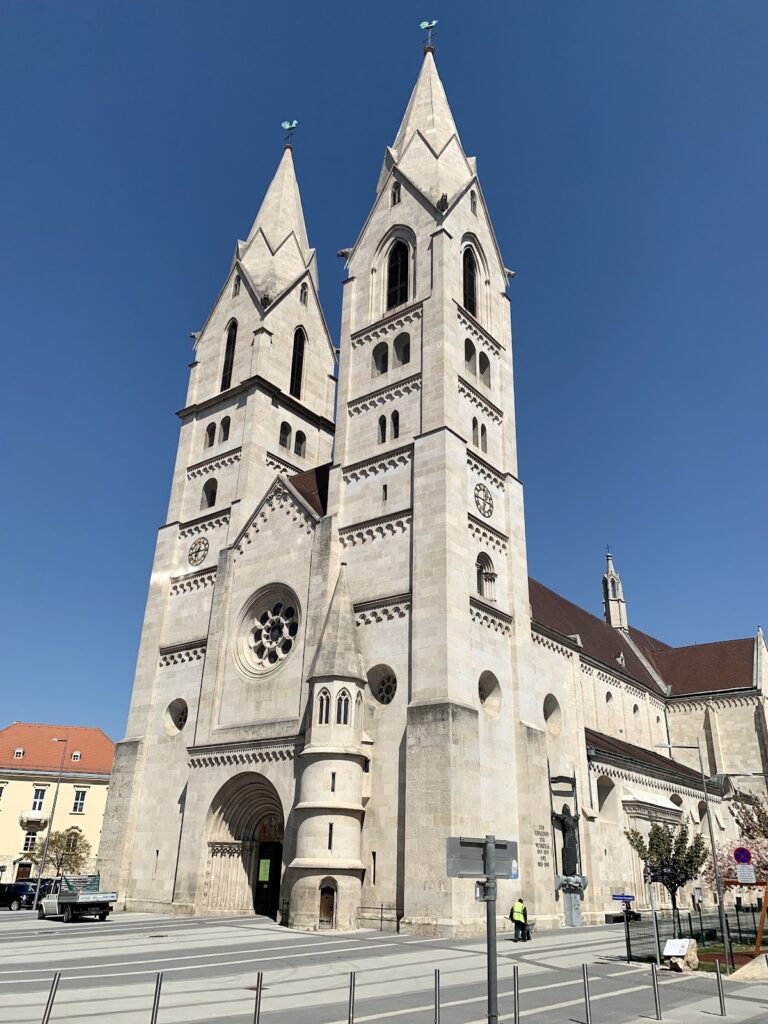
St. George’s Cathedral is a three-aisled Gothic hall church without an apse. It measures 32.15 metres in length, 18.80 metres in width, and 15.01 metres in height. The floor is surfaced with Untersberg marble. The church stands above a five-bay gate hall, probably completed in 1449. Eight round columns, each more than 13 metres high and about 90 centimetres in diameter, carry the gate hall’s flat late Gothic vault. Above it, the nave has a star-rib vault, whose ribs form star-like patterns, while the side aisles have simpler cross-rib vaults.
A gallery runs around three sides of the interior and continues into an oratory, a private or restricted chapel space, on either side of the altar area. Corbels joined by pairs of interlocking arches support the gallery. It carries 55 coats of arms, with 21 on the south side, 19 on the west, and 15 on the north. Their arrangement derives from a model in Grünberg’s Austrian Chronicle and presents a genealogical image of Habsburg rule. The emperor’s oratory on the left is more richly decorated than the one on the right.
The main entrance is reached by a double staircase within the portal, built in 1777. The late fifteenth-century fresco in the tympanum, the field above the doorway, shows Jesus, Saint John, and Saint Coloman. Above the gallery, a heraldic shield displays the imperial double-headed eagle and the Habsburg lion.
The church has nine windows. Three are on the eastern altar side, three are on the west, two are on the north, and one is on the south. Only the eastern windows retain historic painted glass; the other openings contain blue antique glass. The southern window was obscured when the castle’s west wing was constructed between 1769 and 1777.
Dynastic Wall and Painted Decoration
The Heraldic Wall
Peter von Pusica erected the heraldic wall on the eastern interior wall in 1453 for Frederick III. It presents a partly invented genealogy of the House of Austria based on the Chronicle of the 95 Rulers, compiled in 1384 and 1385 by the Viennese cleric Leopold Stainreuter. Only 19 of the wall’s 107 coats of arms are authentic. These genuine arms represent Habsburg possessions in Frederick III’s time, including territories and lordships in Austria, Styria, Carinthia, Carniola, Tyrol, Alsace, Burgundy-related lands, and other Habsburg holdings.
Fifteen coats of arms were remade during the postwar reconstruction, and two more were restored. The upper part of the wall contains figures of Saint Barbara, a copy of the Cherry Madonna representing Saint Mary, and Saint Catherine. The two outer figures were remade during reconstruction. The original sculpted Cherry Madonna and a figure of Frederick III shown as archduke are the only surviving original figures from the wall’s sculptural group. They are later than the wall, probably dating from about 1470 and possibly made by a Wiener Neustadt master.
Fresco and Crucifix
A column in front of the right oratory preserves a comparatively well-preserved fresco from Frederick III’s period. Its nine scenes may have been modeled on fifteen miniatures in Frederick’s prayer book. The paintings include episodes from the lives of Jesus and Mary, among them the Resurrection and Ascension, Pentecost, the Assumption and Coronation of Mary, the Adoration of the Magi, the Presentation in the Temple, the Flight into Egypt, and the twelve-year-old Jesus in the Temple.
The same column carries a large crucifix. Its figure of Christ is an Austrian work of the fourteenth century, while the cross was renewed in 1988.
The Eastern Windows
The eastern late Gothic windows preserve fragments from glass made in 1478 and 1479. The earlier windows were damaged during Matthias Corvinus’s siege of Wiener Neustadt from 1485 to 1487. Replacement windows made by a Netherlandish painter in 1492 were then damaged in a fire two years later, and Ferdinand I commissioned another replacement scheme in 1558. The surviving eastern windows are important examples of Mannerist art, a sixteenth-century style associated with elongated forms and sophisticated artificiality.
The central eastern window is 7.59 metres high and 2.53 metres wide. Beneath the Baptism in the Jordan, it shows Philip the Handsome, Maximilian I, Bianca Maria Sforza, Maria of Burgundy, and Margaret. Their coats of arms represent Spain, the empire, the Sforza family, and Burgundy. The apostle Andrew above Philip refers to the Habsburg and Burgundian connection through his association with the Order of the Golden Fleece.
The two side windows are each 1.89 metres wide and contain saints in 18 panels. Female saints generally appear in the right-hand window and male saints in the left, although male saints also occupy the second register of the right window. Their glass construction, painting technique, and the form of the date 1479 beneath the A.E.I.O.U. Habsburg emblem in the upper part of the right window indicate sixteenth-century production.
Altars, Tombs, and Sacred Furnishings
Altar Area and Madonna
Seven steps lead to the former high altar, beneath which Maximilian I was buried in 1519. The first Gothic high altar was reportedly decorated with Albrecht Dürer’s Baptism in the Jordan. Archduke Maximilian III later replaced it with a winged altar. In 1770 Maria Theresa commissioned another high altar and replaced the two side altars with Baroque altars.
A Milanese bronze Saint George that once stood on the high altar during the period of the order was placed on the former altar. It was stolen in 1948 and broken into 14 pieces before being restored. The bishop’s chair, or cathedra, stands between the present people’s altar and the right side altar. It bears the military bishop’s coat of arms and motto.
The original Cherry Madonna, made around 1470, now stands on the right side altar. The Madonna holds the Christ Child, who carries a small basket of fruit. A copy replaced the sculpture in 1938, allowing the original to escape the destruction of 1945. The left side altar is the sacrament altar and contains a newly created tabernacle. The altar scheme introduced in 2018 incorporates relics of Saint George, Saint Leopold, Blessed Jakob Kern, and Blessed Charles I of Austria.
Baptismal Font and Reliquary
The twelve-sided baptismal font is made of Adnet red limestone and dates from the fifteenth century. It belonged to the original church and was probably used for the baptism of Maximilian I in 1459.
The reliquary shrine, a structure made to contain relics, was probably produced around 1480 and donated by Frederick III. It originally stood about 5.68 metres from the entrance on four bronze columns. Coats of arms of Habsburg possessions decorated it, while 14 panels showed saints associated with its relics. Frederick III’s monogram appeared on the central panel. Relics were removed for Rudolf II and taken to Prague, an action recorded by Bishop Lambert Gruber of Wiener Neustadt in 1580.
The shrine was dismantled during the church rebuilding of 1779 under Franz Joseph Count Kinsky, the academy’s chief director. Its two outer sections were placed in the presbytery of Neukloster Church. Restoration in 1989 reunited the sections, reconstructed the missing central part, and rebuilt two large pinnacles.
Organ and Bells
The present organ is the fourth in the church. Johann Marcellinus Kauffmann made it in 1951 with two manuals, a pedal, 23 stops, and 1,519 sounding pipes. The number of pipes refers to the year of Maximilian I’s death. The organ was renovated in 1993 and again in 2024 and 2025.
The present peal consists of three bronze bells tuned in B minor. The large bell was cast in 1617 by Heinrich Reinhart in Innsbruck. It weighs 3,850 kilograms and carries depictions of the Crucifixion and the Fourteen Holy Helpers, a group of saints traditionally invoked together in times of danger and illness. Josef Pfundner recast the middle George Bell in 1950. Emperor Franz Joseph I donated the small bell in 1896, and it bears his image.
The earlier four-bell peal, tuned to B, D-sharp, F-sharp, and B, was housed in the Rakoczy Tower and lost in the fires of 1608 and 1616. Four replacement bells were cast in 1617. The surviving small Reinhart bell was retired after cracking in 1880, the second-largest was probably recast around the same time, and the F-sharp bell was recast in 1896. During the interwar period, the large bell was transferred to Wiener Neustadt Cathedral and the smaller bell to Neukloster Church, allowing them to avoid destruction in the Second World War. They returned to the reconstructed Rakoczy Tower in 1951. The cracked small bell was welded in 1959, but was not rehung there and was instead given to the Church of the Sacred Heart of Mary.
Memorials and Commemorative Objects
Near the entrance is a terracotta votive panel from around 1600 showing Archduke Maximilian III with Saint Mary and Saint George. It may have served as a model relief for his planned tomb monument in St. James’s Cathedral in Innsbruck.
A red-marble slab near the first column on the right bears an inscription asking whose bones lie beneath it. A memorial plaque identifies Wolfgang Georg Friedrich of the Palatinate, a Cologne auxiliary bishop who died in Wiener Neustadt in 1683 at the age of 24 while returning from a papal audience in Rome. He was buried in the court church at Neuburg an der Donau. Two further plaques commemorate Siegmund von Dietrichstein, a trusted adviser to Maximilian I, and his wife Barbara. Maximilian ordered the plaques in his testament, while Siegmund von Dietrichstein was buried in Saint James’s Parish Church in Villach.
On the first upper floor, an anteroom contains Alfred Kostelecky’s marble sarcophagus and a metal representation of his episcopal coat of arms. Together with the dynastic heraldry, tomb associations, military emblems, and reconstructed furnishings, these features preserve the cathedral’s changing identity from Habsburg chapel to military cathedral.
Nearby sites