Burg Wiener Neustadt: Fortress, Imperial Residence, and Military Academy in Austria


Site at a Glance
- Rating
- 4.6
- Popularity
- Very Low
- Country
- Austria
- Primary era
- Early Modern
- Eras represented
- Medieval, Early Modern, Modern
- Civilizations
- Habsburg, Holy Roman Empire
- Site type
- Military
- Remains
- Castle
On this page14 sections
History
Burg Wiener Neustadt is a medieval urban fortress complex in Austria, built by the Babenberg rulers and enlarged during the early thirteenth century to protect the fortified city against the Kingdom of Hungary. Its history extends from a first fortress associated with the ransom of Richard the Lionheart to its later role as an imperial residence and the seat of the Theresian Military Academy.
Foundations and Babenberg fortification
The first fortress at Wiener Neustadt was built around 1193–1194 together with the city walls. Its construction was financed by the ransom paid for Richard the Lionheart. Tradition places this early stronghold at the northeastern corner of the city, although archaeological evidence has not confirmed that location.
Because the first castle soon proved too small, a larger one was built on the present site at the beginning of the thirteenth century under Leopold VI, Duke of Austria, who ruled from 1198 to 1230. The Babenbergs, the dynasty that ruled Austria and Styria before the Habsburgs, intended the city and castle to secure their frontier against Hungary. Under Duke Frederick II, the last Babenberg duke of Austria and Styria, the castle was strengthened with a moat, outer walls, and towers.
The castle appears in a document from 1260. Its wall had been removed under Otakar II of Bohemia by 1253 and was rebuilt late in the thirteenth century. In 1246, the Battle of the Leitha was fought east of the castle. Frederick II was killed in that battle, which took place near the river that historically formed part of the boundary between Austria and Hungary.
Habsburg rebuilding and fifteenth-century prominence
Earthquakes in 1348 and 1356 destroyed the earlier Babenberg castle. Leopold III of Habsburg began a larger rebuilding campaign in 1378, and a surviving keystone from the former chapel bears the date 1379. The castle and the city reached their greatest importance in the fifteenth century, when Emperor Frederick III, a Habsburg ruler and Holy Roman Emperor from 1452, used the complex as his residence for several decades.
During Frederick III’s residence, St. George’s Cathedral and the heraldic wall were created. After the 1452 siege, Frederick founded the Order of St. George, a chivalric religious order, and the castle became its seat. The order’s residence there ended in 1598.
The castle was besieged in 1452 by an Estates’ army of about 16,000 men during the conflict over Frederick III’s guardianship of Ladislaus the Posthumous, the minor Habsburg ruler who inherited the crowns of Hungary and Bohemia. After negotiations, Frederick surrendered his ward. Matthias Corvinus, King of Hungary from 1458 to 1490, began another siege in 1486. It lasted two years, and his troops were expelled from the castle and city after his death in 1490.
Imperial retreat, prison, and wartime damage
Under Emperor Maximilian I, Frederick III’s son and successor as Holy Roman Emperor, the castle ceased to be a permanent residence. It served instead as an imperial retreat or hermitage. Maximilian was buried in St. George’s Chapel in 1519.
In 1521, Archduke Ferdinand, later Emperor Ferdinand I, withdrew to the castle during resistance by the Protestant Estates, representative bodies of the territories’ privileged orders. The Vienna city government was subsequently arrested, tried in the Wiener Neustadt Bloody Trial, and executed at the castle. A tower was later adapted as a state prison known as the Rákóczi Tower. Its prisoners included Franz II Rákóczi and Peter, Count Zrin.
The castle was attacked but not captured during the Ottoman siege of Vienna in 1529, and it was not attacked during the later siege of 1683. Fires in 1608 and 1616 caused major damage. In 1743, the complex held 1,400 French prisoners of war. A pestilential epidemic caused many deaths, and the castle remained closed for two years after the surviving prisoners had left. It was subsequently little used and fell into disrepair.
The Theresian Military Academy
Empress Maria Theresa, the Habsburg ruler of Austria and queen of Hungary and Bohemia from 1740 to 1780, founded the Theresian Military Academy in 1751. She designated the castle for the education of up to 200 officer cadets. The academy began operating in 1752 after extensive alterations directed by Matthias Gerl, an architect from Vienna.
An earthquake in 1768 severely damaged the castle and made it uninhabitable. Nikolaus Pacassi directed its rebuilding and conversion into a modern training institution. From 1777 until the Second World War, the overall condition of the complex remained largely unchanged. The castle continued as the academy’s institutional home apart from interruptions after the First World War, and the academy reopened in 1934.
Near the end of the Second World War, bombing, fires, and looting almost completely destroyed the castle in 1945. Only the outer walls remained, and a fire lasted fourteen days between April and May. The ruins were restored in historically recognizable form between 1946 and 1959, while the interior arrangement was adapted to contemporary requirements. The Military Academy resumed operations in 1958. The castle, once the property of the sovereign, is now owned by the Republic of Austria and remains the seat of the Theresian Military Academy.
Remains
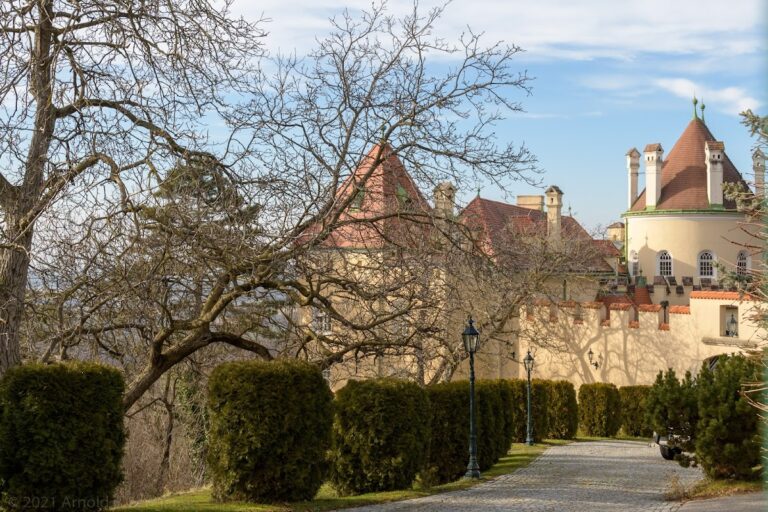
Burg Wiener Neustadt occupies the southeastern side of the city as an urban fortress complex. The castle on the present site was built in marshy ground on wooden piles and later enclosed by a moat, outer walls, and towers. Sections of the earlier walls survive in the cellar vaults. The postwar restoration retained the historical foundations where possible, while the interior room arrangement was modernized.
Castle wings and courtyard
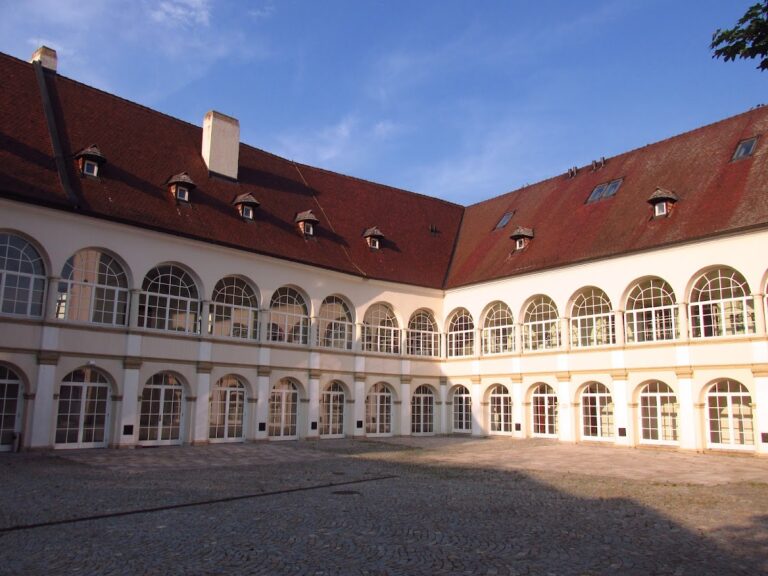
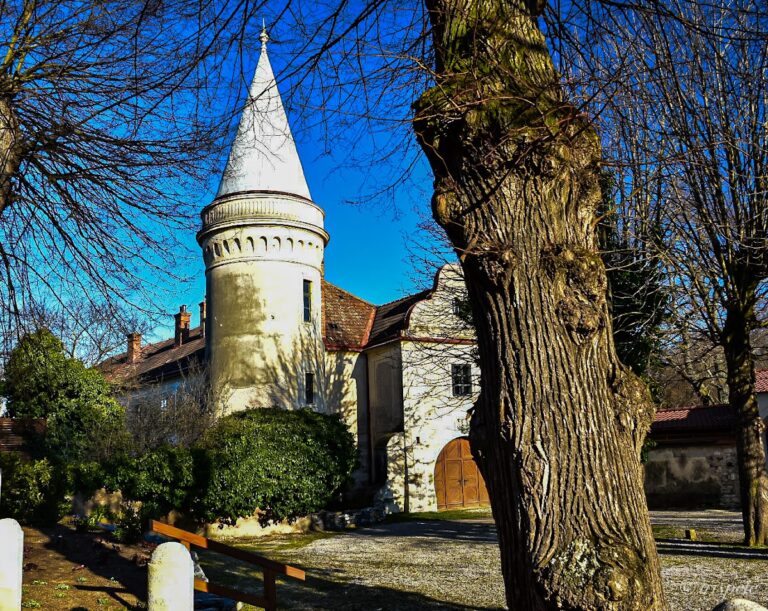
Before the rebuilding of the eighteenth century, the castle had four corner towers. Three were removed after the earthquake of 1768. The east wing contains the imperial rooms created during the subsequent reconstruction. The former Corpus Christi Chapel was replaced by the main staircase, and the same rebuilding produced the western portal. In the east wing, the Generals’ Staircase has a direct spatial relationship with Maria Theresa Square.
Numerous examples of the inscription A.E.I.O.U. appear throughout the castle. The initials were used as a personal and dynastic device by Frederick III, although their exact expansion has long been debated. The heraldic wall can be seen from the castle courtyard.
St. George’s Cathedral
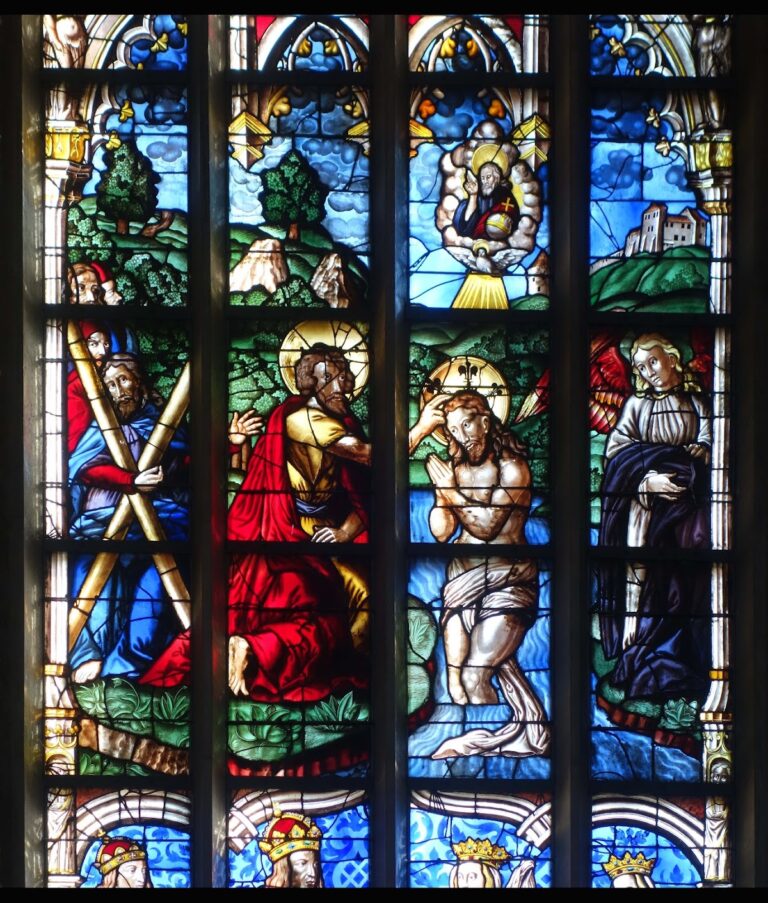
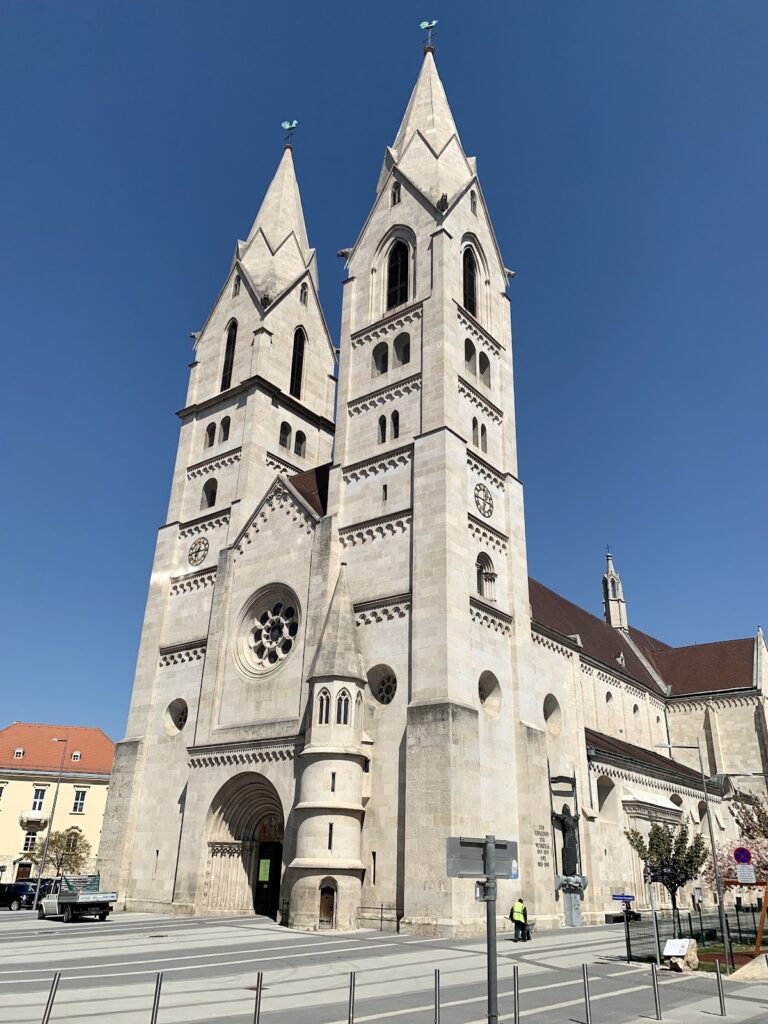
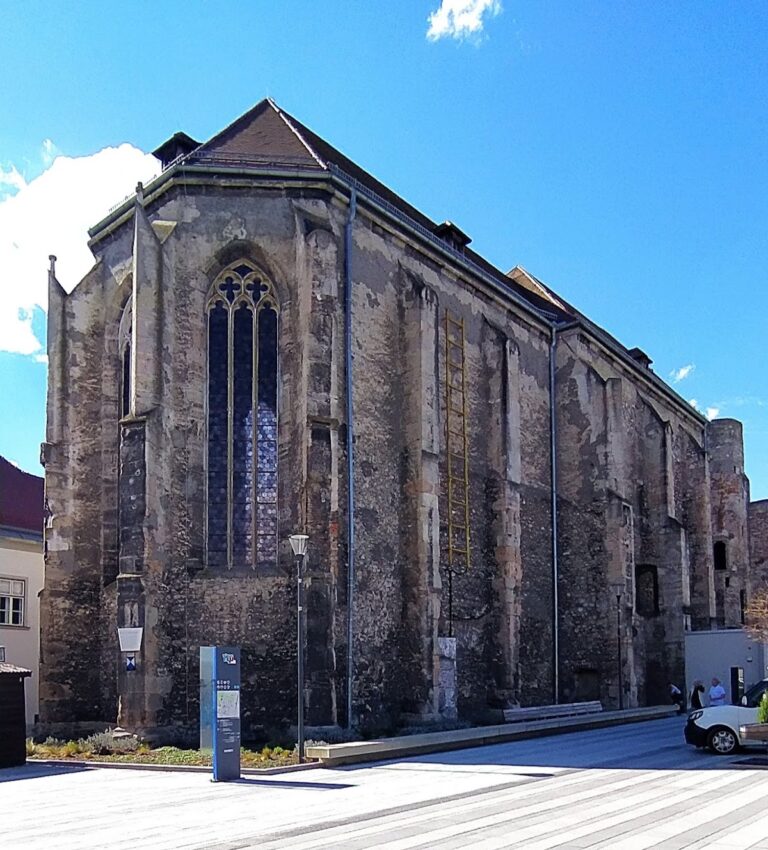
St. George’s Cathedral is a late Gothic, three-nave hall church built by Peter von Pusica between 1440 and 1460. In a hall church, the central nave and side aisles are approximately equal in height, creating a unified interior space. The building replaced the Chapel of St. Mary, also known as Our Lady’s Chapel. Under Frederick III, it became St. George’s Chapel and served as the seat of the Order of St. George.
Maximilian I was buried beneath the steps of the high altar in 1519. The cathedral was almost entirely destroyed during the Second World War. One original column survived, and the church was rebuilt in 1945 with white sandstone from Kaisersteinbruch. It became the seat of the Austrian military bishop in 1963 and was raised to cathedral status in 1987. Since 1990, the Austrian military bishop has held the former Diocese of Wiener Neustadt, dissolved in 1784, as a titular see, a former or nominal diocese assigned to a bishop without serving as a residential diocese.
Maria Theresa Square and Academy Park
Maria Theresa Square lies in front of the east wing within the castle complex and forms part of the Military Academy grounds. Three monuments border the square, dedicated to Maria Theresa, Emperor Franz Joseph, and Count Kinsky. Franz Joseph I was Austrian emperor from 1848 to 1916.
Academy Park occupies the formerly marshy area between Wiener Neustadt and the Leitha. Frederick III had the area drained and established a zoological park there, which remained until 1751. The approximately 106-hectare grounds were later redesigned as an English landscape park and include the cemetery of the Theresian Military Academy.
Park walls and commemorative monuments
Zeiselmauer
Between 1446 and 1465, the Zeiselmauer, or “Long Wall,” enclosed the fifteenth-century zoological park. The wall was almost six kilometres long, and the enclosed grounds later developed into Academy Park.
Rosen Hill obelisk
On Rosen Hill, at the intersection of Fohlenhof Avenue and Great Cross Avenue, a marble obelisk topped by a sphere marks the meridian line at noon. A gloriette formerly stood on the hill. The obelisk records imperial visits associated with the academy between 1769 and 1918. The hill is also traditionally linked with the engagement of Maria Theresa and Franz of Lorraine in 1735.
Kaiserstein memorial
The Kaiserstein memorial commemorates the sixtieth anniversary of Emperor Franz Joseph I’s reign. It consists of a boulder from the Malleiten near Fischau, set on a grass mound and surmounted by a rising bronze double-headed eagle with a dedicatory votive plaque. Major Loidolt designed the monument. Mitterreiter and Dworschak modelled the eagle, which Hans Frömmel cast. The Military Academy’s teaching staff and cadets financed the memorial.
Monument of the 1,400
The Monument of the 1,400 was erected in 1880 to designs by Rudolf Weyr in memory of graduates of the Theresian Military Academy who died in war. Its name refers to approximately 1,400 individually listed dead, a total reached through additions after the First and Second World Wars. The central feature is a monumental memorial wall with marble tablets and the inscription “Faithful unto Death.”
Nearby sites