Neukloster Monastery: A Cistercian Foundation in Wiener Neustadt
Site at a Glance
- Rating
- 4.6
- Popularity
- Low
- Country
- Austria
- Primary era
- Medieval
- External website
- Open
- Eras represented
- Medieval, Early Modern
- Civilizations
- Duchy of Austria, Habsburg, Holy Roman Empire
- Site type
- Religious
- Remains
- Monastery
On this page17 sections
History
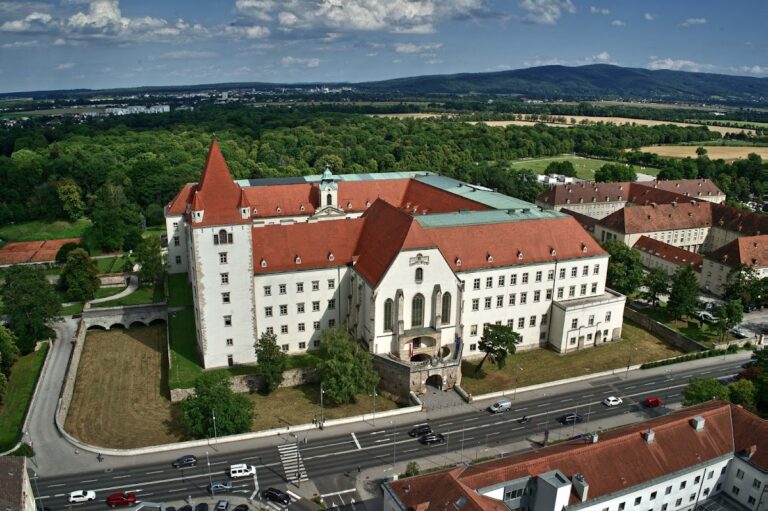
Neukloster Monastery is a Cistercian monastery in Wiener Neustadt, Austria, founded in 1444 by King Frederick III and dedicated to the Holy Trinity. The complex belongs to the late-medieval history of the city and was intended to become a dynastic burial foundation for the Habsburg ruler and his family. Its monks came from Rein Abbey, and the monastery formed part of the Austrian Cistercian Congregation, whose tradition derived from Morimond. Cistercians were a reform branch of Western Christian monasticism that emphasized communal discipline, liturgical observance, and a comparatively austere way of life.
Foundation and dynastic purpose
The site had previously housed a Dominican monastery founded in 1227 by Duke Leopold VI. After the Dominicans left, Frederick III secured the complex for the Cistercians. The name Neukloster, meaning “new monastery,” referred both to the new foundation and to Cîteaux, the original Cistercian monastery traditionally invoked as the exemplary novum monasterium. Frederick, a Habsburg ruler who became Holy Roman Emperor in 1452, acted as the monastery’s royal founder and principal patron.
The first abbot came from Rein. From 1446, the office was held by Gottfried von Otterstätt, formerly cellarer of Maulbronn Abbey. Frederick endowed the monastery with Rohr fortress near Wildon, which had been confiscated from a supporter of Albrecht VI, and with an annual payment of 300 pounds pfennigs from the parish of St. Peter in Ljubljana. These endowments helped establish the economic basis of the new house.
Neukloster also developed an unusual pastoral role for a Cistercian monastery. In the decades after its foundation, its monks received dispensations to serve as pastors. A document of 1457 allowed women to attend Mass at the rood screen, a partition or gallery separating the chancel from the nave in a medieval church.
The foundation was intended to serve as a dynastic burial place. Empress Eleonore Helena of Portugal, Frederick’s wife, was buried in the abbey church in 1467, and three of the couple’s children were buried there as well. Frederick himself was ultimately interred in Saint Stephen’s Cathedral in Vienna, so the planned imperial burial foundation was not completed.
Early-modern administration and rebuilding
The monastery experienced periods of serious decline during the early modern period. A visitation in 1640 found the community in poor condition. Abbot Johann Jakob Pettard, who was seriously ill, resigned and died soon afterward. Bernhard Breil succeeded him but became abbot of Baumgartenberg in 1649. On 21 March of that year, a fire destroyed much of the monastery. Robert Notius, formerly abbot of Michaelstein and later parish priest of Eisenstadt, then became abbot of Neukloster.
Abbot Alexander Standhartner, who governed from 1683 to 1707, began a major phase of reconstruction and Baroque alteration. Later generations described him in an inscription as the “second founder.” He transformed the church, enlarged the convent buildings, and commissioned the Chapel of the Holy Cross near the west portal. Under Abbot Alberich Stingel, who served from 1775 to 1801, Maria Theresa gave the monastery the former military-academy garden. It was laid out between 1776 and 1781 and connected to the monastery by a two-winged stone staircase.
During the eighteenth century, Neukloster became a favored residence of the imperial family and a center of local prosperity. From 1797 until October 1803, Archduke Ferdinand Karl of Austria-Este, his wife Maria Beatrice d’Este, and their children lived there after their expulsion during the Coalition Wars, a series of conflicts in which European powers fought revolutionary and Napoleonic France.
Parish, school, and liturgical life
The Josephine reforms, the church policies of Emperor Joseph II that placed monasteries, parishes, schools, and other religious institutions under closer state control, put Neukloster under considerable pressure without suppressing it. In 1784, the monastery church became the second parish church of Wiener Neustadt. A grammar school opened in 1804 and passed into state administration in 1871. Its teachers included monks from Heiligenkreuz, Zwettl, Lilienfeld, and Neukloster.
The church also hosted an important musical event. Mozart’s Requiem was performed there in 1793 as a Requiem Mass for the deceased wife of Count Franz von Walsegg. This was the first performance of the work in the liturgical setting for which Walsegg had commissioned it.
Neukloster’s wider pastoral network included the pilgrimage church of Maria Kirchbüchl at Höflein an der Hohen Wand from 1608. The monastery also incorporated the parishes of St. Johann am Steinfeld, Ternitz-St. Lorenzen, and St. Valentin-Landschach from 1617, followed by St. Peter im Moos and Schloss Strelzhof in 1662, and Maiersdorf from the same year.
Union with Heiligenkreuz
Long-term financial weakness led to the union of Neukloster with Heiligenkreuz Abbey, approximately 30 kilometres away, in 1880 and 1881. This unio extinctiva was a union in which one religious institution was extinguished and its property and remaining community absorbed by another. The Neukloster community died out, its independent status ended, and the complex became a priory of Heiligenkreuz. On 11 January 1882, its fifteen capitulars swore obedience to Heinrich Grünbeck, the abbot of Heiligenkreuz.
Neukloster remains a simple priory of Heiligenkreuz under the Latin designation Prioratus simplex ad Sanctissimam Trinitatem. Michael Weiss has served as prior since 2019. A public museum developed during the first half of the nineteenth century from the monastery’s earlier collections. In 2017, these collections were reorganized and opened under the Baroque designation Kunst- und Wunderkammer, and the monastery formed part of the Lower Austrian State Exhibition in 2019.
Remains
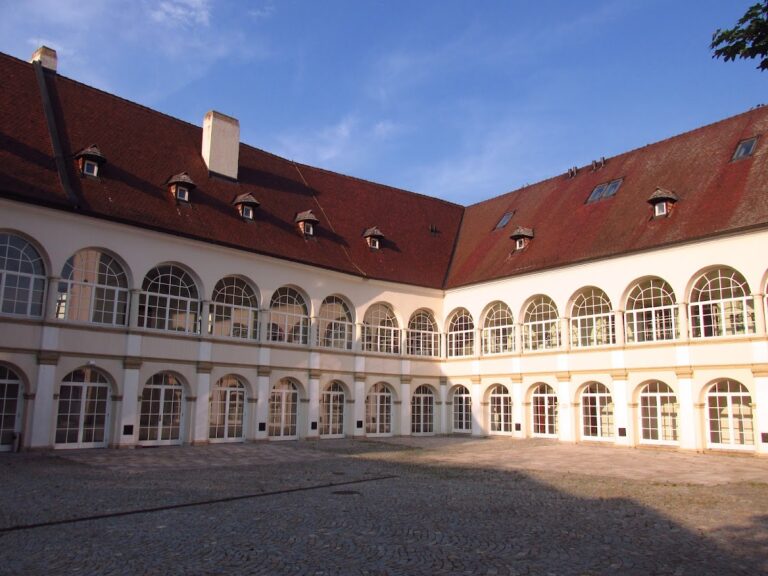
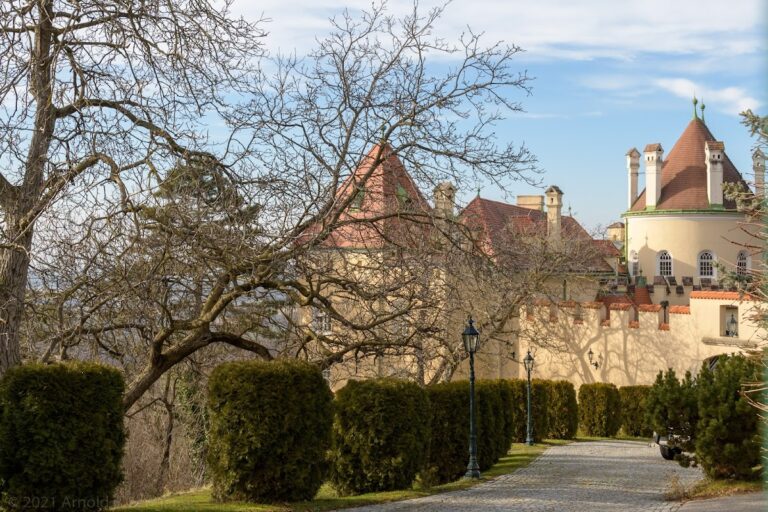
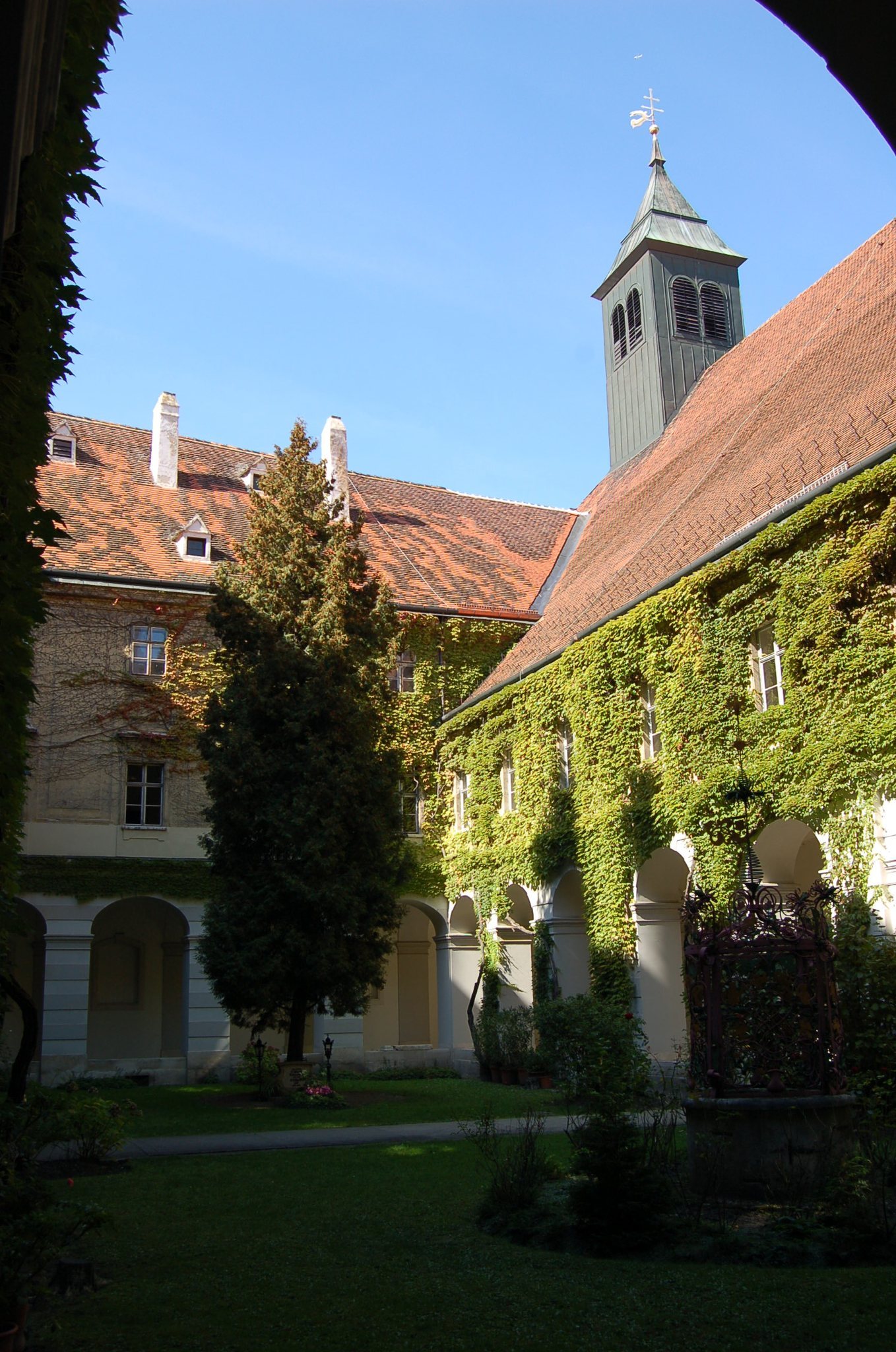
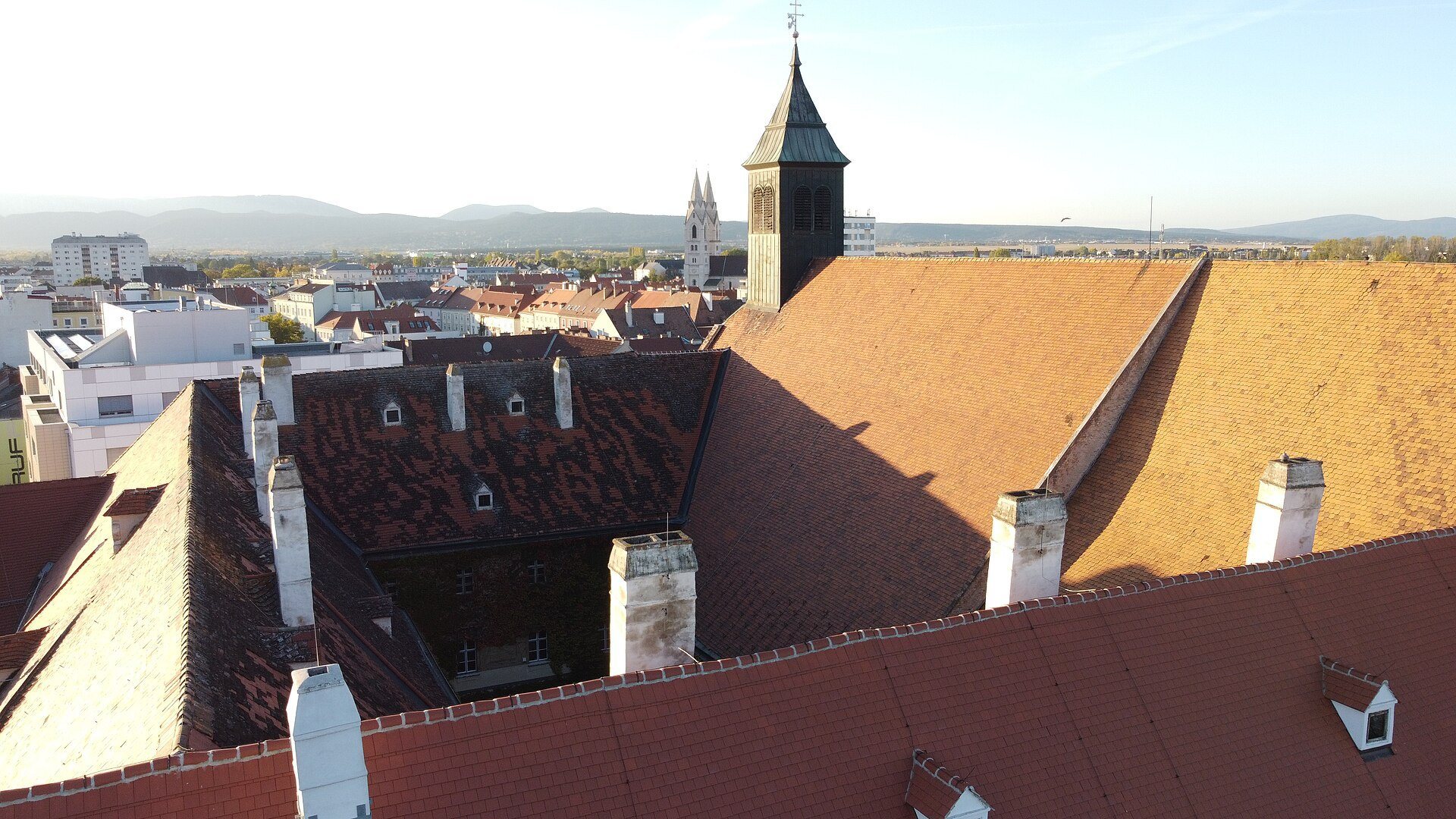
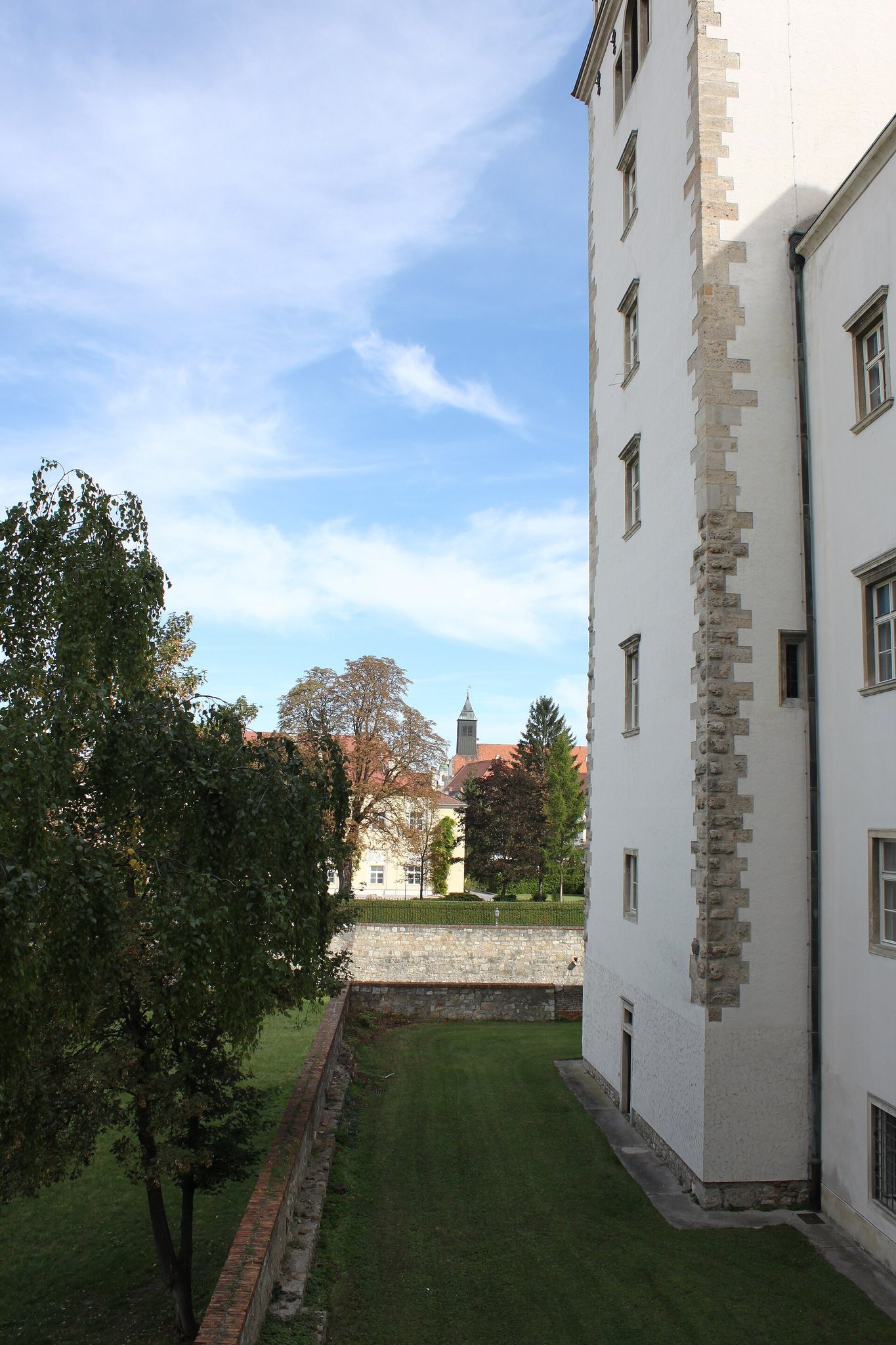
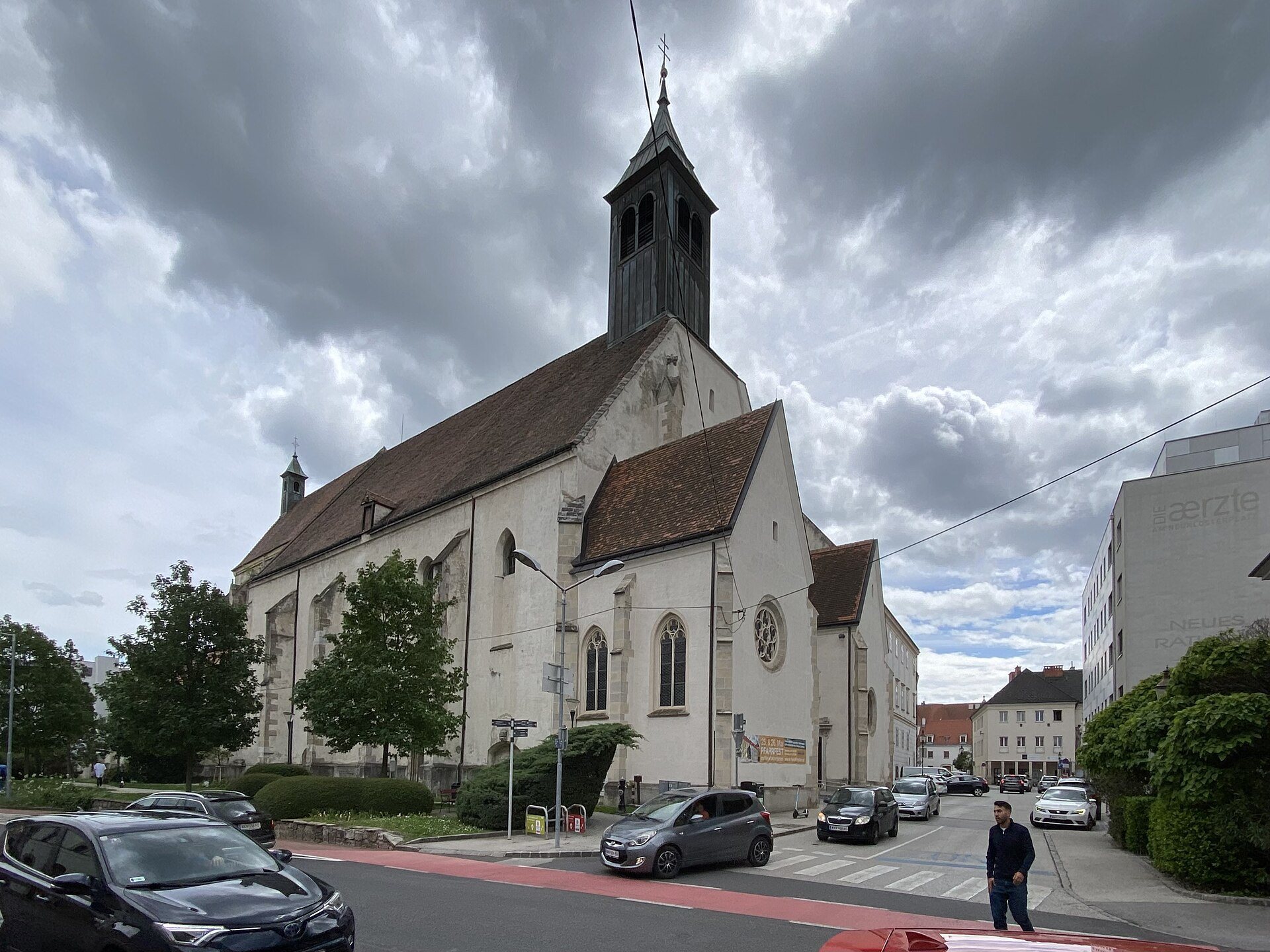
The surviving complex combines a late-medieval monastery church with Baroque alterations, convent buildings, a cloister, a garden, a library, and associated chapels. Its interiors preserve tombs, heraldry, paintings, inscriptions, and furnishings that reflect both the original Cistercian foundation and its later role as an imperial residence and priory of Heiligenkreuz.
Abbey church
Tombs and memorials
The church’s apse contains the tomb of Empress Eleonore Helena of Portugal, while three children of Eleonore and Frederick III are buried opposite her. The tombstone is attributed to the Netherlandish sculptor Niclas van Leyden, who was also credited with the tomb monument associated with Frederick III. West of the Angel Altar stands the burial monument of Beatrix Lopi, a chamber woman of Eleonore. Her white sandstone tombstone shows her in shallow relief, wearing a high headdress and a long courtly dress, with a rosary in her right hand. The church also served as a burial place for the West Hungarian noble family of the Counts of Mattersdorf-Forchtenstein.
Altars and paintings
A large Gothic Marian altar donated by Frederick III in 1447 was sold to the Vienna Cathedral Chapter in 1884 and installed in Saint Stephen’s Cathedral, where it is known as the Wiener Neustädter Altar. In Neukloster, the high altar painting depicts the Assumption of Mary and was made by Anton Schoonjans, described as a grandson and pupil of Peter Paul Rubens. Side altars contain works by Martino Altomonte, Michelangelo Unterberger, Francesco Solimena, and Paul Troger, including the Guardian Angel, plague-patron, Holy Family, and John of Nepomuk altars.
Heraldry and earthquake damage
Numerous coats of arms referring to Frederick III appear in the nave, together with his large AEIOU monogram, which is displayed twice. The pillars were left leaning by the Wiener Neustadt earthquake of 27 February 1768 and are supported by iron rods.
Chapels and monastic buildings
Loreto Chapel
A Loreto Chapel was built against the north side of the nave in 1647. Such a chapel imitates the Santa Casa, the small shrine traditionally associated with the house of the Virgin Mary at Loreto in Italy. The Neukloster chapel was intended to provide a daily Mass and a burial place for its founder, Matthias Wägelle of Khielmanßegg. Further endowments followed in 1657 and 1664, including one from Johann Schulz-Morlin, a cavalry officer and citizen. The chapel was dismantled in 1895, and many of its former tombstones were transferred to the abbey church.
Cloister and garden connection
The cloister was renewed in 1723 and 1724, and again in 1763 and 1764, when the work was carried out by the architect Josef Matthias Gerl. A gate to the south aisle erected in 1767 bears a Latin text attributed to Bernard of Clairvaux, the twelfth-century Cistercian abbot and theologian who helped promote the Cistercian reform. The former garden, laid out between 1776 and 1781, is connected with the monastery by a two-winged stone staircase.
Chapel and refectory
The Chapel of the Holy Cross near the west portal belongs to the Baroque rebuilding initiated by Alexander Standhartner. The eastern façade facing the garden and the Baroque refectory were restored in connection with the modern presentation of the monastery. The refectory contains frescoes by Johann Baptist Bergl.
Library and collections
Library hall
The monastery library began with 60 books and seven psalters listed at the foundation. Under Abbot Joseph Stübicher, it expanded substantially from 1750 through the purchase of the libraries of Bishop Ferdinand Count von Hallweil and Johann Wilhelm Count von Wurmbrand-Stuppach. Its historical holdings exceed 9,000 volumes and emphasize history. A Baroque library hall was created in 1774 and decorated with ceiling frescoes by Johann Baptist Wenzel Bergl. A modern glass “room within a room” allows the library to be viewed as part of the exhibition installation.
Art and natural collections
The monastery’s collections brought together objects from many regions and artistic disciplines, heraldic letters, minerals, and 450 portraits. The total collection comprised approximately 4,700 objects. It was formerly kept and partly displayed in the public Neukloster museum before being reorganized as the Kunst- und Wunderkammer.