Schloss Eichbüchl: Castle and Site of Austria’s Second Republic


Site at a Glance
- Rating
- 4.6
- Popularity
- Very Low
- Country
- Austria
- Primary era
- Modern
- Eras represented
- Medieval, Early Modern, Modern
- Civilizations
- Austria-Hungary, Habsburg, Holy Roman Empire
- Site type
- Domestic
- Remains
- Castle
On this page8 sections
History
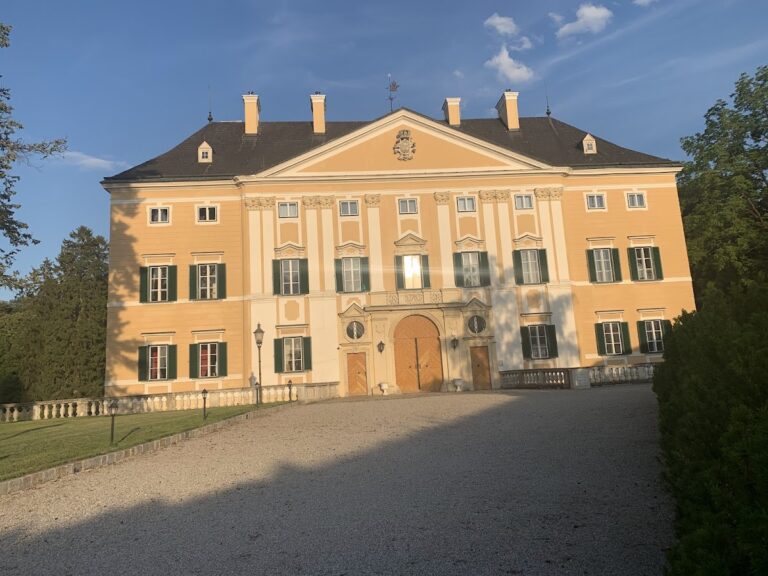
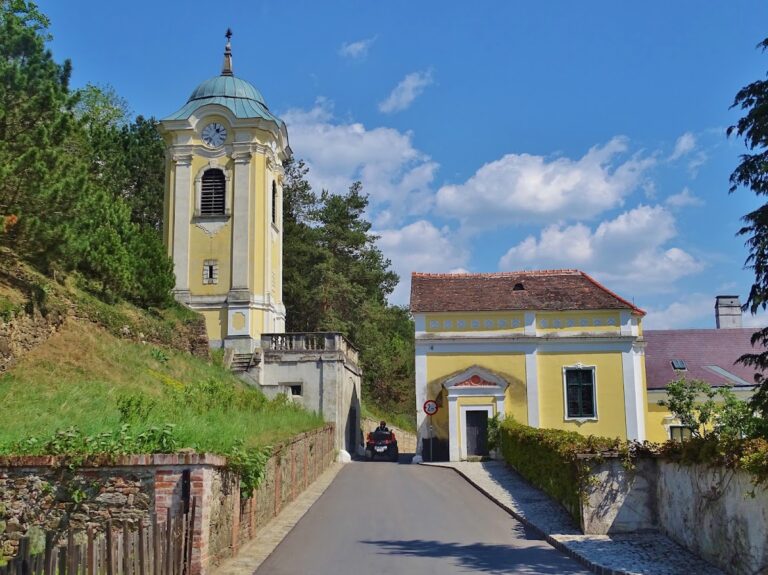
Schloss Eichbüchl is a historic castle in Austria, in Eichbüchl within the municipality of Katzelsdorf, often dated to the fourteenth century and largely shaped by a 1906 remodeling in the confectioner’s style, a decorative architectural manner known for elaborate, cake-like historicist ornament. It is widely associated with the re-establishment of the Republic of Austria in 1945.
Medieval and Early Modern Origins
The castle’s construction date remains uncertain. One tradition places its origins in the fourteenth century, possibly under the Lords of Vierdung, while another dates construction to between 1558 and 1566. A defensive predecessor may have stood nearby before being destroyed during the First Ottoman Siege of Vienna in 1529, the Ottoman campaign against Vienna that affected surrounding parts of Austria. The present castle may then have been rebuilt at a slightly different location, although the relationship between the two structures is not established.
Georg Hohenkircher zu Tegernau and Aichbüchel was the first documented owner, in the fifteenth century. The castle was inhabited by Hans Hohenkircher in 1566, and he died at Eichbüchl in 1571. His widow later married Friedrich von Sinzendorf in 1580. The village of Eichbüchl was founded in 1611, probably through the initiative of Katharina von Donawitz, who was described as the wife of the lord of Aichbüchl.
Estate Ownership and Remodelling
At the beginning of the seventeenth century, Schloss Eichbüchl became part of the Frohsdorf estate. The two castles remained linked in ownership until 1868. The Barons of Teufel held the property in the early seventeenth century, followed by the Counts of Hoyos, who owned it from 1657 to 1818.
After a period of gradual decline, Quirin Ritter von Leitner acquired the castle in 1868 and began restoring it. Friedrich Freiherr von Waldbott-Bassenheim continued the work. In 1906, a Chinese-silk importer completely remodeled the building in the confectioner’s style, giving Schloss Eichbüchl much of the appearance associated with it today.
Until the end of the 1920s, the castle’s history was connected with Jewish entrepreneurs and landowners whose properties included horse farms, dairies, and agricultural estates. A trotting-horse farm on the estate belonged to the Trebitsch family of Jewish industrialists, including Leopold Trebitsch, Siegfried Trebitsch, and the writer and philosopher Arthur Trebitsch.
War, Expropriation, and Political History
Before the Second World War, Erwin Rommel lived at the castle for two years. Following the annexation of Austria in 1938, the property was expropriated. During the war, it was looted and partly demolished, and after 1945 it was returned in a severely damaged and stripped condition.
From 9 to 20 April 1945, Karl Renner stayed at Eichbüchl while working on plans to rebuild the Austrian state. Renner, an Austrian Social Democratic politician, wrote to Joseph Stalin, who led the Soviet Union, and tried to establish contact with Soviet leaders together with Adolf Schärf and Josef Kollmann, a Christian Social finance minister. On 27 April 1945, Renner became State Chancellor of the Second Republic, the Austrian republic established in 1945 after Nazi rule and the Second World War. The first government proclamation of that republic had been prepared at Eichbüchl, which is consequently described as the site of Austria’s political re-establishment.
Postwar Intellectual and Cultural Use
Ernst Florian Winter and his wife, Johanna von Trapp, lived at Eichbüchl from 1964 to 1977. For more than a decade, the castle hosted the Eichbüchl Conversations and Austrian seminars. Participants included the economist Oskar Morgenstern, the sociologist Paul Lazarsfeld, the historian and cultural thinker Friedrich Heer, and Henry Kissinger, an American diplomat and political scholar.
Gedeon Wein, a Hungarian Jewish industrialist, owned the castle from 1977 to 1997. The German violin dealer Dietmar Machold owned it from 1997 to 2011 and used it for meetings and events connected with classical-music enthusiasts, as well as concerts and cultural events. Since 2012, the owner has been the industrialist Walter Burghart. On 27 April 2005, the sixtieth anniversary of the Second Republic, the castle hosted a historical-project presentation initiated and coordinated by the historian Johann Hagenhofer.
Remains
Castle Structure
Schloss Eichbüchl is classified as a rock castle and survives as an existing historic building, with the whole structure or substantial parts of it preserved. Its building history may include reconstruction at a slightly displaced site after the possible destruction of an earlier defensive building in 1529. The exact connection between that predecessor and the present structure remains uncertain. The extensive 1906 remodeling in the confectioner’s style is responsible for much of the castle’s current architectural character.
Entrance and Estate Features
The entrance gate carries a commemorative plaque for Karl Renner’s stay from 9 to 20 April 1945 and his work on plans for the Second Republic. The inscription includes his description of spending twelve days working intensively on plans for its reconstruction. The surrounding estate also included a trotting-horse farm associated with the Trebitsch family.
Nearby sites