St Magnus Cathedral, Kirkwall: A Norse Romanesque Cathedral in Scotland


Site at a Glance
- Rating
- 4.7
- Popularity
- Medium
- Country
- United Kingdom
- Primary era
- Medieval
- External website
- Open
- Eras represented
- Medieval, Early Modern, Modern
- Civilizations
- Kingdom of Scotland, Norwegian
- Site type
- Religious
- Remains
- Cathedral
On this page15 sections
History
St Magnus Cathedral, Kirkwall, is a medieval cathedral in the United Kingdom, founded by Norse rulers in 1137 in the Romanesque and Norman traditions. Built in the principal town of Orkney, it was dedicated to Saint Magnus and became the seat of the islands’ bishop. The cathedral is described as the oldest cathedral in Scotland, the most northerly cathedral in the United Kingdom, the only wholly medieval Scottish cathedral, and one of the best-preserved buildings of its period in Britain.
Saint Magnus and the foundation
Saint Magnus of Orkney was a Norse earl remembered as a Christian martyr. During a Norwegian raid on Anglesey in 1098, he refused to fight and stayed aboard his ship singing psalms. He later ruled Orkney jointly with his cousin Håkon from about 1105 to 1114. Their relationship deteriorated, and when they agreed to meet on Egilsay with two ships each, Håkon arrived with eight ships and captured Magnus.
Magnus offered exile, pilgrimage, or imprisonment instead of armed conflict. An assembly of chieftains nevertheless demanded the death of one earl, and Håkon’s cook, Lifolf, killed Magnus with an axe. Magnus was martyred on 16 April 1116 or 1117. He was buried at Christchurch in Birsay, where tradition held that the rocky ground around his grave became a green field. Reports of miracles and healings encouraged his veneration. Bishop William the Old first condemned these reports as heresy, but tradition said that he was struck blind and recovered his sight after praying at Magnus’s grave.
Magnus was canonised in 1135, and 16 April became his feast day. His relics were transferred to St Olaf’s Church at the settlement then called Kirkjuvágr, now Kirkwall, before the cathedral was begun. The foundation followed a promise by Rögnvald Kali Kolsson, Magnus’s nephew, to build a large stone minster for his uncle and move the bishop’s seat and relics from Birsay.
Construction under Norse earls
Rögnvald received the right to rule Orkney from the king of Norway in 1129, but Earl Paul, who had succeeded Håkon, resisted his claim. Rögnvald eventually secured control of the islands. Paul was kidnapped, sent to Caithness, and later murdered. Construction began under the direction of Rögnvald’s father, Kol. When money became scarce, Kol advised Rögnvald to restore Norwegian odal rights, inherited landholding rights, in exchange for cash payments. This allowed the work to continue for more than three centuries.
The principal Romanesque cathedral was completed during the twelfth century, while later building campaigns enlarged and altered it. Rögnvald was killed in 1158 while construction was still under way, and his bones were brought to the cathedral. He was canonised in 1192, although records supporting his sainthood are missing. His remains were found and reinterred during nineteenth-century work on the building.
The cathedral originally served the Roman Catholic bishops of Orkney. In 1152 the bishopric became a suffragan, a diocese under the authority of a higher-ranking archbishop, of Nidaros. Although Orkney was annexed to Scotland by King James III in 1468, the see remained nominally under Nidaros until 1472, when it came under the archbishopric of St Andrews. Later bishops of Orkney were Scottish rather than Scandinavian.
War, royal connections, and religious change
The cathedral and its neighbouring buildings were drawn into the conflicts of Orkney’s later medieval and early modern history. King Haakon IV of Norway died in the Bishop’s Palace in December 1263 after overwintering following his defeat at the Battle of Largs, an event that marked the decline of Norwegian power in the western isles. His body was temporarily buried in the cathedral before being taken to Bergen.
In August 1557, an English fleet led by William Woodhouse and John Clere burned Kirkwall. Clere entered the cathedral and brought six cannon ashore for an attack on the castle. On 13 August, islanders defeated the force trying to capture the Bishop’s Palace, and 97 men, including Clere, drowned. After the Scottish Reformation of 1560, the cathedral lost its former rich furnishings and was adapted for Presbyterian worship, although the changes were less severe than those made to many other Scottish cathedrals.
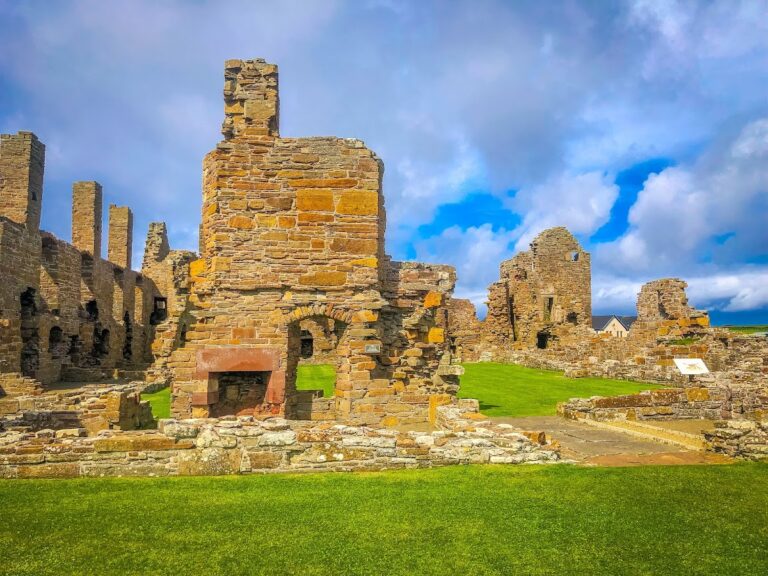
Government forces besieging and destroying Kirkwall Castle in 1614 also intended to destroy the cathedral because rebels had taken refuge inside it. Bishop James Law intervened and prevented the attack. The nearby Earl’s Palace preserves the ruins of the residence of Orkney’s earls and reflects the rule of the Stewart earls during the late sixteenth and early seventeenth centuries. It was later destroyed during that period of Stewart rule.
The cathedral is now a parish church of the Church of Scotland and forms part of the Orkney Islands Church of Scotland parish. Orkney Islands Council, successor to the burgh of Kirkwall, owns the building. Major restoration began in the early twentieth century, including the reconstruction of the tower’s lost spire. Damage identified in the 1970s showed that the west end was in danger of separating from the rest of the structure, leading to further restoration and stabilisation. Queen Elizabeth II unveiled a new west window in 1987 during the cathedral’s 850th anniversary. The building is a Category A listed building, Scotland’s highest grade of listed building.
Remains
Romanesque and Gothic fabric
Original cathedral
The cathedral is built mainly from sandstone, using red stone quarried near Kirkwall and yellow stone from Eday. These materials are frequently arranged in alternating courses and chequerboard patterns, creating a polychrome exterior. The original twelfth-century plan included a chancel of three aisled bays, a shorter eastern bay ending in an apse, a transept with one eastern chapel, and an eight-bay nave. The original structure forms the present choir.
Its Norman work is attributed to English masons who may also have worked at Durham Cathedral. Structural elements are comparable to those at Durham Cathedral and Dunfermline Abbey. The narrow, high nave creates an impression of greater size, while the medieval fabric includes relatively small windows and very narrow spiral stone staircases.
Later medieval additions
Extensions made in the late twelfth and early thirteenth centuries carried the building eastward and introduced vaulting throughout. In the late fourteenth century, the present lower front was joined to the earlier cathedral. This work introduced Gothic pointed arches, giving the building a visible combination of massive Romanesque construction and later Gothic forms.
The original spire was struck by lightning and lost in the late seventeenth century. Early-twentieth-century restoration replaced the tower’s former squat slated pyramid with a taller copper-clad spire, bringing the exterior closer to its earlier appearance. A new west window was unveiled in 1987 after the building’s west end had undergone stabilisation.
Burial evidence and confined spaces
Saint Magnus’s relics
In the late 1910s, a hidden cavity in a column was opened and found to contain a box of bones. Among them was a skull bearing a wound consistent with a blow from an axe. The remains were identified with the relics of Saint Magnus, whose cult had provided the religious purpose for the cathedral’s foundation.
Marwick’s Hole
Between the choir and the south transept lies Marwick’s Hole, a bottle dungeon, meaning a prison chamber with a narrow opening and a widening or arched floor below. Its exact date is uncertain, but it is generally placed around the middle of the sixteenth century, probably during Bishop Robert Reid’s episcopate.
The dungeon was first reached by a sloping passage from the courtroom above. Prisoners could be sent down through it but could not climb back up. After the Reformation, the passage was blocked, and prisoners were lowered through an opening cut through a former window. The dungeon continued to serve as a prison until as late as the eighteenth century. Orkney witchcraft suspects were commonly imprisoned and tried in the cathedral between 1594 and 1708. Allison Balfour was accused of being hired by Patrick Stewart, second Earl of Orkney, to poison his brother, and was tried and executed in 1594. In the seventeenth century, Jenn Forsyth, condemned to be burned for witchcraft, was rescued from the dungeon by her lover.
Associated buildings and furnishings
Bishop’s Palace
The Bishop’s Palace stood beside the cathedral as a large rectangular building. Its great hall was positioned above vaulted storage rooms. After 1540, Bishop Robert Reid restored the palace and added a round tower known as the Moosie Toor. The palace later fell into ruin. Its history is also connected with King Haakon IV, who died there in 1263 and was temporarily buried in the cathedral.
Bells and clock
Four bells were donated by Bishop Robert Maxwell in 1528. The smallest, which was never hung, has no inscription or date. The bells were operated by pulling their tongues sideways rather than by using ordinary wheels or cranks, and their notes were not arranged at diatonic intervals.
The third bell measures 41.5 inches (105 centimetres) across and 33 inches (84 centimetres) high. Its tenor note is described as G a quarter-tone sharp. An inscription names Robert Maxwell as donor and Robert Borthwik as maker at Edinburgh Castle. Lightning struck and burned the tower in 1671, causing the bells to fall into the church and cracking the largest. In 1682 that bell was taken to Amsterdam and recast by Claudius Fremy. It weighed 1,500 pounds (680 kilograms) before recasting and 1,528 pounds (693 kilograms) afterward, with a 46-pound (21-kilogram) tongue, and returned to Kirkwall on 23 August 1682.
The original turret clock was made in 1761 by Hugh Gordon, a clockmaker from Aberdeen. James Ritchie and Son fitted it with an automatic mechanism in 2018. A Henry Willis organ was installed in 1925 and has continued to be maintained by the same firm.
Memorials and burials
The cathedral contains memorials to Orcadian explorers William Balfour Baikie and John Rae, writers Eric Linklater, George Mackay Brown, and Edwin Muir, filmmaker Margaret Tait, artist Stanley Cursiter, and psychiatrist Thomas Clouston. John Rae is also buried within the cathedral.
Nearby sites