Bishop’s Palace, Kirkwall: Medieval Residence of Orkney’s Bishops
Site at a Glance
- Country
- United Kingdom
- Primary era
- Early Modern
- Eras represented
- Medieval, Early Modern
- Civilizations
- Kingdom of Scotland, Norwegian
- Site type
- Religious
- Remains
- Palace
On this page9 sections
History
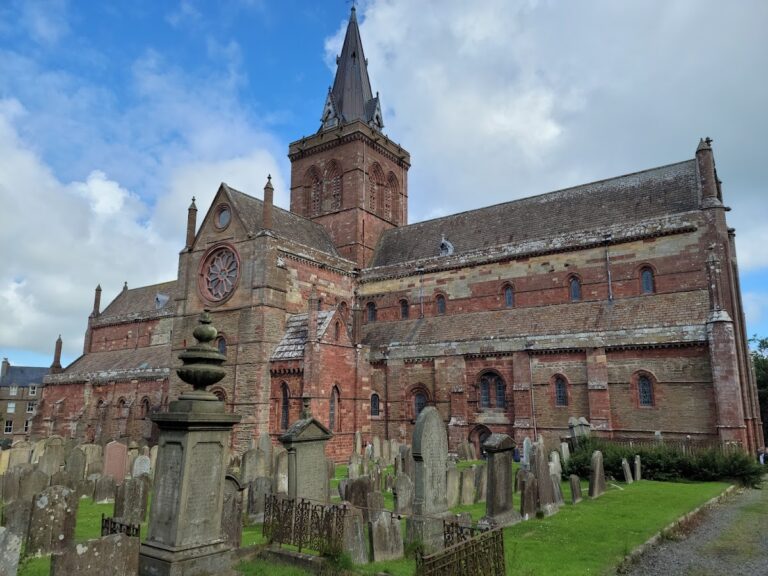
Bishop’s Palace, Kirkwall, is a twelfth-century residence for Orkney’s bishops in the United Kingdom, built beside St Magnus Cathedral. Its architecture is described as Romanesque and Gothic, and the palace became the setting for events marking the end of Norse rule over the Outer Hebrides.
The bishop’s seat and Norse rule
The bishop’s base moved from Birsay to Kirkwall after St Magnus Cathedral was built. An earlier cathedral had been constructed at Birsay around 1050, where St Magnus, an Orkney earl venerated as a saint, was buried in 1117. St Rognvald, a later Orkney earl also venerated as a saint, built the Kirkwall cathedral in 1137. Magnus’s body was then transferred there, and the palace was built alongside it as the bishops’ residence.
William the Old, the first bishop to live in the palace, served under the Archbishop of Nidaros, the senior church authority over bishops in his jurisdiction, based in Trondheim. After losing the Battle of Largs in 1263, King Haakon IV of Norway spent the winter at the palace. He died there during the night of 15 to 16 December. His death marked the end of Norse rule over the Outer Hebrides. He was temporarily buried in St Magnus Cathedral, and his body was taken to Bergen in spring 1264. The Saga of Haakon Håkonsson recounts his death.
Margaret, Maid of Norway, a Norwegian princess and heir to the Scottish throne, died during a brief stay in Orkney in 1290. She may have stayed at the palace. Her death triggered a succession crisis over the Scottish throne. By 1320, the palace had fallen into disuse and ruin.
Restoration and conflict in the sixteenth century
In 1526, William Sinclair, 4th Lord Sinclair, took possession of the palace briefly, but was ordered to return it to the Bishop of Orkney. When James V of Scotland visited Kirkwall in 1540, he placed troops in both the Bishop’s Palace and Kirkwall Castle.
Bishop Robert Reid carried out extensive restoration and alterations around 1550, a campaign responsible for much of the fabric that survives. In 1557, Mary I of England sent a fleet to Scotland under William Woodhouse and John Clere. Clere’s troops attacked St Magnus Cathedral on 12 August. They were defeated the following day while trying to capture the palace. Many of the English troops in retreat, including Clere, drowned as they tried to reach their ships.
Stewart ownership and later history
The palace passed to Robert Stewart, 1st Earl of Orkney, in 1568. His will of 1593 mentions eight pieces of old tapestry that probably furnished the building. Patrick Stewart, 2nd Earl of Orkney, built the neighbouring Earl’s Palace and intended to incorporate the Bishop’s Palace into it, but the plan was not completed. Patrick also altered the Bishop’s Palace.
In 1614, Patrick’s son Robert seized both palaces, and a siege followed amid an Orkney revolt. Whether the siege damaged the buildings is uncertain. The Bishop’s Palace later fell into ruin again. It is now administered by Historic Environment Scotland and is both a scheduled monument and a Category A-listed building. Its scheduled status dates to 26 September 1921.
Remains
Layout and surviving features
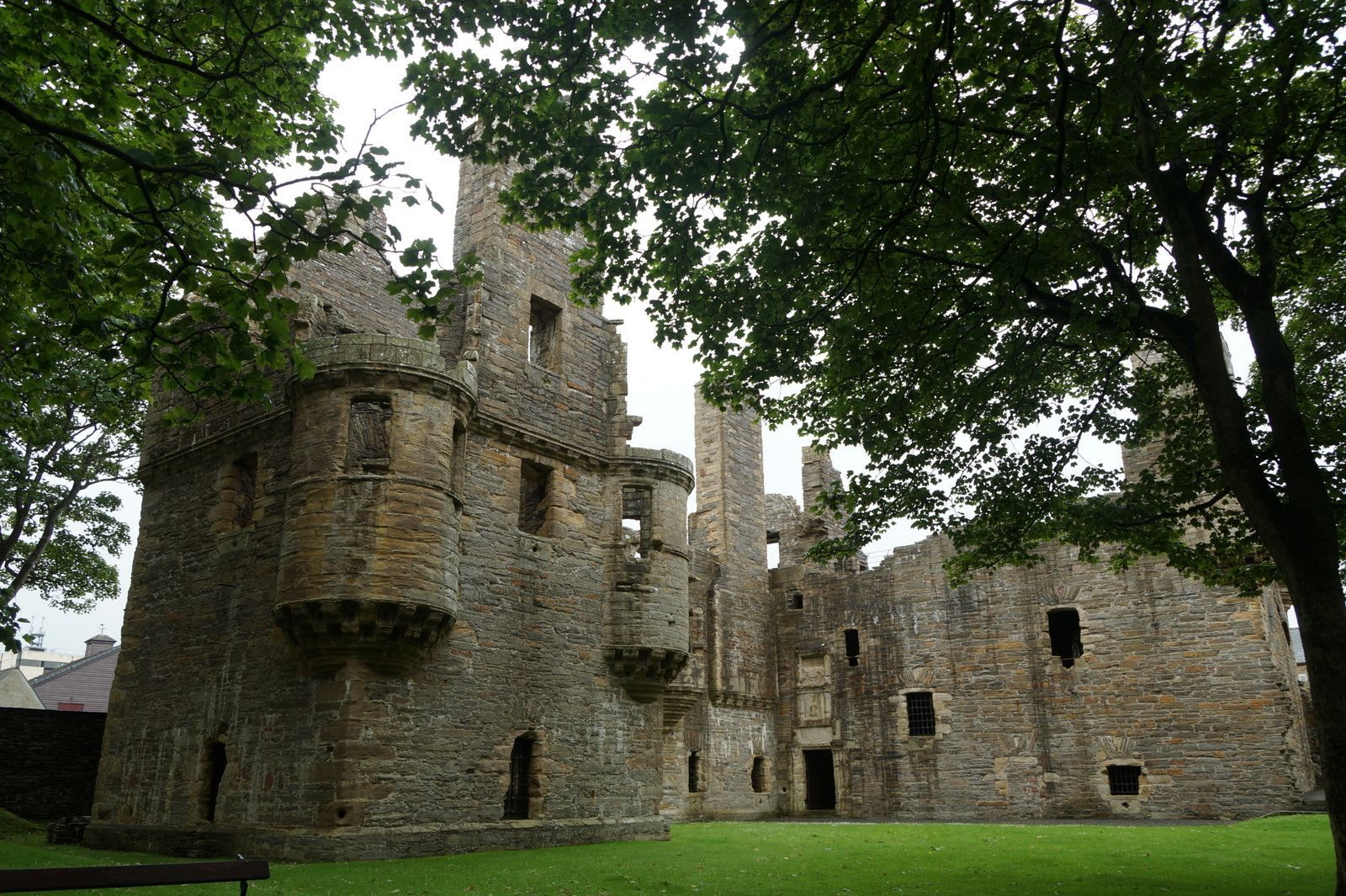
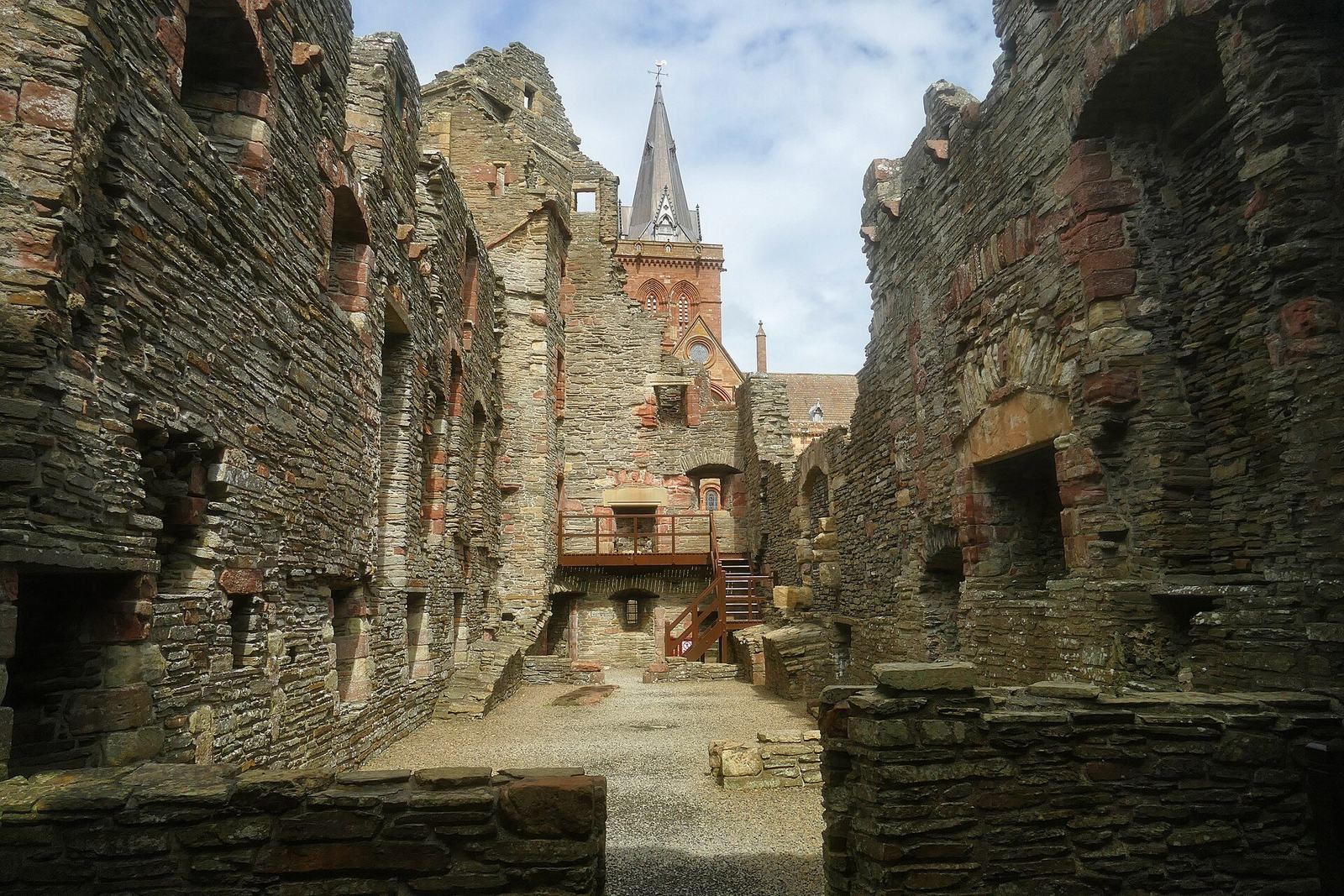
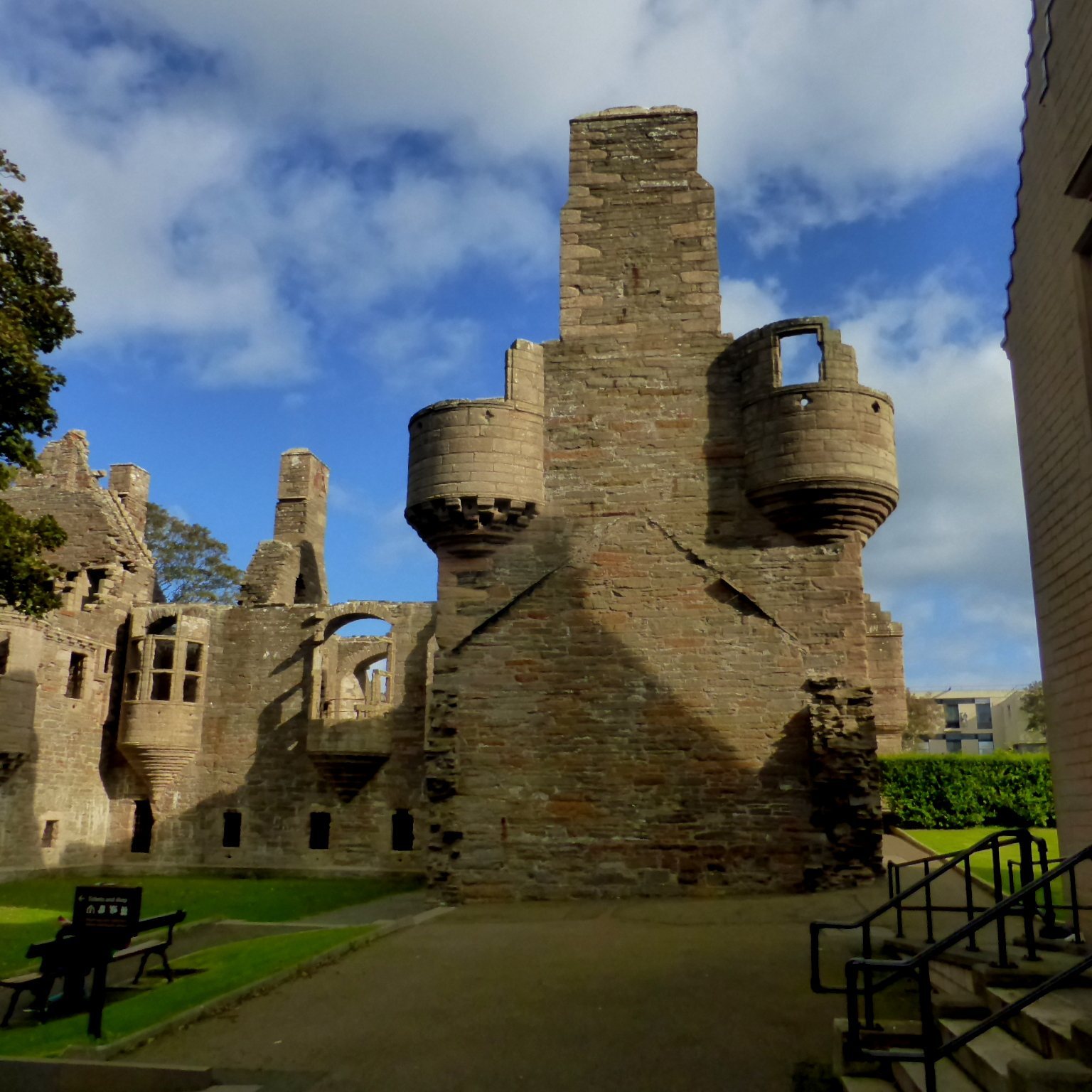
The ruined palace stands beside St Magnus Cathedral and near the Earl’s Palace. Its surviving fabric gives it the appearance of a small castle.
Probable original arrangement
The palace was probably arranged on the model of a typical royal Norwegian residence. This plan would have included a large rectangular hall above storage rooms, with a tower serving as the bishop’s private dwelling.
Rectangular wing and round tower
The surviving portion is a two-storey rectangular wing. At its northwest corner stands a large round tower, added during Bishop Reid’s alterations. It is known as Bishop Reid’s Tower and as the Moosie Toor. A white statue set in a niche in the tower wall is thought to represent St Rognvald.
Square towers and chapel
Descriptions associated with Haakon IV’s death refer to two square towers and a separate chapel as parts of the palace.