Pistoia Cathedral: Romanesque Cathedral and Seat of the Diocese of Pistoia


Site at a Glance
- Rating
- 4.6
- Popularity
- Medium
- Country
- Italy
- Primary era
- Medieval
- External website
- Open
- Eras represented
- Medieval, Early Modern, Modern
- Civilizations
- Grand Duchy of Tuscany, Holy Roman Empire
- Site type
- Religious
- Remains
- Cathedral
On this page21 sections
History
Pistoia Cathedral is the principal Catholic church of Pistoia, Italy, and the seat of the Diocese of Pistoia. Dedicated to Saint Zeno, the fourth-century bishop of Verona, it is a Romanesque building whose present form began to develop in the tenth century and was reshaped by later Baroque and Neoclassical interventions. The cathedral follows the Roman rite and stands in Piazza del Duomo, opposite the Baptistery of Saint John.
Early church and medieval cathedral
Tradition holds that the church was first dedicated to Saint Martin and was rededicated to Saint Zeno under Lombard rule. A smaller cathedral may already have stood at Pistoia by the fifth century, although its precise location remains uncertain. Possible locations include the present cathedral site, the site of Sant’Andrea, and the area later occupied by the monastery of San Pier Maggiore.
The earliest written reference dates to 923, when a notarial act mentioned an Ecclesia SS. Zenonis, Rufinis et Felicis, a church associated with Saints Zeno, Rufinus, and Felix. A diploma issued by Otto III in 998 referred to an early Christian building between the royal road and a watchtower, in the area of the present Piazza del Duomo. The existing cathedral was probably constructed during the tenth century.
A fire damaged the building in 1108, after which it was probably rebuilt during the first decades of the twelfth century. Bishop Atto consecrated an altar dedicated to Saint James in 1145. He had established a chapel for relics of the apostle brought from Santiago de Compostela, linking the cathedral with one of medieval Christianity’s major pilgrimage destinations.
Further damage followed a fire in 1202 and an earthquake in 1298. The side aisles received vaults in 1274 and 1275, while work on the elaborate silver altar of Saint James began in 1287. The altar remained an evolving project for generations, receiving additions from several artists and workshops. A statue of Saint Zeno by Jacopo di Mazzeo was installed on the facade around 1336.
Facade, chapels, and Renaissance work
Between 1379 and 1449, the west facade was altered through the addition of three tiers of open galleries and a portico. The facade’s marble statues of Saint Zeno and Saint James were formerly positioned in the galleries and now stand at the two ends of the gable. In 1504, Andrea della Robbia was commissioned to decorate the portico. He created a vegetal festoon around the archivolt, centered on the emblem of the Opera di San Jacopo, as well as blue coffers with gilded rosettes for the vault and a central lunette showing the Madonna and Child with Angels. The work was completed in 1505.
The Chapel of Saint James occupied the first two bays of the right aisle. Founded by Bishop Atto in the mid-twelfth century, it housed the apostle’s relics and the silver altar begun in 1287. The chapel was demolished in 1786. Its altar was moved to the Chapel of Saint Rocco in 1785 and then transferred to the Chapel of the Crucifix in 1953.
Around 1440, Bishop Donato de’ Medici founded the Chapel of the Blessed Sacrament at his own expense to shelter the miraculous image known as the Madonna delle Porrine, which had originally stood outside. The chapel was incorporated into the cathedral in 1591 after the Pappagalli family acquired its patronage, and it was remodelled between 1594 and 1596 to designs by Jacopo Lafri.
Saint Atto’s body was discovered in the church of San Giovanni in Corte in 1337 and transferred to a marble arca in the cathedral. It remained there until 1786, when it was moved to the chapel beside the high altar. The Chapel of Saint Atto, also called the Chapel of the City, was created with alms collected after the plague of 1630. The silver altar of Saint James stood there from 1787 until about 1940.
Baroque remodelling and later changes
Between 1598 and 1614, the medieval presbytery, the area around the high altar reserved for the clergy, was demolished. The chapels at the ends of the side aisles were modified, and the original apse was replaced by a raised Baroque tribune with a dome designed by Jacopo Lafri. New cross-vaults were installed over the central nave, and the tribune and main chapel received painted decoration. The Baroque changes introduced more dynamic spaces and elaborate effects into the earlier Romanesque church.
The former lateral crypts were extensively altered and partly destroyed in 1599. The crypt beside the Chapel of the Blessed Sacrament became a burial place for the Pappagalli family. Its vaults were later replaced by a coffered reinforced-concrete ceiling, while fragments of the original columns survived.
Andrea Vaccà made the statue of Saint James installed on the facade in 1721. The Chapel of Saint James was demolished in 1786, and Saint Atto’s remains were moved beside the high altar in the same year. Giovanni Gambini remodelled the presbytery in a Neoclassical style between 1834 and 1837. Plaster decoration added in 1838 and 1839 was subsequently removed during restoration.
Restoration and archaeological investigation
Between 1952 and 1966, the Monuments Superintendency restored the cathedral toward its earlier forms. The five large cross-vaults over the central nave, installed in 1657, were removed, revealing the polychrome wooden roof made in 1338. Nineteenth-century plaster was also taken away, and seventeenth-century windows were closed while medieval single- and double-light windows were reinstated. The removal of the plaster may have destroyed a valuable fresco cycle, of which only indistinct traces remain.
Archaeological work connected with the restoration uncovered two finely carved cubic marble capitals, fragments of twelfth-century frescoes, and the foundations of the southern apse of the Romanesque choir. Two marble panels from the former late-twelfth-century pulpit were also found reused upside down as paving in the central nave. Excavation revealed the tomb of Bishop Gerardo Gerardi, aligned with his later marble monument.
The campanile was restored between 1997 and 2000. Pope Paul VI elevated the cathedral to the status of a minor basilica in December 1965. The former organ, built by Luigi and Benedetto Tronci in 1793, retained its original meantone temperament, a 47-note keyboard, and an eight-note divided pedalboard. It was donated to the Tartini Conservatory in Trieste in 2020. The present organ was built by Costamagna in 1969.
Remains
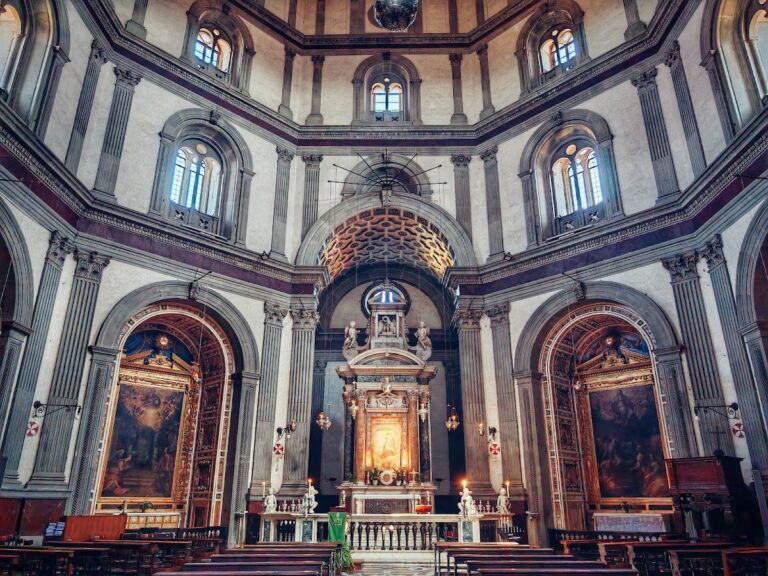
Pistoia Cathedral retains the basic organization of a Romanesque church, with a west facade facing Piazza del Duomo, a freestanding bell tower on the left, and three aisles separated by longitudinal rows of columns. The presbytery is raised above the crypt. A wooden trussed roof covers the central nave, while the side aisles are vaulted. The raised central tribune and dome belong to the late-sixteenth- and early-seventeenth-century remodelling designed by Jacopo Lafri.
Facade and bell tower
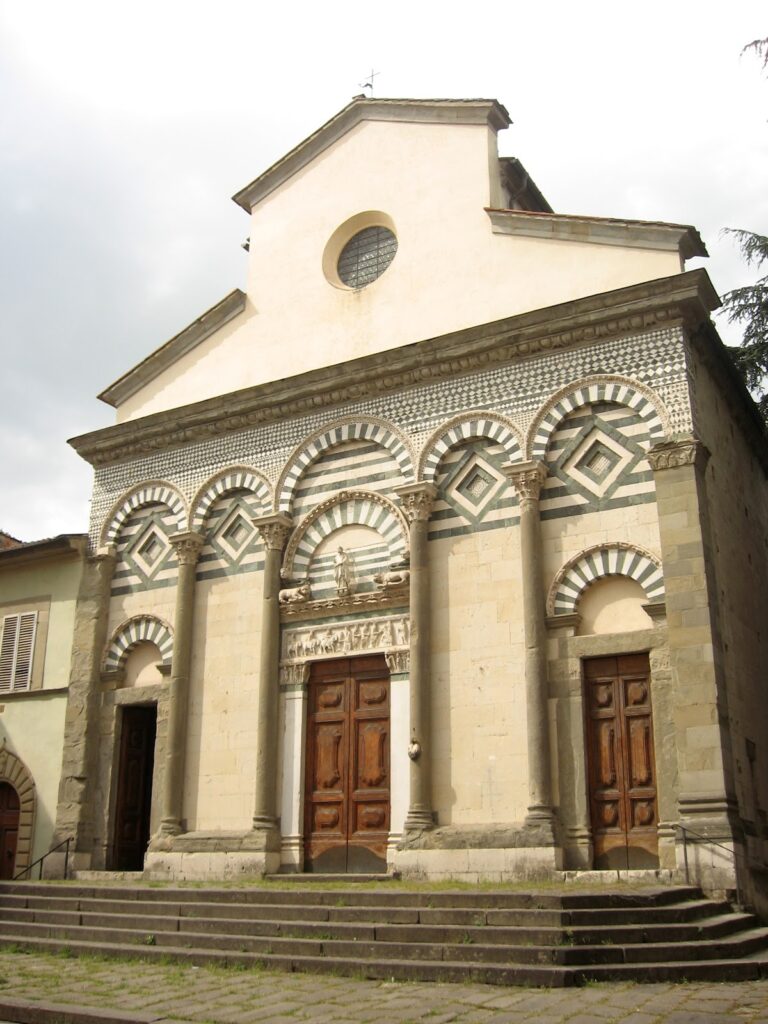
Romanesque facade
The facade follows the Romanesque pattern also found in Pistoia churches such as San Bartolomeo and Sant’Andrea. It is arranged in three levels of open galleries above a portico. Marble statues of Saint Zeno and Saint James occupy the two ends of the gable; they were formerly placed in the galleries. Above the central entrance is a thirteenth-century lunette fresco of Saint Zeno by an unknown artist. Near the right entrance are frescoes from 1347 by Bonaccorso di Cino, showing personifications of the Virtues.
The portico preserves Andrea della Robbia’s 1504 and 1505 decoration. Its archivolt carries a vegetal festoon around the emblem of the Opera di San Jacopo, while the vault has blue coffers with gilded rosettes. The central lunette contains the Madonna and Child with Angels.
Campanile
The freestanding campanile, or bell tower, stands beside the cathedral’s left side and is approximately 67 metres high. It dates from the twelfth century and may incorporate a Lombard tower rebuilt at the end of the thirteenth century by Giovanni Pisano. Restoration of the tower took place between 1997 and 2000.
Nave, entrances, and chapels
Central nave and entrance furnishings
The central nave has a wooden trussed roof and contains a pulpit designed by Giorgio Vasari in 1560. On a central-nave pier is Salerno di Coppo’s fresco of the Madonna and Child, dated 1275. Near the right side entrance is a holy-water stoup with busts of Saints Peter, Paul, John, and James, attributed to the workshop of Nicola Pisano. The stoup formerly belonged to the Chapel of Saint James.
To the right of the central entrance stands the arca of Saint Atto. Its three marble reliefs, made in 1337 by the workshop of Giovanni di Agostino of Siena, show Saint Atto blessing between two angels, pilgrims receiving the relics of Saint James at Compostela, and pilgrims presenting the relics to Saint Atto. Leonardo Marcacci made the surrounding aedicule, inscription, tomb slab, and marble-and-mother-of-pearl front panel in the early seventeenth century.
To the left of the central entrance is a baptismal font made in 1497 by Andrea Ferrucci of Fiesole and Jacopo del Mazza, after a design by Benedetto da Maiano. Its surrounding aedicule contains a sculpture of the Baptism of Christ, together with scenes of the Birth of Saint John the Baptist, the Preaching in the Wilderness, the Dance of Salome, and the Beheading.
Right aisle
The right aisle contains an anonymous triptych from 1424 showing the Crucifixion between the Madonna, Saint John, Saint James, and Saint Jerome. It also holds a copy of the Annunciation of the Santissima Annunziata in Florence by Domenico Cresti, known as Il Passignano, and the 1337 tomb monument of Cino Sinibuldi of Pistoia, attributed to Agostino di Giovanni.
The Chapel of the Blessed Sacrament contains the tabernacle and the marble tomb slab of Bishop Donato de’ Medici, dated 1475 and attributed to Antonio Rossellino. The chapel is also known as the Chapel of Saint Donato because it contains Lorenzo di Credi’s Madonna Enthroned between Saints John the Baptist and Donato, painted between 1474 and 1486. Andrea del Verrocchio began the work, which was completed by his pupil Lorenzo di Credi. The bishop beside the Madonna has also been identified as Saint Zeno.
Toward the nave, the chapel’s altar bears Giovan Battista Paggi’s Assumption of the Virgin, painted around 1591 to 1596. Beneath it is a reclining marble statue of Saint Felice, a priest of Pistoia, carved by Raffaello Petrucci, known as Il Sordo.
Left aisle
The left aisle contains the monument to Cardinal Niccolò Forteguerri, commissioned from Andrea del Verrocchio by Pistoia’s General Council in 1473. After Verrocchio’s death in 1488, Lorenzo Lotti, known as Il Lorenzetto, completed the figure of Charity. Gaetano Masoni added the present framing, sarcophagus, bust, and two torch-bearing figures in 1753.
Other works in the aisle include the fourteenth-century Madonna delle Porrine, a fresco by an unknown artist; a 1618 statue of Pope Leo XI, formerly Alessandro de’ Medici, who had been Bishop of Pistoia in 1573; the 1776 tomb of Bishop Federico Alamanni; and Matteo Bonechi’s oil painting Martyrdom of Saint Bartholomew.
The aisle also contains a panel Crucifixion made in 1274 by Coppo di Marcovaldo and his son Salerno. Six accompanying scenes depict the Arrest of Jesus, Christ before the Priests, the Flagellation, the Deposition from the Cross, the Deposition of Jesus in the Tomb, and the Three Marys at the Tomb. The work was located between the central and left aisles on 10 August 2024.
Presbytery and crypt
Presbytery and tribune
The raised tribune and dome are products of Jacopo Lafri’s late-sixteenth- and early-seventeenth-century remodelling. The presbytery vault carries Domenico Cresti’s frescoes from 1602, including the Father Eternal in Glory, the Fall of the Rebel Angels, the Fall of Adam, and the Annunciation. In the apse is Cristofano Allori’s Resurrection, painted between 1606 and 1610 and flanked by two silvered-clay statues of Saint Zeno and Saint James from 1603, attributed to the school of Giambologna.
Gregorio Pagani’s Pentecost, painted in 1602, stands to the right of the high altar, while Benedetto Veli’s Ascension, painted in 1606, stands to the left. The presbytery also contains a 1442 bronze candlestick by Maso di Bartolomeo, the 1703 cenotaph of Bishop Gherardo Gherardi, the 1650 tomb of Bishop Alessandro Del Caccia, and the 1695 funerary monument of Bishop Leone Strozzi.
Crypt
The present crypt beneath the tribune is divided into three aisles by six rough-hewn stone columns with matching pilasters. It has a sail-vaulted ceiling and contains a stone-framed altar recess, early-seventeenth-century Passion frescoes by Alessio Gimignani, two late-Mannerist stone-framed niches, and marble memorial plaques to bishops of Pistoia and Prato from the late eighteenth and nineteenth centuries.
The medieval crypt originally had rows of columns and three apses. Construction of the later tribune destroyed the central space and buried the lateral spaces for use as burial areas. Damp severely affected the surviving frescoes. Filippo Torchiani’s Deposition from the Cross was removed because of the humidity and is preserved in the cathedral’s canonical rooms. It was replaced by a semicircular niche containing an eighteenth-century crucifix.
The former lateral crypt beside the Chapel of the Blessed Sacrament became a Pappagalli family burial place. Its later coffered reinforced-concrete ceiling replaced the earlier vaults, and fragments of the original columns remain.
Chapel of the Crucifix and the silver altar
The Chapel of the Crucifix houses the silver repoussé altar of Saint James. Repoussé is a technique in which relief is raised by hammering metal from the reverse. Made by approximately twelve craftsmen between 1287 and about 1450, the altar consists of a decorated panel behind the altar and a decorated front panel, each worked on three sides.
Andrea di Jacopo d’Ognabene began the project in 1287, producing images of the Virgin and Child for the rear and scenes from the New Testament for the front before completing his contribution in 1316. The Sienese goldsmith Pace di Valentino made additional figures. After the Black Death ended in 1348, a large silver enthroned statue of Saint James by Giglio Pisano was commissioned in thanksgiving and made between 1349 and 1353.
Leonardo di ser Giovanni and Francesco Niccolai produced side panels with scenes from the Old Testament and the life of Saint James between 1361 and 1371. The workshop of Lunardo di Mazzeo and Piero di Giovanni da Pistoia contributed work in 1400 and 1401. Filippo Brunelleschi is thought to have carved part of the rear panel with Saints Augustine and John the Evangelist and busts of the prophets Jeremiah and possibly Isaiah.
Additional medieval and modern furnishings
Last Judgment Chapel
The Chapel of the Last Judgment contains fragments of Giovanni da Ponte’s Last Judgment fresco, dated 1420 to 1425, on the front wall. Fragments of a Dante-inspired fresco remain on the side wall.
Chapel of Saint Atto
The Chapel of Saint Atto contains the saint’s urn made by Cleto Lapi in 1952 and Mattia Preti’s painting of Saints Baronto and Desiderio, formerly part of the demolished Foresi Benesperi altar. Its late-eighteenth-century wrought-iron screen, two large wall frescoes by Luigi Sabatelli and Giuseppe Bezzuoli, and dome frescoes by Ulivelli and Vannucci remain associated with the chapel. The present altar, made by Andrea Vaccà, came from the monastery church of Santa Maria degli Angeli. The urn rests on an 1855 silver step by Silvestro Mariotti of Pontedera.
Organ and choir
The Costamagna organ built in 1969 stands on both sides of the presbytery, above the wooden choir stalls and behind the high altar. It has electro-pneumatic transmission, 46 stops, three 61-note manuals, and a 32-note pedalboard.