Blackhammer Chambered Cairn: A Neolithic Burial Monument on Rousay
Site at a Glance
- Rating
- 4.6
- Popularity
- Very Low
- Country
- United Kingdom
- Primary era
- Stone Age
- Eras represented
- Stone Age
- Civilizations
- Unclassified
- Site type
- Burial
- Remains
- Burial Mound
On this page10 sections
History
Blackhammer Chambered Cairn is a Neolithic burial monument on southern Rousay in Orkney, United Kingdom, built by farming communities around 3000 BC. It belongs to the Orkney–Cromarty type of chambered cairn, a long stone burial monument whose inner chamber was divided into compartments by pairs of upright slabs.
Neolithic construction and use
The cairn formed part of a wider group of prehistoric monuments on Rousay. Taversoe Tuick stands only a few metres away, while the Knowe of Ramsay, Knowe of Lairo, and Midhowe Cairn are nearby. The Knowe of Yarso chambered cairn occupies higher ground on the same hill and dates to the same period.
Blackhammer’s entrance passage was blocked when the monument was abandoned. Excavation later revealed limited human remains, a pattern that may indicate the chamber was periodically cleared so that later communities could reuse it. This interpretation remains uncertain.
Excavation and protection
Walter Gordon Grant excavated the monument in 1936. Grant was a Scottish archaeologist and antiquarian who worked on prehistoric monuments. After the excavation, the cairn was placed under state management. Historic Environment Scotland, the Scottish public body responsible for protecting and managing many historic monuments, now manages the site.
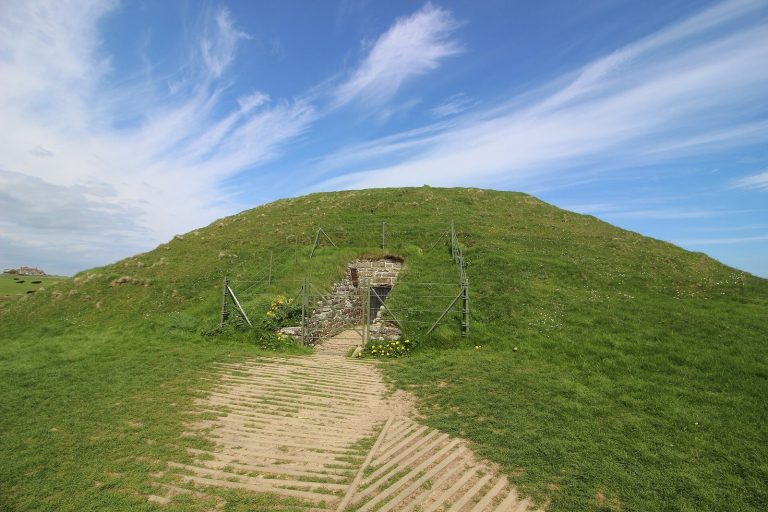
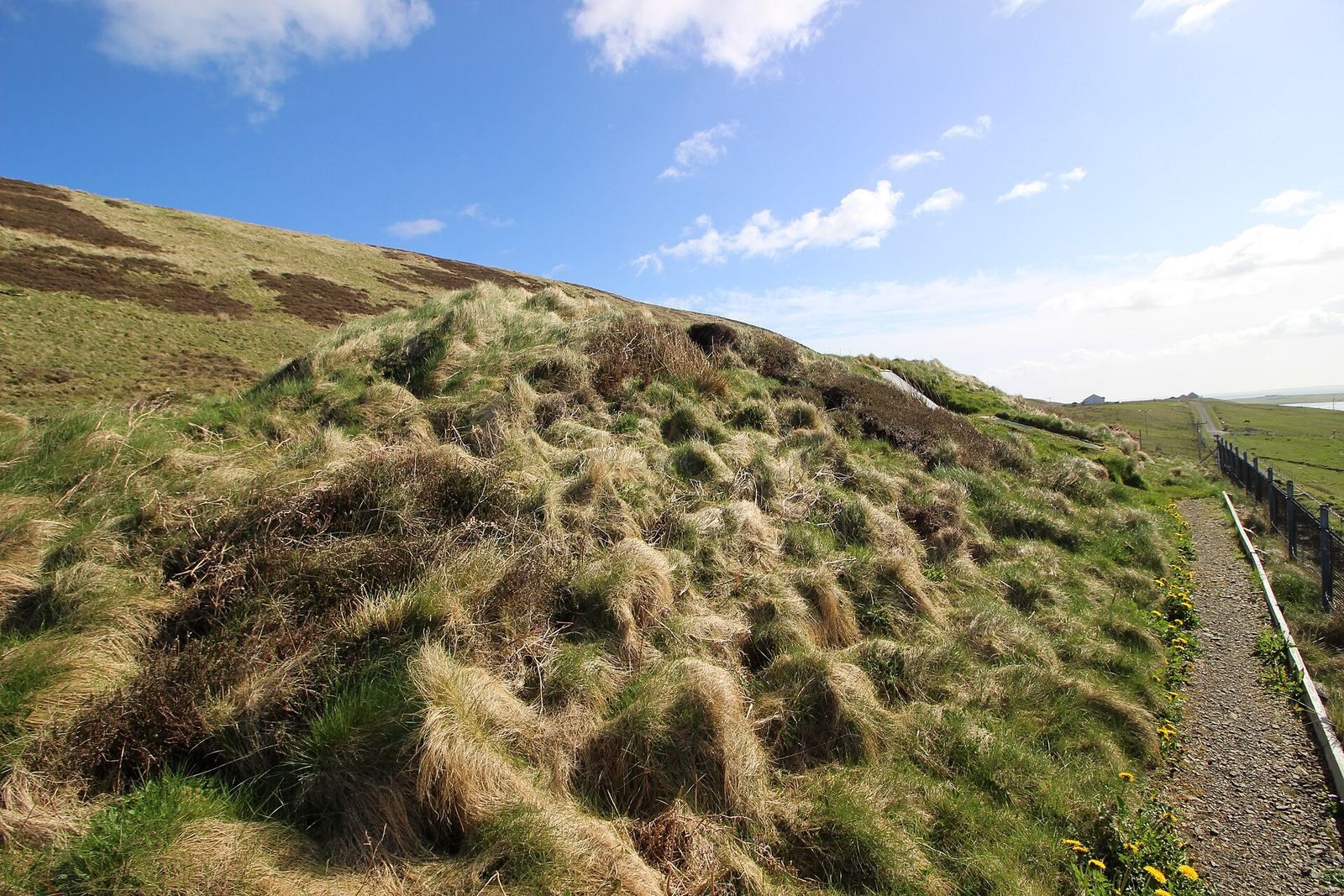
The original capstones had been removed, leaving the surviving side walls relatively low. A modern concrete roof, covered with turf, was constructed to protect the chamber from weather. Blackhammer was designated a scheduled monument in 1994, a legal status that protects archaeological sites considered nationally important in Scotland. The cairn takes its name from Blackhammer Farm, which once stood on a higher terrace above it; the farm foundations remain.
Remains
Blackhammer stands on the lower part of a hillside, about 60 metres above sea level, on a small terrace above the road beside Wyre Sound. It overlooks Eynhallow Sound. The monument is an oblong or oval cairn built from dry stone masonry, with its long axis running west-northwest to east-southeast.
Architecture
Outer cairn and entrance
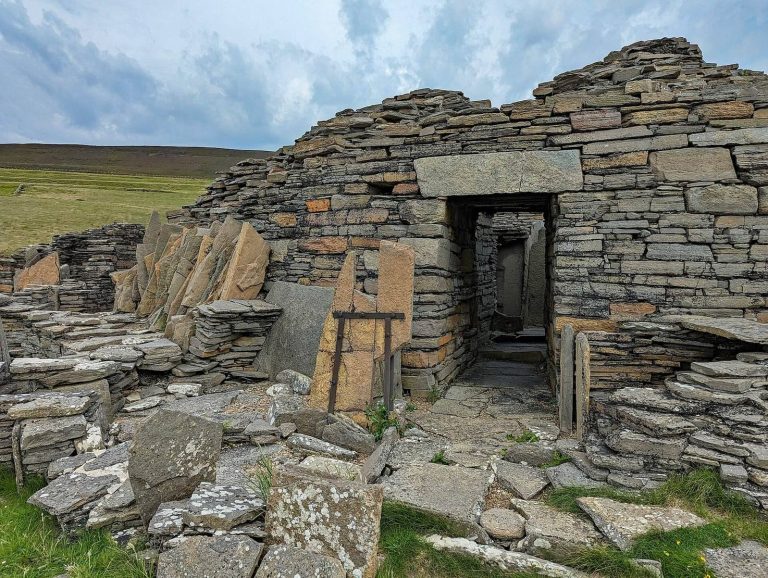
The cairn measures about 22 metres in length and 8 to 9 metres in external width. Its outer facing consists of sloping courses of stone arranged in alternating, line-filled triangular patterns. Similar masonry is associated with Unstan Ware, a distinctive Neolithic pottery tradition linked especially with Orkney and northern Britain. Comparable decoration appears at Midhowe Cairn and the Knowe of Yarso, while triangular masonry also flanks Blackhammer’s entrance.
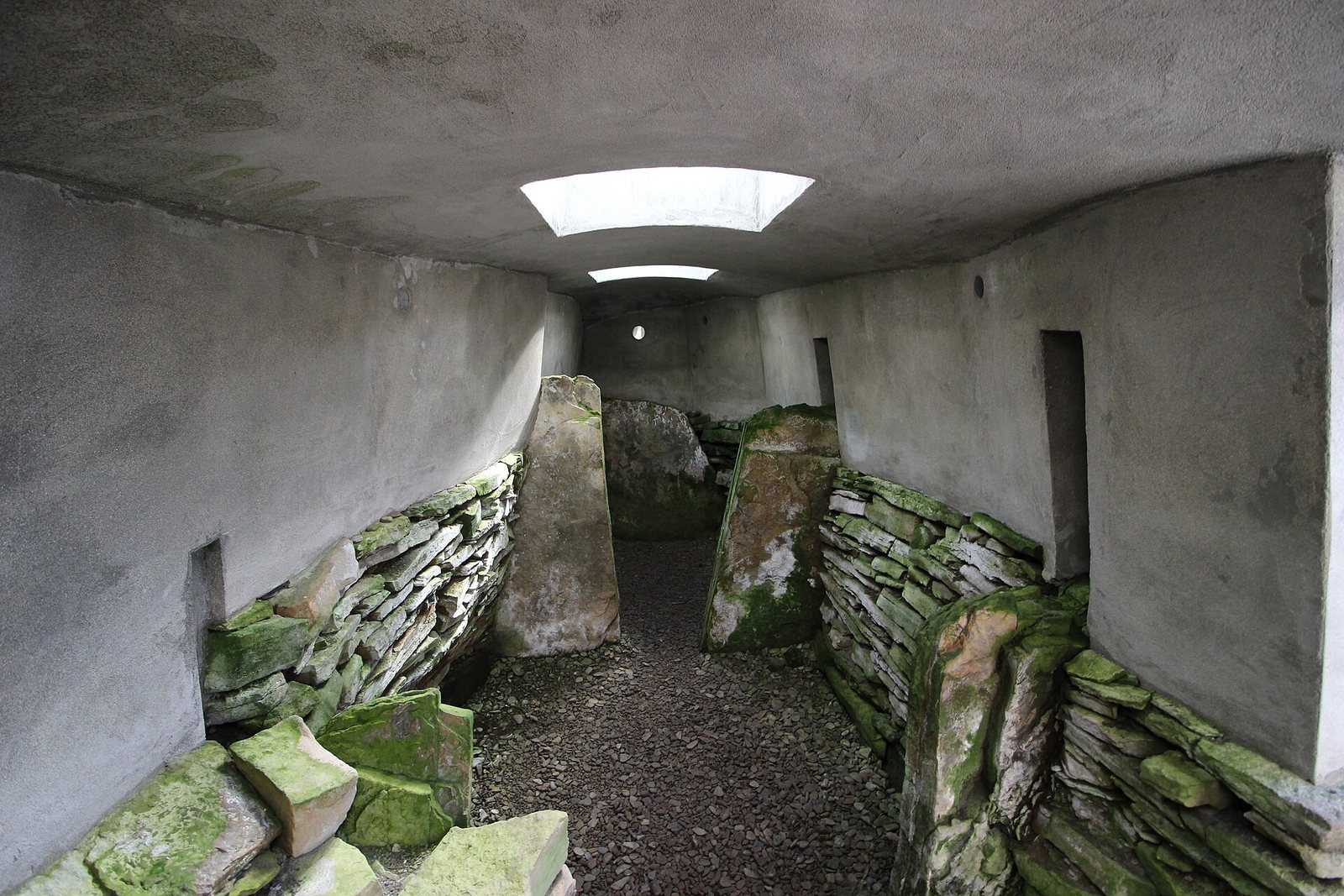
The entrance passage lies on the south side. It is approximately 3 metres long, 76 centimetres wide, and 1 metre high. The passage was sealed when the monument went out of use. The original capstones were removed, and the remaining side walls stood only about 1 to 1.3 metres high by the time of excavation. The modern concrete roof now spans the chamber and includes several windows; access to the interior is through a hatch and ladder.
Burial chamber
The internal chamber is about 13 to 13.5 metres long and between 1.4 and 2 metres wide. It was originally divided into seven compartments, or stalls, by pairs of upright, flat stone slabs. Four of the original dividing slabs had disappeared by the time of excavation. The masonry at the centre of the tomb is coarser than the surrounding work and may belong to a later phase, perhaps when the missing slabs were taken out.
Excavated remains
Human and animal remains
The excavation uncovered the remains of two adult men. One lay in the westernmost compartment, while the other was found in the entrance area. One skeleton was largely complete apart from the upper part of the skull and one thigh and upper-arm bone. The second survived as the skull, upper pelvis, and lower-leg regions.
Animal bones from the chamber consisted mainly of cattle and sheep, together with smaller quantities of deer, geese, cormorants, and gannets. The bones were generally mixed with rubble and occurred most frequently at the eastern end. Many had been burned, and some flints showed traces of burning.
Pottery, tools, and other finds
Objects from the cairn include flint and other stone tools, four scrapers made from brown, yellow, and grey flint, and remains of an Unstan Ware bowl. A flint knife with one flat and one curved face belongs to a type characteristic of the British Late Neolithic. Other finds include a polished stone axe and a burned stone knife. The bowl fragments and burned knife came from a hollow in the floor of the compartment beside the entrance.
A bone needle from Blackhammer is held by the National Museum of Scotland in Edinburgh. Parallels for the flint knife and related material occur at Midhowe Cairn, the Torrylin gallery grave on the Isle of Arran, and horned-forecourt megalithic monuments at Audleystown and Rossinure Beg in County Fermanagh.