Castell d’Oliana: A Medieval Castle and Church in Spain


Site at a Glance
- Rating
- 4.2
- Popularity
- Very Low
- Country
- Spain
- Primary era
- Medieval
- Eras represented
- Medieval
- Civilizations
- Unclassified
- Site type
- Military
- Remains
- Castle
On this page9 sections
History
Castell d’Oliana is a tenth-century castle in Spain, located north of Oliana, whose origins are associated with the Counts of Urgell. It appears in records from 919–920 as Castro Uliana, placing it within the political landscape of the medieval County of Urgell.
The castle church and medieval lordship
The castle church, later known as the parish church of Sant Andreu del Castell, was consecrated between 1037 and 1040 by Eribau, Bishop of Urgell. Its religious role formed part of the continuing life of the castle and the settlement around it.
A hearth-tax register from 1365–1370, a medieval fiscal record that assessed households and could also identify ownership, lists the castle as belonging to the Viscounty of Cardona. In 1381, it appears in the Cerdanya district as a possession of the Count of Urgell.
Changes in ownership and settlement
In 1414, King Ferdinand of Antequera granted the castle to Antoni Cardona i Luna, lord of Maldà and Maldanell. The grant followed the imprisonment of James of Urgell, known as the Unfortunate, during the political conflict surrounding the succession to the Crown of Aragon.
From 1453 until the nineteenth century, Castell d’Oliana was held by the chapter of Urgell Cathedral, the body of clergy responsible for assisting in the administration and religious life of the cathedral. The settlement associated with the castle was abandoned before the sixteenth century, and its inhabitants moved to the present town of Oliana.
Protection and restoration
Castell d’Oliana is protected as a Cultural Asset of National Interest as a historical monument and is also registered as a Spanish Asset of Cultural Interest under reference RI-51-0006407. The church was restored in 1978.
Remains
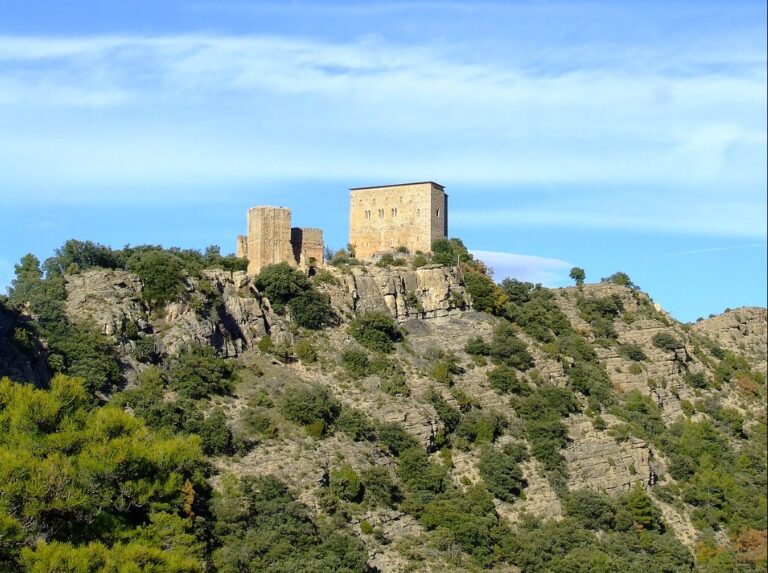
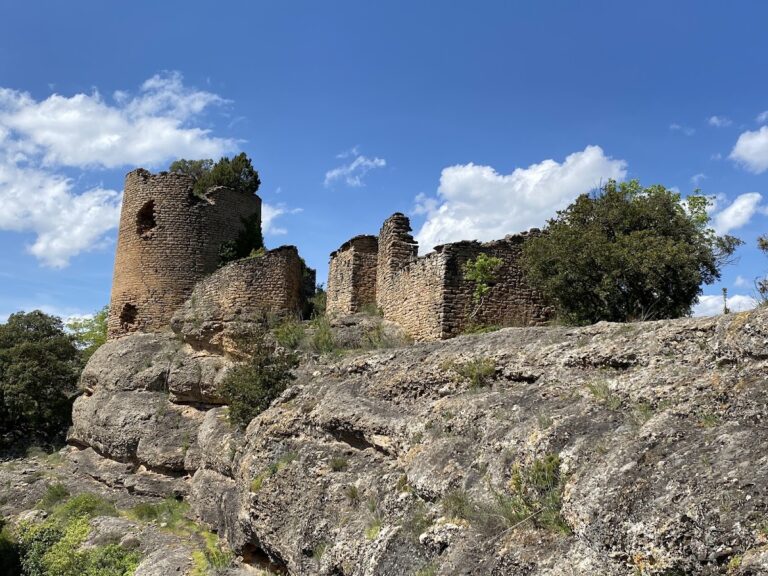
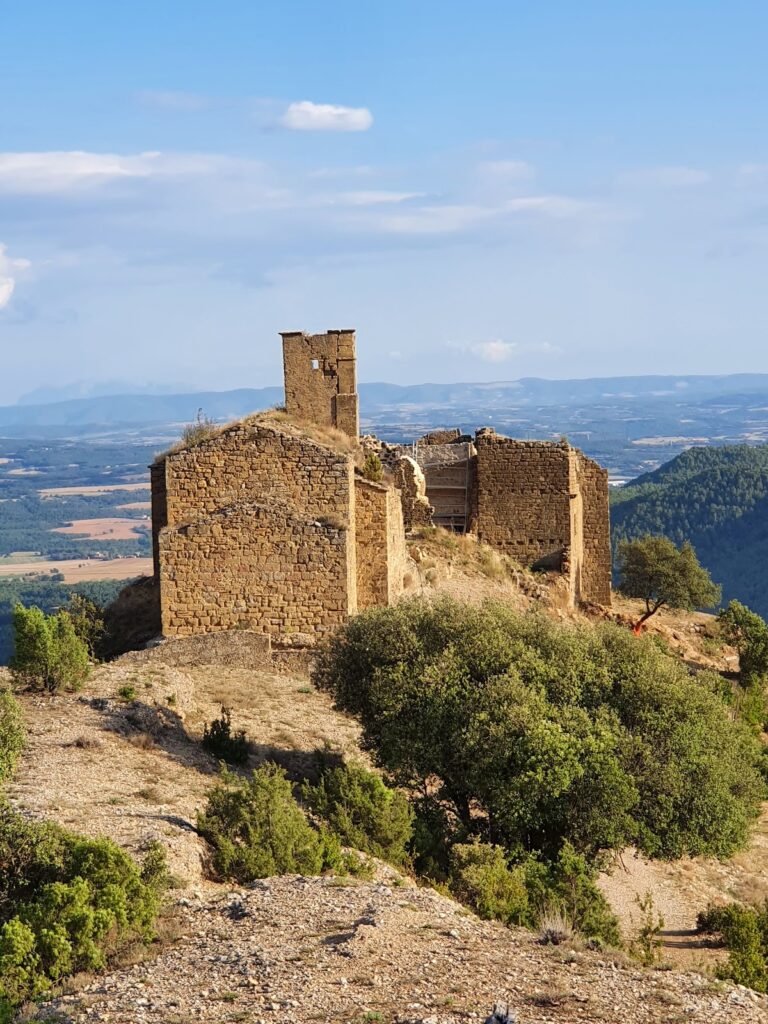
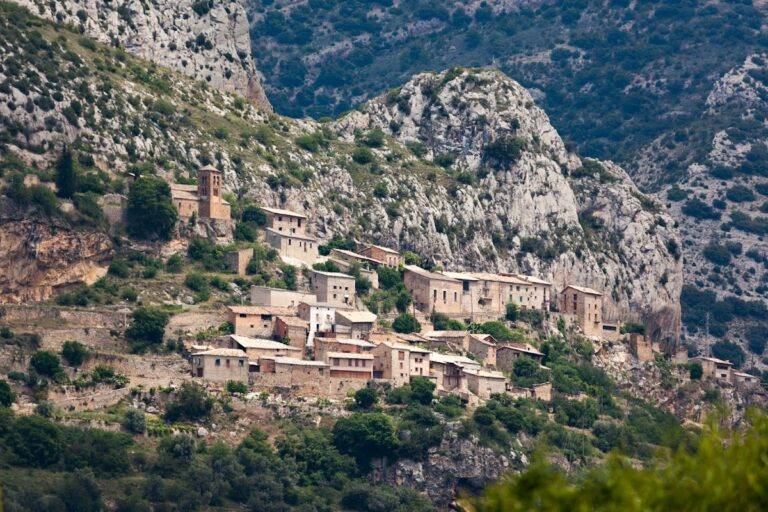
The surviving site lies at approximately 547 metres above sea level, north of Oliana. It retains sections of the former castle walls and remains of the medieval settlement, which was arranged around the Romanesque church of Sant Andreu del Castell. The castle walls also served as the exterior walls of the settlement’s houses.
Medieval settlement and defensive walls
Castle walls
The remaining walls are built from relatively large, elongated blocks of varying sizes. Their dual use as the outer walls of the houses connected the settlement’s domestic buildings directly with the castle’s defensive enclosure.
Village houses
The medieval village lay below the church. Its small houses consisted of a single room with a fireplace, providing a simple domestic arrangement within the settlement associated with the castle.
Church of Sant Andreu del Castell
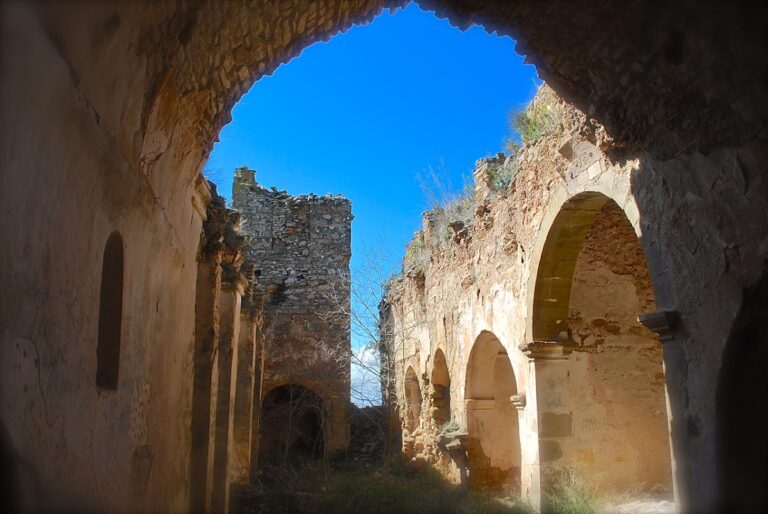
Sant Andreu del Castell is a Romanesque church, a medieval architectural tradition known for heavy masonry, rounded arches, vaulted spaces, and restrained monumental forms. It has a single nave covered by a barrel vault, a continuous semicircular ceiling extending along the length of the space.
The church ends in a semicircular apse, a rounded termination commonly used for the sanctuary, decorated in the Lombard style. This Romanesque decorative tradition is associated with northern Italian architecture and uses restrained bands, arches, and geometric ornament. A three-storey bell tower is attached to the south facade. The church is popularly called “El Castell” because it is the most distinctive surviving feature of the former castle.
Nearby sites