Castell d’Abella de la Conca: A Romanesque Medieval Castle in Spain


Site at a Glance
- Rating
- 4.8
- Popularity
- Very Low
- Country
- Spain
- Primary era
- Medieval
- External website
- Open
- Eras represented
- Medieval
- Civilizations
- Unclassified
- Site type
- Military
- Remains
- Castle
On this page6 sections
History
Castell d’Abella de la Conca is an eleventh-century Romanesque castle in Spain, above the village of Abella de la Conca. The place-name Abbelia first appears in 1033, and the strong position of the castle made it important during the transition from the High to the Late Middle Ages.
The castle under the Counts of Urgell
The castle belonged to the Counts of Urgell, the medieval rulers of the County of Urgell in the Pyrenean region. From its rocky ridge, it controlled routes leading from Conca Dellà toward Alt Urgell, especially through Bóixols. This route was used by the men of the Count of Urgell to enter and dominate the Pallars basin while it remained under Saracen control.
The site was infeudated, meaning that its use, administration, or lordship was granted as a fief in return for obligations to a superior lord, to Miró Sunyer de Abella. He served as its castellan, the official responsible for administering and defending a castle. His family retained the lordship for two generations. In 1097, Guitard de Caboet and his son Guillem Guitard declared themselves castellans.
Lordship and medieval records
The Abella family, whose name became associated with the place, held the lordship of the town and valley of Abella for a long period. Pere Estopinyà is recorded as a possessor of the site in 1154.
Castell d’Abella de la Conca may also be the kastrum of Abizela mentioned in 1110 in the testament of Guillem Guitard de Caboet. A kastrum was a fortified settlement or castle. In the testament, Guillem Guitard left several castles in Pallars, including Abisella, to his son Bernat, although the identification with Castell d’Abella de la Conca remains possible rather than certain.
The castle is protected as a Cultural Asset of National Interest in Catalonia. This designation dates from 8 November 1988 and is recorded under reference RI-51-0006199.
Remains
Ridge-top layout
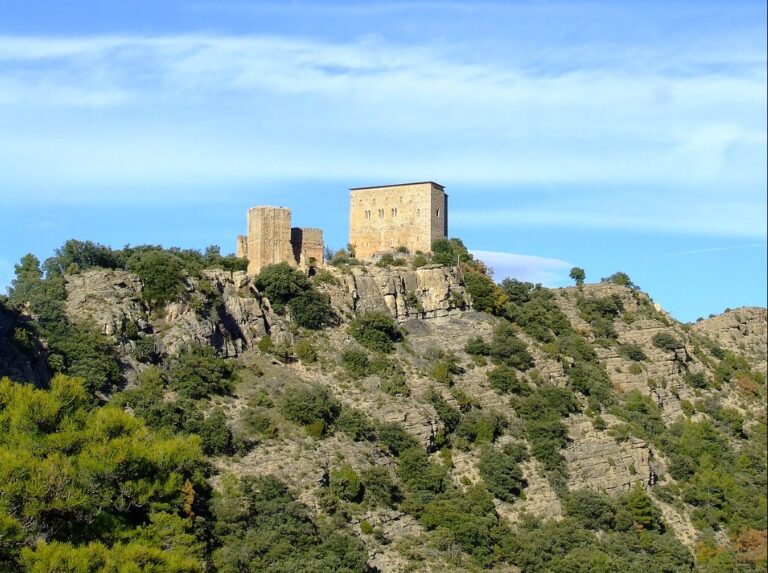
The ruins stand on a rock above Abella de la Conca, on the northern side of the village, at an elevation of approximately 1.01 kilometres. The surviving group is recognizable as the remains of a Romanesque castle. Its position on a rocky ridge shaped the site’s defensive arrangement and gave it control over the surrounding routes.
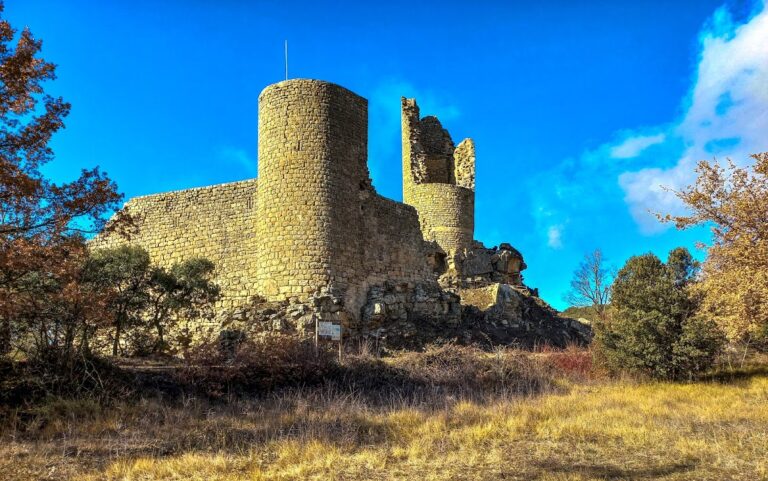
Walls and surviving masonry
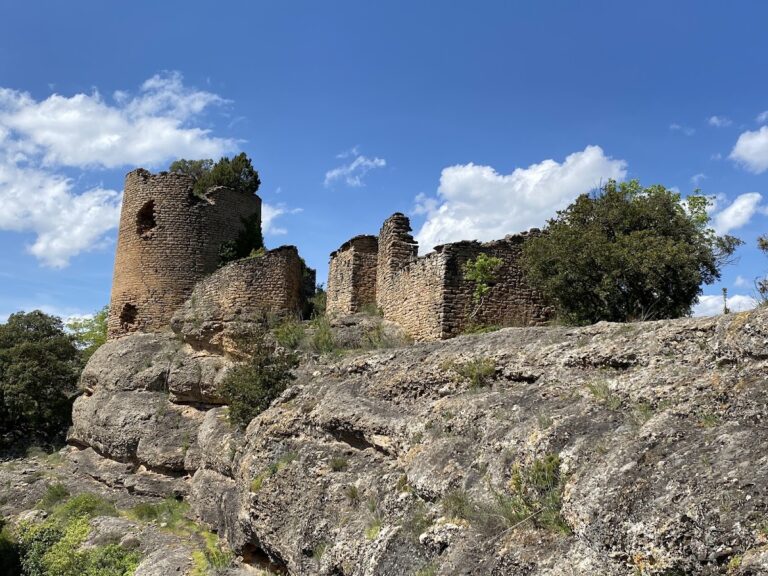
The most substantial remnant is a wall approximately 13 metres long and one metre thick, aligned from east to west. It probably formed the southern boundary of a quadrangular structure. Remains at the edge of the cliff probably belonged to its northern boundary, while further wall fragments lie slightly to the west. Their stones are carefully aligned, but their association with the castle church or with other castle buildings has not been established. The surviving masonry probably belongs to an eleventh-century construction. An earlier castle or watchtower dating as early as the tenth century may also have existed, and the ridge may have supported a watchtower whose presence remains unconfirmed.