Castell de Montmagastre: A Medieval Territorial Castle in Spain


Site at a Glance
- Rating
- 4.6
- Popularity
- Very Low
- Country
- Spain
- Primary era
- Medieval
- Eras represented
- Medieval
- Civilizations
- Unclassified
- Site type
- Religious
- Remains
- Church
On this page8 sections
History
Castell de Montmagastre is a medieval territorial castle in Spain, at Montmagastre in Lleida, associated with the Christian expansion that shaped the County of Urgell. The castle was documented in 1003 and became an important stronghold in the county’s development and history.
Conquest and the County of Urgell
Montmagastre was associated with the conquest of Montmagastre, Alòs, and Malagastre during an expedition against Muslim-held territories in 1015 and 1016. The campaign reached beyond Balaguer and formed part of the medieval Christian expansion into lands ruled by Muslim authorities in the Iberian Peninsula.
The site is traditionally identified as the place where Ermengol II, Count of Urgell, and Berenguer Ramon I, Count of Barcelona, reached an agreement between 1018 and 1026. Their arrangement concerned the organization of the territory between Montsec de Rúbies, a mountain range in the Catalan Pre-Pyrenees, and the Segre River.
Fiefs and Later Conflicts
Castell de Montmagastre belonged to a network of territories through which the counts of Urgell exercised authority. Arnau Mir de Tost held the castle as a fief, meaning a territorial possession granted in return for allegiance and service, from the Count of Urgell. The Count of Urgell was himself a vassal of the Count of Barcelona. In his 1071 testament, Arnau Mir bequeathed the castle to his grandson Guerau Ponç.
The castle remained part of the political and feudal history of the region. In 1156, Berenguera, Countess of Cabrera, left the castles of Artesa and “Magamastre,” among others, to her son Ponç. In 1186, Alfonso the Chaste, King of Aragon and Count of Barcelona, granted the formal investiture, or confirmation of possession, of “Magamastre” to Ponç III, Viscount of Cabrera.
Successive conflicts later damaged the stronghold, and it was ultimately devastated. The surviving remains are protected as a Cultural Asset of National Interest, a Catalan heritage designation for culturally important monuments and properties. The site has also appeared on the Red List of Endangered Heritage since 2008.
Remains
The Castle Summit
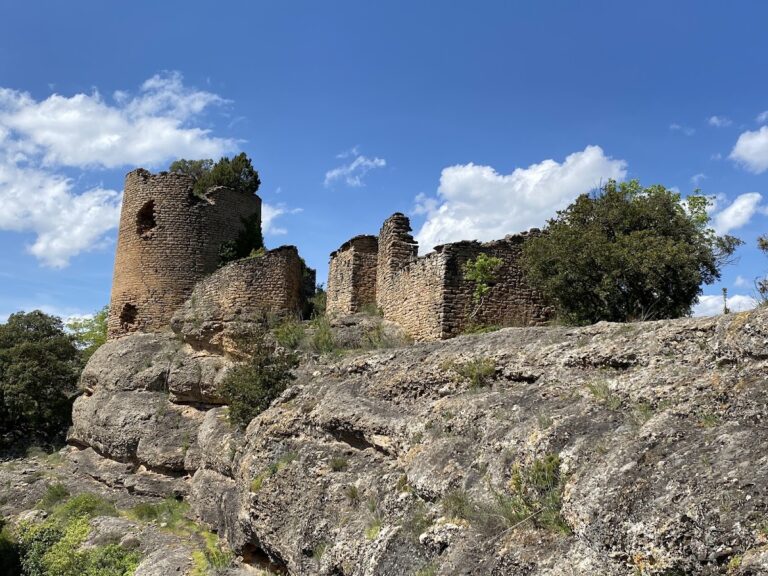
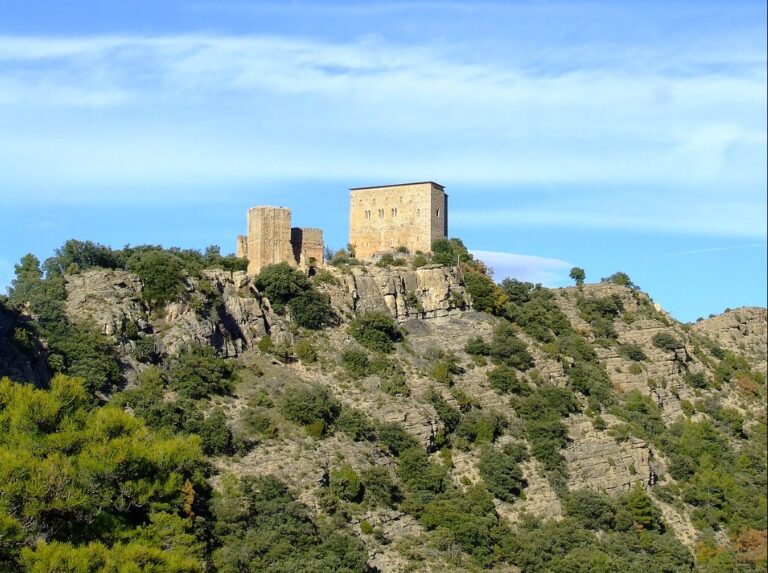
The complex occupies the summit of the conical Montmagastre hill, 732 metres above sea level. The castle ruins stand on the rocky summit, while the remains of the church and its canonical complex lie at a lower level.
Only the foundations of the castle walls survive on the summit. A cistern remains below these foundations, preserving part of the water system associated with the stronghold.
Sant Miquel Church and Canonry
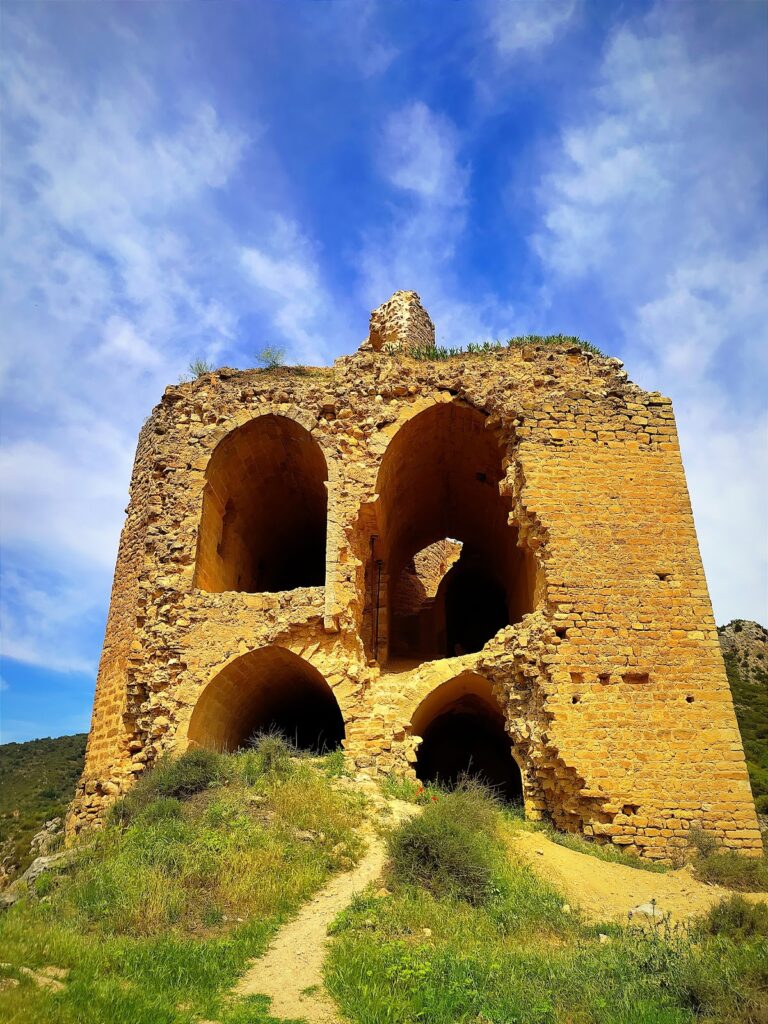
The principal surviving building is the canonical church of Sant Miquel, a Romanesque church of the eleventh century. Romanesque architecture is characterized by heavy masonry, rounded arches, substantial walls, and relatively small openings. The church stands a short distance below the castle and is crowned by a tall surviving bell tower. Its high, monumental apse preserves remains of fourteenth-century mural paintings.
Interior Features and Inscriptions
Medieval graffiti remains visible inside Sant Miquel, including drawings of several mail gloves, an eagle, a lance, and a crown. Stone slabs among the ruins covered graves and carry readable inscriptions. A subterranean crypt can also be discerned, together with several stone basins and spaces that were used at some period as storerooms or pantries.
Construction and Condition
The principal walls contain an unusual construction detail. Horizontal courses are separated by vertically placed stone slabs, creating a series of small openings facing the valley. Several points inside the church present a risk of collapse, while the castle itself survives chiefly through its foundations and associated underground features.
Nearby sites