Fort Driant: German Fortification and Battlefield in France


Site at a Glance
- Rating
- 4.8
- Popularity
- Very Low
- Country
- France
- Primary era
- Modern
- External website
- Open
- Eras represented
- Modern
- Civilizations
- German
- Site type
- Military
- Remains
- Fort
On this page11 sections
History
Fort Driant is a German-built fortification in France, near Ars-sur-Moselle, constructed between 1899 and 1905 in the late-nineteenth-century Biehler system. Originally called Feste Kronprinz, it formed part of the second fortified belt of Metz and the wider Moselstellung, the German defensive system along the Moselle between Metz and Thionville. Its guns controlled the Moselle valley, the road and railway route toward Nancy, and the Mance valley, helping guard the German Empire against a French attempt to retake Alsace and Moselle.
Construction and German service
A German order dated 13 May 1897 selected Height 364 in the Gorgimont forest, a plateau southwest of Metz bounded by steep slopes toward the Mance and Moselle valleys. Wilhelm II, German emperor from 1888 to 1918, approved the design on 4 April 1899, and construction began on 24 April. The works were completed in 1905.
The fort was named Kronprinz in honor of Crown Prince Wilhelm of Prussia. Wilhelm II formally inaugurated it on 19 May 1913. Modernization followed between 1914 and 1916, as the fort’s defenses were adapted to the increasing power of artillery and changing military requirements.
During the First World War, Fort Driant stood behind the principal German lines and served as a relay position for troops moving toward the fronts at Saint-Mihiel and Verdun. In November 1918, it fired some shells while an advance party of American troops was present in the Rupt de Mad valley.
French occupation and rearmament
French forces occupied the fort in 1919 and renamed it Fort Driant after Émile Auguste Cyprien Driant, a French lieutenant colonel and writer killed near Verdun in 1916. French engineers studied the German fortified groups around Metz and later incorporated them into the French defensive system. During the 1930s, the works were adapted and rearmed as part of the wider defensive planning associated with the Maginot Line, France’s interwar system of permanent fortifications along its eastern borders.
Reoccupation and the battle for Metz
After the French withdrawal in June 1940, the German army reoccupied Fort Driant. During the Second World War, German guns and armored components were removed from several Metz fortifications for use on the Atlantic Wall. Fort Driant itself, however, became a major defensive position during the 1944 battle for Metz.
Fighting around Fort Driant lasted from 7 September to 11 December 1944. Together with the fortified group Verdun, the position dominated the Moselle valley near Dornot and helped prevent a major American crossing. German troops also controlled the Mance valley. Their knowledge of the terrain supported repeated night counterattacks toward Ancy-sur-Moselle and Dornot.
From September to November 1944, the garrison included the 208th and 698th Replacement Grenadier Battalions, the 1419th Fortress Infantry Battalion, the 179th Reconnaissance Detachment, the 938th Coastal Artillery Regiment, elements of the 19th Volksgrenadier Division, and at least eight companies of officer cadets from the Metz officers’ school. Minefields surrounded the fort, and the units carried out regular reliefs.
The American attacks
American Operation Thunderbolt was planned on 17 September 1944 to combine ground and air attacks against the fortified positions. On 26 September, fighter-bombers dropped 500-kilogram napalm bombs, but the buried concrete works resisted the assault. American artillery then supported attacks by the 11th Infantry Regiment of the 5th Infantry Division on 27 September. The troops failed to cross the wire obstacles, and two further air raids before 30 September proved ineffective.
American troops captured one of the five barracks on 3 October, after which the fighting continued both on the surface and in the connecting tunnels. Four tanks were disabled on the first day, and five more were hit by Panzerfaust weapons during the night of 3 to 4 October. A Panzerfaust was a German single-use anti-tank weapon. Task Force Warnock replaced the 11th Infantry Regiment on 6 October, while a German counterattack supported by two Jagdpanzer IV tank destroyers was stopped north of the site.
Further American attacks on 7 October failed. On 8 October, German troops deliberately blocked a gallery leading to the southern battery with explosives, killing about twenty American soldiers. After losing 21 officers and 485 men, the attacking force withdrew during the night of 12 to 13 October. Before leaving, American engineers detonated about 3,000 kilograms of explosives in captured tunnels and bunkers.
The isolated Moselle Battery was evacuated into the central part of the fort on 17 October. The 5th Infantry Division was replaced by the 95th Infantry Division on 20 October, and the 2nd Infantry Regiment replaced its units on 23 November. After the surrounding forts fell and communications with Metz were cut, Colonel Richter commanded the remaining garrison and abandoned a proposed breakout.
Surrender and later military use
Colonel Richter surrendered the fort to Colonel Roffe of the 2nd Infantry Regiment on 8 December 1944, after roughly three months of siege. About 611 German survivors emerged and were sent into captivity at Cherbourg. Fort Driant was among the last Metz fortifications to surrender. Its resistance delayed the American advance and allowed German forces to withdraw toward the Saar.
After the war, the French army used Fort Driant for exercises. The site later served as a military destruction area for weapons and ammunition recovered in Moselle. It remains a restricted military area.
Remains
Dispersed fortified layout
Fort Driant is a dispersed Biehler-type fortification. In this design, defensive positions were spread across a broad area and concealed by the natural topography rather than concentrated in one building. The fortified works occupied approximately 142 hectares, while the total site was described as about 223 hectares. The central work forms a trapezoidal building with a base approximately 200 metres long. It contained the command post, an electrical generator, an infirmary, sanitary installations, and other auxiliary rooms.
An infantry parapet protected the northern approaches and contained combat shelters. Five concrete infantry blockhouses stood at critical points, while five fortified barracks housed the troops in heated dormitories supplied with running water and sanitary facilities. The barracks and other works were protected at the rear by earth cover and at their fronts and roofs by reinforced concrete.
Artillery and observation positions
Five artillery batteries were arranged along a northwest-southeast axis. Two mounted 150-millimetre howitzers with a range of about 10 kilometres, and three mounted 100-millimetre guns with a range of about 7 kilometres. Their fire could intersect with that of the fortified group Verdun on the opposite bank of the Moselle.
The Moselle Battery stood outside the protected perimeter on the southern flank, approximately 40 metres below the main fort. It provided additional fire against the Moselle valley and the railway connection toward Nancy. During the fighting in 1944, its personnel were withdrawn into the central fort on 17 October.
The artillery positions included armored gun installations. Sixteen observation cupolas and twenty-nine lookout posts allowed the garrison to direct mortar and heavy-machine-gun fire over the exterior approaches and the interior perimeter. Openings, doors, windows, and ventilation ducts were fitted with heavy lockable metal panels.
Underground communications and defenses
An extensive underground gallery system linked the individual positions. The fortified barracks were connected to the batteries, allowing movement through the complex and enabling combat below ground during the American attacks in October 1944. The galleries also formed the setting for the fighting that followed the capture of one barracks on 3 October.
Five diesel engines, each rated at 35 horsepower, supplied the fort’s power. Defensive points were surrounded by barbed-wire obstacles protected by heavy machine guns. The fortification also included a broad ditch and a high outer fence. These defenses worked together with the buried construction and dispersed plan to withstand air raids, artillery fire, armored attacks, and attempts to penetrate the galleries during the 1944 fighting.
Entrance and protective construction
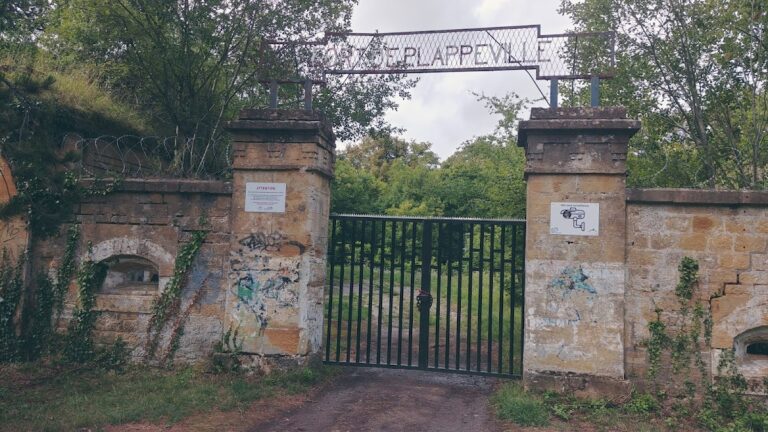
The fort had a single approach across an exposed causeway. Its gate was a heavy metal structure operated by a complex mechanism. Reinforced concrete, earth cover, armored observation positions, and concealed underground works protected the internal spaces, while metal panels secured the principal openings and ventilation passages.