Starhemberg Castle Ruins: A Medieval Hilltop Fortress in Austria


Site at a Glance
- Rating
- 4.6
- Popularity
- Very Low
- Country
- Austria
- Primary era
- Medieval
- Eras represented
- Medieval
- Civilizations
- Duchy of Austria, Holy Roman Empire
- Site type
- Military
- Remains
- Castle
On this page10 sections
History
Starhemberg Castle Ruins are the remains of a medieval hilltop castle near Dreistetten in Austria, in the Piesting Valley of Lower Austria. The castle was probably established in the mid-12th century, with proposed dates around 1140 to 1145 or about 1160, when the Piesting marked the boundary between Styria and the March of Austria. Its earlier name, Starkenberg, means “strong mountain.” Despite the similar name, the castle is unrelated to the Starhemberg castles and princely family of Upper Austria.
Foundation and the Styrian frontier
In 1147, Adalram von Waldeck held Starhemberg and transferred the castle and its lordship to Ottokar III, Margrave of Styria. The transfer formed part of an arrangement connected with Adalram’s former advocacy of a monastery. Ottokar used the lordships of Waldeck and Starhemberg in completing Adalram’s foundation of Seckau Abbey. Adalram later entered the monastery as a lay brother, while his wife, Richinza von Perg, became a nun.
The early lords of Starchemberg, whose name became associated with the castle, died out during the 12th century. Their possessions were also linked with Schloss Fischau. In 1192, Styria and Starhemberg passed to the Babenbergs, the medieval dynasty that ruled Austria until it died out in 1246.
Babenberg stronghold
Frederick II the Warlike, the last Babenberg duke of Austria, expanded and fortified Starhemberg. During the 13th century, it became one of the most important castles in Lower Austria. The Ebstorf World Map represents Starhemberg, Vienna, and Krems as the only places shown in the Duchy of Austria.
In the mid-13th century, the Babenberg family archive was kept at Starhemberg. The family treasure was also hidden there during wartime. After Frederick II’s death, the Teutonic Order, a medieval religious and military order that could also perform custodial duties, guarded these holdings.
Habsburg, Hungarian, and early modern rule
After the Habsburg victory at the Battle of Dürnkrut, also known as the Battle on the Marchfeld, in 1278, the castle passed to the Habsburgs. Hungarian forces under King Matthias Corvinus captured and occupied it for several years from 1482.
Sigmund Spaur III administered Starhemberg from 1480 to 1491. Alterations during this period included a Renaissance residential wing, a late-medieval and early-modern section shaped by Renaissance forms for residence and representation. Spaur may have initiated the work and placed his coat of arms on the completed wing, although the precise extent of his intervention remains uncertain.
Anna Maria von Heussenstein inherited the Starhemberg-Hernstein lordship from her mother, Anna von Petschach, who had married into the Welzer von Eberstein family. Anna Maria’s husband, the Protestant Hans von Heussenstein, had come from Germany and served as a chamberlain to the emperor. The emperor later pledged the castle to Francisco Lasso de Castilla and then to the Taxis family. After a severe earthquake damaged the property in 1570, Heussenstein repurchased the lordship in 1577 for 24,500 gulden.
Decline and wartime damage
During the Second Ottoman Siege of Vienna in 1683, Starhemberg sheltered people from the surrounding area. Around 1800, the Counts of Heussenstein removed the doors and window frames and stripped the roofs to avoid the new roof tax. This began the castle’s decline. The ruin passed to Baron Stephan von Badenthal in 1817 and to Archduke Rainer of Austria, Viceroy of Lombardy–Venetia, in 1830.
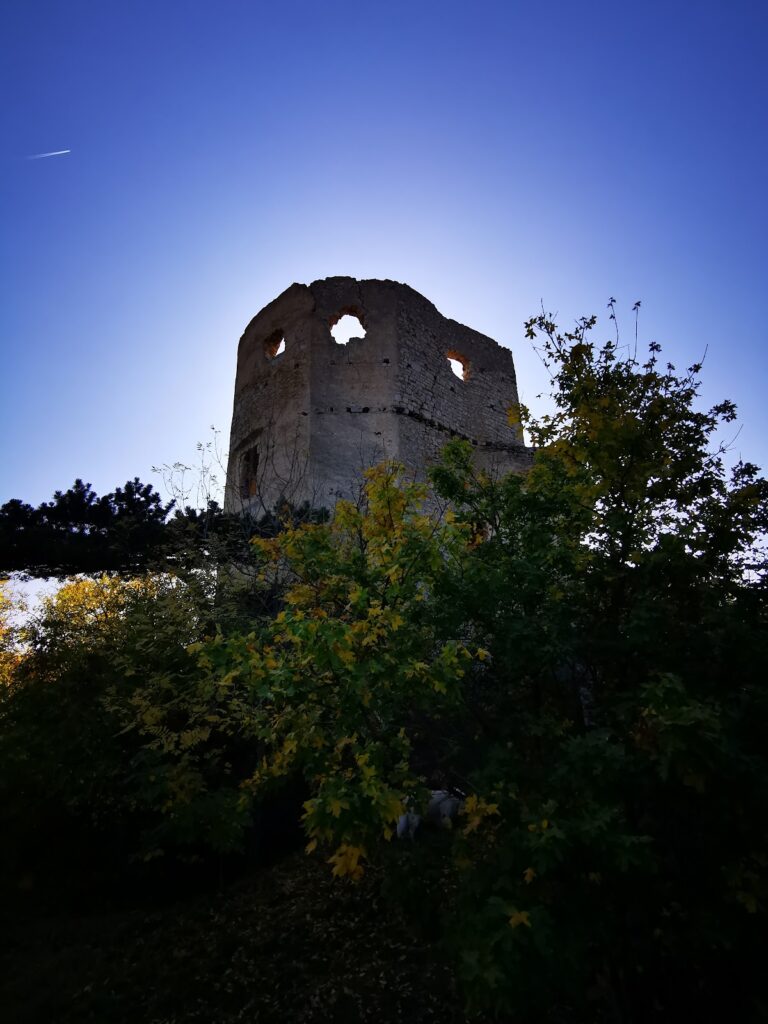
A large part of the great hall collapsed around 1870. Local inhabitants continued taking building materials from the ruin until the middle of the 20th century. In spring 1945, during the final phase of the Second World War, a Waffen-SS unit occupied the site and maintained an observation post in the tower above the chapel. Soviet artillery fire then caused severe damage to the walls. The Waffen-SS was the armed wing of the SS under Nazi Germany.
Preservation in the modern period
The Friends of Starhemberg Castle began seeking the ruin’s restoration in 1931 and resumed intensive work in 2019. The Salvator Habsburg-Lorraine family has owned the site since 1913. By 2008, Austria’s monument-preservation authorities were protecting and caring for the ruin. An agreement concluded on 2 August 2022 leased the castle grounds to Markt Piesting for restoration and preservation, with the eventual aim of reopening the site in stages. The ruin has been closed for safety reasons since 2007.
Remains
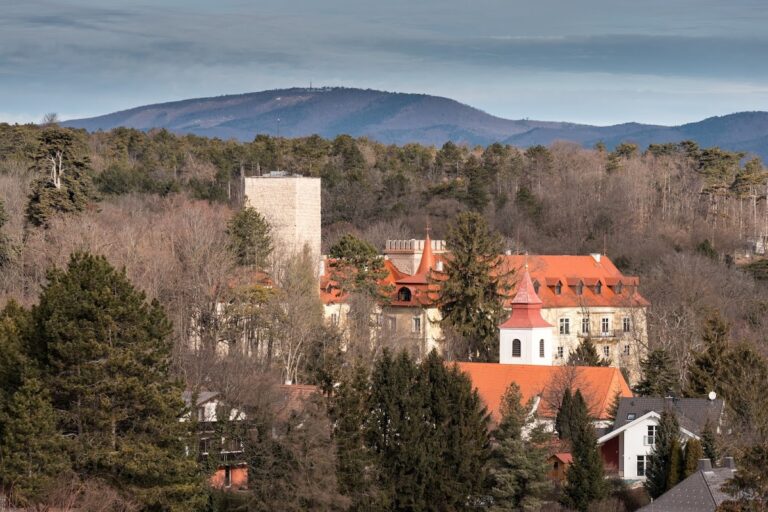
Starhemberg is a Höhenburg, or hilltop castle, spread across the summit of a hill at approximately 520 metres above sea level. Its long axis runs from southwest to northeast. The surviving complex contains an inner bailey, residential buildings, ring walls, a chapel with an associated tower, and remains of the great hall. The inner-bailey southern walls and the western castle walls form part of the preserved structure.
Defensive and residential structures
The northern residential tract has an interior wall that turns toward the eastern interior wall. Its northeastern exterior wall retains bullet holes caused by Soviet artillery in 1945. Behind the residential buildings, the northwestern ring wall also serves as the exterior wall of the northern residential tract, joining the domestic and defensive parts of the complex.
A kitchen chimney, or domed kitchen funnel, survives within the residential tract. It is topped by a pyramid-like structure made of calcareous tuff. In the western part of the northern residential tract, an octagonal column stump remains in place, with a cross vault surviving on its western side.
Later residential wing
The late-15th-century alterations produced a Renaissance residential wing within the castle complex. Its completed form carried the coat of arms of Sigmund Spaur III, who may have begun the work while administering Starhemberg. The surviving wing belongs to the castle’s transition toward residential and representative use while it continued to retain its fortified character.
Chapel and great hall
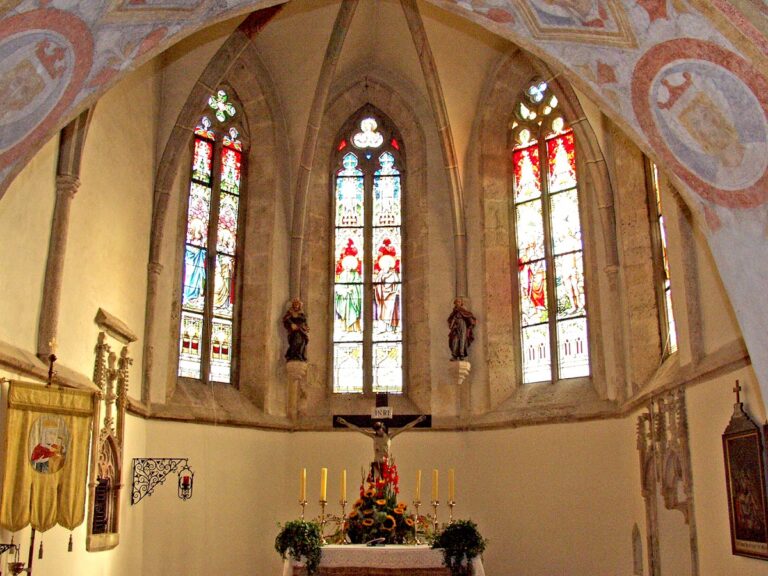
The chapel and its tower remain part of the castle’s surviving architectural group. The tower above the chapel was used as an observation post in spring 1945. The great hall is represented by its surviving remains after a large section collapsed around 1870. Together with the walls, residential structures, and ring defenses, these fragments define the present ruin.
The castle is preserved in a fragmentary state. Roofs, doors, and window frames were removed around 1800, building materials were taken from the site over subsequent generations, and artillery fire caused further damage to the walls in 1945.
Nearby sites