Cove Fort: A Coastal Defence Fortification in Ireland


Site at a Glance
- Rating
- 4.7
- Popularity
- Very Low
- Country
- Ireland
- Primary era
- Early Modern
- Eras represented
- Early Modern
- Civilizations
- Irish
- Site type
- Military
- Remains
- Fort
On this page10 sections
History
Cove Fort is a small coastal defence fortification in Ireland, located east of Cobh in County Cork. Built in 1743 on the instructions of the Vice-Admiral of the Coast, a naval official responsible for coastal affairs, it replaced temporary artillery batteries that had defended Cork Harbour. The fort controlled the harbour’s main shipping channel and helped protect the naval yards at Haulbowline, an island that became an important naval base and dockyard.
Eighteenth-century coastal defence
The fort formed part of the harbour’s defensive system, with three tiers of guns facing the sea. A 1763 report listed several 24-pounder long guns at Cove Fort. Charles Vallancey, an eighteenth-century Irish surveyor and engineer, later recorded a small detachment of the Royal Irish Artillery, the British artillery corps responsible for artillery service in Ireland. By 1811, at least 20 24-pounder guns were positioned at the fort.
Later eighteenth-century reports criticised Cove Fort’s defensive arrangement. Higher ground behind the position overlooked it, while the bastions planned for its landward side were never completed. These limitations reduced the strength of the fort’s landward protection even as its guns continued to command the harbour approach.
Nineteenth- and twentieth-century use
During the nineteenth century, Cork Harbour’s wider defences expanded through works at Fort Westmoreland on Spike Island, Fort Carlisle at Whitegate, and Fort Camden at Crosshaven. By the end of the Napoleonic Wars, the European conflicts associated with Napoleon Bonaparte between 1803 and 1815, Cove Fort had been adapted for use as a naval and military hospital.
By the 1830s, hospital functions occupied most of the site, although the fort continued to serve as a barracks. Its principal role had therefore shifted away from that of a defensive battery. The Queenstown Military Hospital remained in operation until after the First World War, extending the site’s military history into the twentieth century.
Remains
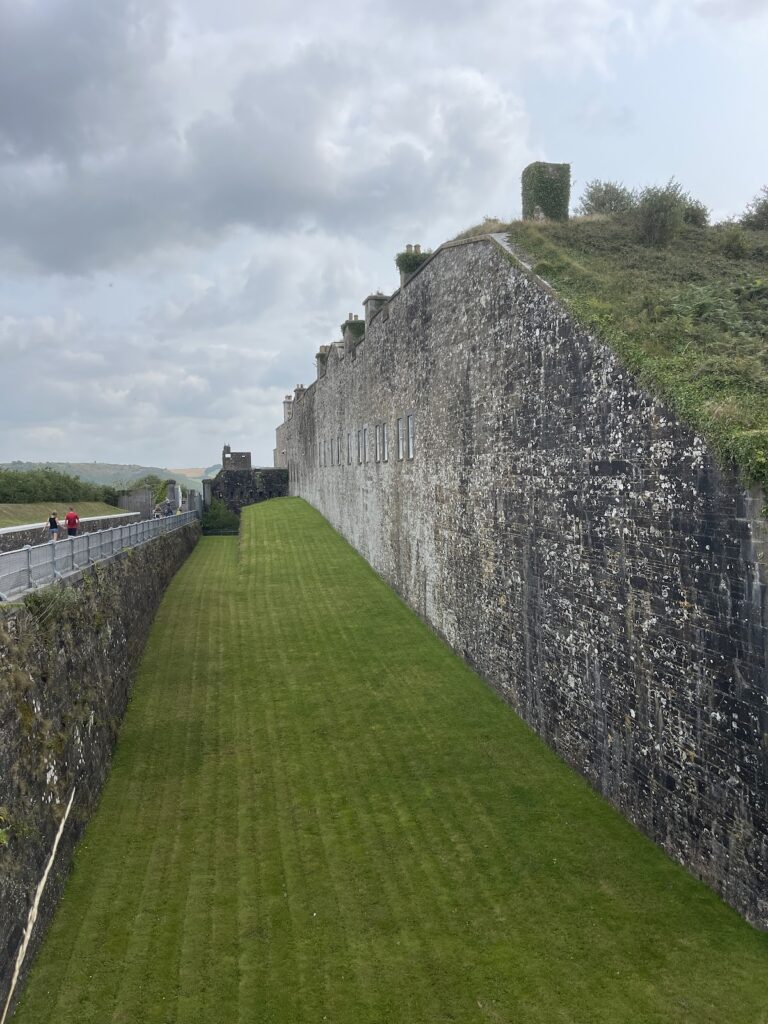
Cove Fort occupies about 2.5 acres and survives as a small bastioned land battery, meaning a shore-based artillery position intended to fire on vessels or protect a harbour. Its former military grounds now incorporate harbour facilities, landscaped public space, and a memorial garden.
Fortification and artillery remains
Seaward battery
The seaward frontage was demi-bastioned, using partial bastions that combined a projecting face with one flank. Three tiers of gun emplacements were directed toward the harbour’s main shipping channel. The artillery included 24-pounder long guns, with at least 20 in position by 1811, linking the surviving fortification to its principal defensive purpose.
Landward defences
The landward walls contained musketry flanking galleries, protected passages from which small-arms fire could be directed along the base of a wall. The original defensive design also called for bastions on this side, but those planned works remained incomplete.
Memorial and later site features
Cobh Titanic Memorial Garden
The former fort area includes the Cobh Titanic Memorial Garden. Its glass structure is engraved with the names of the 123 passengers who boarded the RMS Titanic at Cobh, then called Queenstown, on the liner’s final port call before it crossed the Atlantic. The garden has a line of sight toward the Titanic’s last anchorage near Roche’s Point at the mouth of Cork Harbour.
Harbour and park buildings
Other present features within the former fort area include a Port of Cork operations building, a harbour pilot station, and the landscaped grounds of Bishop Roche Park. These later uses form part of the site’s current physical character alongside the surviving elements of its military past.
Nearby sites