Fort de Pontisse: A Belgian Fort of the Fortified Position of Liège


Site at a Glance
- Rating
- 4.1
- Popularity
- Very Low
- Country
- Belgium
- Primary era
- Modern
- External website
- Open
- Eras represented
- Modern
- Civilizations
- Belgian, German
- Site type
- Military
- Remains
- Fort
On this page16 sections
History
Fort de Pontisse is a Belgian late-nineteenth-century fort near Liège, Belgium, built between 1881 and 1884 as one of twelve forts in the Fortified Position of Liège. Designed by General Henri Alexis Brialmont, it protected the Meuse valley and the Albert Canal downstream while helping guard Liège against another French occupation. The fort was occupied by Belgian troops soon after completion and became one of the largest forts in the Liège region.
Construction and Belgian defense
The fort formed part of Belgium’s National Redoubt, a strategic system of fortified positions intended to preserve a defensible core of the country if an invading army overran other territory. The Fortified Position of Liège was its defensive ring around the city, and Pontisse occupied a position northeast of Liège between Fort de Liers and Fort de Barchon. Its location gave it a role in controlling movement through the Meuse valley and along the canal downstream.
First World War
In August 1914, Captain-Commandant Speesen commanded a garrison of about 380 artillerymen and infantrymen. On 5 August, Pontisse opened fire on a German pontoon bridge at Lixhe. With information from observers outside the fort, its guns destroyed the bridge three times, causing heavy German casualties that included Count Arnim-Boitsenburg.
On 5 and 6 August, the fort continued firing on the German 34th Brigade and disrupted its concentration at Hermée. Its 57-mm guns repelled an attack by three companies of the 90th Fusilier Regiment, although machine-gun fire destroyed the searchlight. After Liège fell on 7 August, General Otto von Emmich offered Pontisse terms of surrender, but the garrison refused.
German batteries at Saint-Remy, Cheratte, Wandre, and other positions began bombarding the fort on 9 August. The fire damaged the superstructure, filled the ditch with rubble, heavily damaged two 150-mm guns, and shifted the turrets by breaking their concrete protection. Pontisse continued to answer, firing at German forces near Dalhem and at a 210-mm battery on the road between Warsage and Visé.
On 12 August, heavy shells damaged the cupolas, pierced the cisterns, and left the fort in darkness. Pontisse then became the first fort attacked by German 420-mm artillery, including the heavy siege mortars known as “Big Bertha.” Four 420-mm shells struck on the morning of 13 August and destroyed the fort’s remaining effective resistance. With its ammunition exhausted and its position untenable, the commander raised the white flag around noon. The garrison surrendered with the honors of war, and the officers were permitted to keep their swords.
Occupation and interwar rebuilding
During the German occupation, the fort was improved in 1916. Better ventilation and sanitary facilities were installed, and damaged sections were replaced with reinforced concrete. Belgium regained and reoccupied Pontisse after the 1918 armistice.
During the 1930s, Pontisse was rearmed as part of the second phase of the Fortified Position of Liège, known as Fortified Position of Liège II. The work was intended to deter a German incursion from the Belgian frontier. The original 57-mm guns were replaced by machine guns, new artillery and an anti-aircraft battery were added, and the ventilation, sanitation, communications, electrical systems, and protective structures were modernized.
As the northernmost fort in its sector, Pontisse was assigned to support Fort Eben-Emael. A flanking bunker was constructed to observe the Laveau ravine, provide an alternative exit, and supply ventilation air. A new underground quadrilateral was excavated 22 metres below the older fort, making it the deepest such work among the rearmed forts along the Meuse.
Second World War and later use
In 1940, Captain-Commandant Fernand Pire led a garrison of 223 men. After German forces captured Fort Eben-Emael on 11 May, Pontisse provided fire support for Belgian field units and neighboring forts for several days, including fire directed toward the Eben-Emael area.
A German air attack on 18 May destroyed Pontisse’s 105-mm turret and damaged its four 75-mm turrets. With its ammunition nearly or entirely exhausted, the fort surrendered at 13:45 that day. After the war, it served as a munitions depot for the Belgian army and later for the national munitions factory. Salvagers removed its metal equipment during the 1950s.
Pontisse was abandoned from 1993 and gradually deteriorated. In 2002, the ASBL Fort de Pontisse acquired it for a symbolic euro and undertook sanitation work. The association manages the above-ground area as a nature reserve and arranges summer guided visits by appointment. The deep galleries are also preserved as a refuge for bats, especially during winter hibernation, and are closed from approximately mid-October to April for their protection.
Remains
Layout and concrete construction
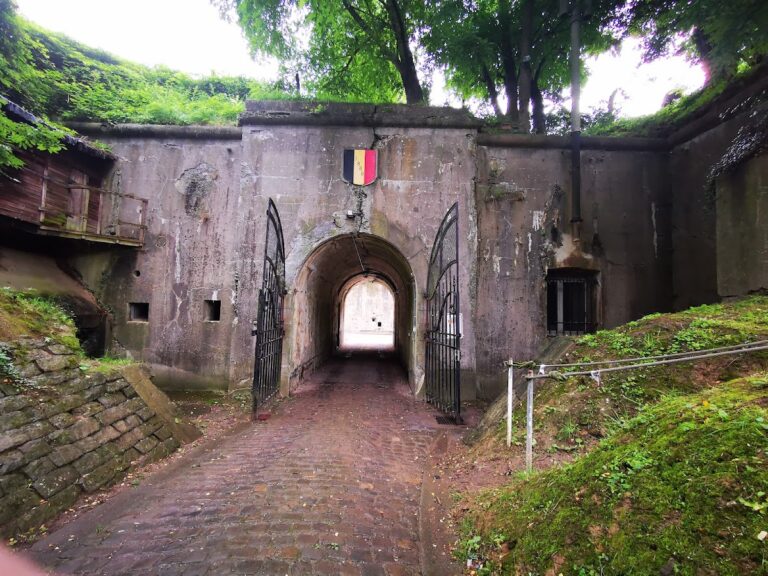
Fort de Pontisse lies near Vivegnis in the Herstal area, about 7 kilometres northeast of central Liège. It overlooks the Meuse valley and the Albert Canal downstream from Liège. Unlike the triangular plan used for most of Brialmont’s forts, Pontisse has an unusually large, irregular trapezoidal layout surrounded by a ditch about 6 metres deep and 8 metres wide.
The fort was built entirely of unreinforced concrete. The Meuse forts belonged to Belgium’s earliest concrete buildings and to Europe’s early military structures made from the material. The central concrete massif contained the fire-control office, magazines, and artillery cupolas. Its roof was 4 metres thick, while the less exposed caserne walls were 1.5 metres thick. The design was intended to resist 21-cm artillery, then regarded as the heaviest available when the fort was planned, but the First World War bombardment exposed its vulnerability to heavier weapons.
Artillery and observation systems
Original gun turrets
The original armament included two turrets, each carrying a single 210-mm Krupp howitzer, a turret with two 150-mm guns, and two turrets, each mounting two 120-mm Krupp guns. Four retractable 57-mm turrets provided close defense. Eight rapid-fire 57-mm guns in counterscarp casemates fired into the ditches and defended the rear postern.
Observation and communication
An observation turret with a searchlight stood on the central massif. Other observers positioned on nearby church towers, at crossroads, and on elevated ground transmitted information to the fort by telephone. Forts de Liers and de Barchon communicated with Pontisse by light signals. The artillery used black powder, whose choking gases could spread from the enclosed firing chambers through the fort.
Interwar armament
The 1930s modernization replaced the original artillery with one 105-mm turret, four 75-mm turrets, and a turret for machine guns and grenade launchers. The former searchlight cupola was replaced by a special armored bell developed by the Royal Cannon Foundry, and an anti-aircraft battery was added. The four original 57-mm turrets were replaced by machine guns.
Ditches, service areas, and underground works
Counterscarp defenses
The outer side of the ditch, known as the counterscarp, contained casemates whose guns fired lengthwise along the ditch in enfilade fire. This arrangement allowed the defenders to sweep the narrow defensive zone toward firing positions at its opposite end. The side facing Liège was more lightly defended to support a possible Belgian recapture.
Rear facilities
The barracks and service facilities opened toward the rear ditch. This ditch supplied light and ventilation while remaining exposed to artillery fire. Latrines, showers, kitchens, and the service area were placed in the counterscarp, where their position became difficult to maintain during combat. The fort’s foundations rested largely on schist, shaping the arrangement of its water and underground facilities.
Deep modernization works
The flanking bunker built during the interwar modernization watched the Laveau ravine and provided an emergency exit and a source of ventilation air. Its associated underground works extend 22 metres below the original fort. German bombardment in August 1914 damaged the superstructure, ditch, concrete protection, artillery, cupolas, and cisterns, while later German repairs introduced reinforced-concrete replacements. The 1940 air attack destroyed the 105-mm turret and damaged the 75-mm turrets.
Present physical survival
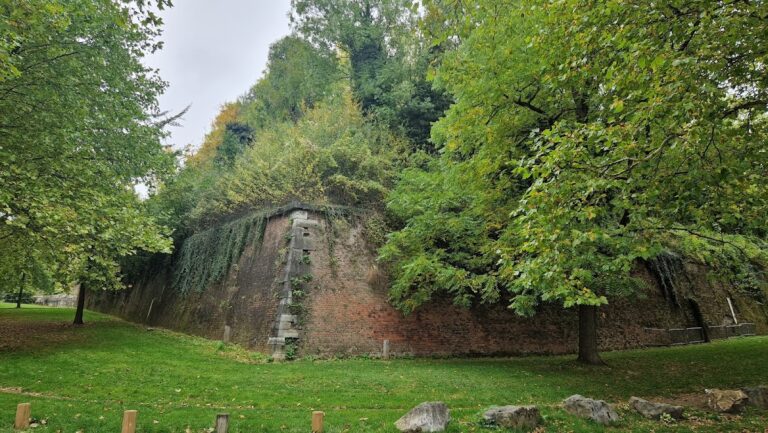
The above-ground structures survive within a nature reserve surrounded by an extensively urbanized environment. The deep galleries retain their role as a bat refuge and winter hibernation site. Their seasonal protection period, from approximately mid-October to April, preserves the underground spaces for the bats that use them.
Nearby sites