Camden Fort Meagher: A Coastal-Defence Fortification at Cork Harbour


Site at a Glance
- Rating
- 4.7
- Popularity
- Low
- Country
- Ireland
- Primary era
- Modern
- External website
- Open
- Eras represented
- Early Modern, Modern
- Civilizations
- British, English
- Site type
- Military
- Remains
- Fort
On this page12 sections
History
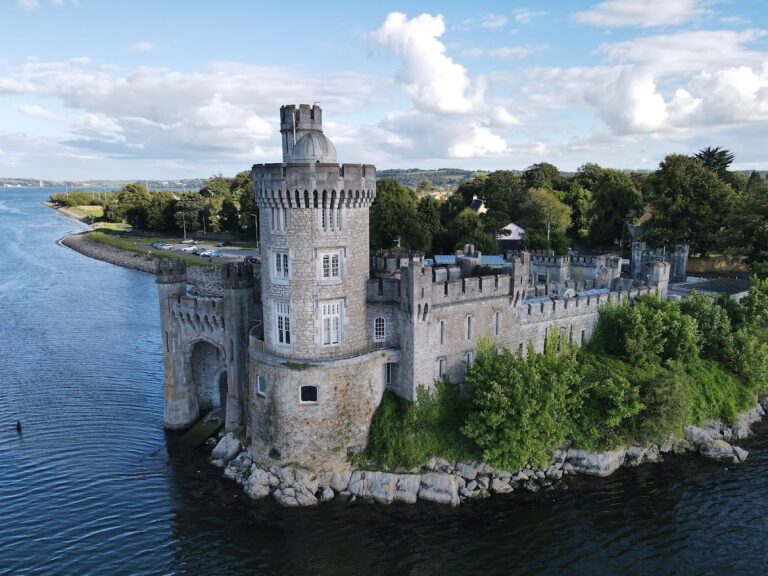
Camden Fort Meagher is a coastal-defence fortification in Ireland, on Ram’s Head near Crosshaven, overlooking the entrance to Cork Harbour. Its history reflects the harbour’s strategic naval importance and the development of interconnected defences around its approaches. The fort’s present form chiefly dates from a major nineteenth-century reconstruction that began in 1861.
Early batteries and the Williamite War
The first defence on Ram’s Head was James’ Battery, built in 1550 and extended in 1600. It fell into disuse after the Nine Years’ War, a conflict in Ireland that ended with the defeat of the Gaelic lords and their allies. The position was strengthened again in 1690 during the Williamite War in Ireland, the late-seventeenth-century struggle between the forces of William III and those supporting James II.
A party then captured the fort in a covert overland assault. Cork and Kinsale were subsequently taken by Williamite forces commanded by John Churchill, 1st Earl of Marlborough, who later became the 1st Duke of Marlborough. By 1779, the defensive position was known as Ram’s Head Battery and formed part of a wider harbour system that included Haulbowline, Spike Island, Whitegate, and Templebreedy.
Fort Camden and nineteenth-century reconstruction
In 1795, the fortifications were named Fort Camden in honour of John Pratt, 2nd Earl Camden, who was then Lord Lieutenant of Ireland. By the 1830s, the garrison had been reduced to a small force, and the fort was briefly used as a prison.
A Royal Commission in the 1850s reassessed Cork Harbour’s strategic importance and proposed stronger landward defences together with new seaward gun batteries. Major reconstruction began in 1861, employing convict, military, and civilian labour. The fort was extended, and much of the surviving structure belongs to this phase.
Modern military use and transfer
During the 1880s and 1890s, the fort’s artillery was modernised with breech-loading rifled guns and larger cannons. A minefield was laid across the harbour channel, and a launching position for the Brennan torpedo was installed in 1891. The Brennan torpedo was a wire-guided weapon developed in the late nineteenth century and is associated with the world’s first practical guided weapon.
In the First World War, Cork Harbour served as a naval base covering the Western Approaches, the sea routes west of Britain and Ireland. An anti-submarine net and further defensive improvements were added. Under the Anglo-Irish Treaty, the harbour’s Treaty Port defences remained under British control. These strategically important naval installations were transferred to the Irish authorities in July 1938.
During the Emergency of 1939–1945, elements of the Coastal Defence Artillery of the Irish Artillery Corps operated from Fort Camden and nearby Templebreedy Battery. The Coastal Defence Artillery was the Irish Army branch responsible for artillery protecting coastal and harbour approaches. After the transfer to Irish control, the fort was renamed Fort Meagher in honour of Thomas Francis Meagher, an Irish nationalist associated with the Young Ireland movement and the 1848 rebellion.
Fort Meagher remained an Irish military installation until 1989, when the army transferred it to Cork County Council. In the mid-to-late twentieth century, it was used mainly for training the Civil Defence and Reserve Defence Forces after the Coastal Defence Artillery had been incorporated into other Irish Army artillery regiments. Following the transfer, the fort became disused, overgrown, and derelict. In 2010, the council granted a lease to community members from Crosshaven, whose volunteer campaign cleared and redeveloped the site. It is now known as Camden Fort Meagher and is largely restored.
Remains
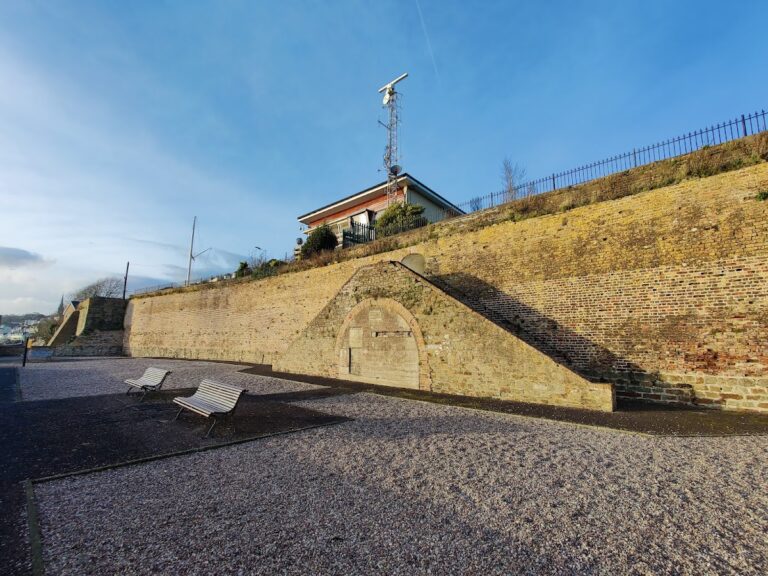
The fort occupies the Ram’s Head headland above the entrance to Cork Harbour. Its surviving layout combines a landward wall and moat with defensive works on the landward side and gun batteries facing the sea. The fortification forms part of a wider landscape of harbour defence that also included Fort Mitchell on Spike Island, Fort Davis at Whitegate, and Templebreedy Battery near Crosshaven. Much of the nineteenth-century complex was built underground.
Landward and seaward defences
Landward works
The landward side is defined by a wall and moat, together with associated defensive works. These elements belong principally to the reconstruction and extension begun in 1861, when the earlier position was developed into a larger fortification. Their surviving form shows how the site was arranged to protect the inland approach while the rest of the complex covered the harbour entrance.
Seaward batteries
Seaward gun batteries formed the artillery face of the fort. Their armament was renewed during the 1880s and 1890s with breech-loading rifled guns and newer, larger cannons. A minefield across the harbour channel supplemented these batteries as part of the late-nineteenth-century defensive system.
Guided weapon and harbour barriers
Brennan torpedo position
A launching position for the Brennan torpedo was added in 1891. The installation survives as an exhibit within the fort and represents the site’s transition from traditional gun batteries toward newer systems of controlled maritime defence. The torpedo was guided by wires, an arrangement that made it an early practical guided weapon.
Anti-submarine net
An anti-submarine net was added to the harbour defences during the First World War, when Cork Harbour served as a naval base covering the Western Approaches. It formed part of the wartime improvements associated with protecting the harbour and its approaches.
Restored underground complex
Many structures within the fort are underground, reflecting the defensive reconstruction of the 1860s and later artillery modernisation. After decades of overgrowth and dereliction, volunteer-led clearance and redevelopment began in 2010. The resulting work left Camden Fort Meagher largely restored as a surviving coastal-defence complex.
Nearby sites