Haus Heyde: A Former Aristocratic Estate in Unna, Germany


Site at a Glance
- Rating
- 4.9
- Popularity
- Very Low
- Country
- Germany
- Primary era
- Medieval
- Eras represented
- Medieval
- Civilizations
- Holy Roman Empire
- Site type
- Domestic
- Remains
- Castle
On this page12 sections
History
Haus Heyde is a former aristocratic estate in Germany, at the northern edge of Uelzen, now part of Unna. It was first mentioned in 1343, while its manor house was built in the early seventeenth century and later transformed into a Baroque three-wing complex. The estate was demolished in 1966, but its moat and parts of its surrounding landscape remain. Uelzen became part of Unna on 1 January 1968.
Medieval origins and early owners
The earliest probably identified owner was Friderich opper Heide, also called Friderich van der Heide, who appeared as a witness at Unna in 1343. He may have belonged to the von Hilbeck family, although that identification is uncertain. The first secure evidence for an aristocratic seat at Heyde comes from 1422 and 1479, when the knight Henrike Sprenge was described as lord of Heyde and Borgmühlen. The locally prominent Sprenge family probably became extinct by the end of the fifteenth century.
At the close of the fifteenth century, Haus Heyde passed through marriage to the extensive von der Recke family. That family was based at another estate called Haus zur Heyde, later Haus Reck, in present-day Hamm-Lerche. The similar names and close geographical proximity have left parts of the succession unresolved.
Around 1500, Jasper Torck acquired Haus Heyde. He was associated with Haus Brügge in present-day Bönen-Lenningsen and served as Drost of Unna and Kamen, a senior territorial official with administrative, judicial, and often military duties. Torck left the estate to his daughter Katrin, who was married to Matthias, or Thies, von Aldenbockum. Matthias succeeded Torck as Drost.
The Aldenbockum and Ascheberg estates
Three generations of the von Aldenbockum family owned and occupied Haus Heyde during the sixteenth century. Their charitable activities connected the estate with institutions in the surrounding towns. Johann and Diederich von Aldenbockum donated funds to the Kamen school in 1586. In a testament of 1585, Johann von Aldenbockum and his second wife, Mette Bycker, provided an annual grain rent for the poor of Unna and 60 Reichstaler for the school at Hamm.
Five generations of the von Ascheberg family held Haus Heyde through much of the seventeenth century. Heberich, also recorded as Heilwig or Sibrich, inherited the estate and married Heidenreich von Ascheberg, lord of Byinck. Their son, Aldenbockum von Ascheberg, donated a gilded silver communion chalice to the Unna church in 1620. The family built the manor house in the early seventeenth century, but became impoverished during the Thirty Years’ War, the European conflict of 1618 to 1648 that brought widespread destruction and economic decline to German territories.
Johan Diederich Heidenreich von Ascheberg zu Byinck and Heyde died without children in 1712. He left the estate to his sister’s son, Jan Steffen Heidenreich von Palant zu Schadeburg. Palant sold Haus Heyde in 1743, apparently without having lived there and probably because of financial difficulties, to Christoph Friedrich Steffen von Plettenberg zu Lenhausen-Stockum.
The Plettenberg period
Christoph Friedrich Steffen von Plettenberg paid 40,722 Reichstaler for the estate. He financed the purchase by selling the ruined Lower House at Lenhausen and other Lenhausen property, as well as using proceeds from his participation in the First Silesian War, one of the eighteenth-century conflicts between Prussia and Austria over Silesia.
As a member of the Protestant line of the von Plettenberg family in the Catholic Duchy of Westphalia, Plettenberg was not eligible to sit in the provincial assembly. He therefore served Prussia as an officer. During the Second Silesian War he became a lieutenant colonel and received the Order Pour le Mérite, a prestigious Prussian order of merit associated especially with military achievement. He later served as a major general during the Seven Years’ War, which lasted from 1756 to 1763 and included the Third Silesian War.
On 6 May 1757, while commanding two Prussian dragoon regiments at the Battle of Prague, Plettenberg was severely wounded and became unfit for field service. In 1758 Frederick the Great assigned him responsibility for remount horses for the Prussian army. Plettenberg retired as a lieutenant general in 1761, aged 62, because of illness. He lived at Haus Heyde, bought the neighbouring Binkhoff estate in 1768, and died on 17 March 1777. He was buried in the choir of the Unna town church, although his gravestone no longer survives.
The conversion of Haus Heyde into a Baroque complex of three wings and the creation of its park probably took place under Christoph Friedrich von Plettenberg or his son Henrich Ludwig von Plettenberg. Henrich Ludwig inherited the estate, married Sophie Charlotte von Plettenberg-Heeren in 1767, and acquired the Bögge and Nordhof estates in 1785. These purchases approximately doubled the family’s holdings.
The von Bodelschwingh family
Henrich Ludwig’s eldest daughter, Friederike von Plettenberg, married Franz von Bodelschwingh-Velmede in 1785. Through this marriage Haus Heyde passed to the von Bodelschwingh family. Four generations of the family lived at the estate, which became their principal centre until they sold it to the city of Kamen in 1927.
Franz and Friederike von Bodelschwingh owned six estates and ranked among the wealthiest landowners in the area. After Franz died in 1827, Friederike continued to live at Haus Heyde until her death in 1850. Their children included Sophie, who later inherited Bögge and Nordhof; Ernst, who inherited Velmede and Töddinghausen; and Carl, who inherited Heyde and Binkhoff.
Ernst and Carl von Bodelschwingh became prominent public figures from the Hamm and Unna region. Both served as district administrators, government presidents, Prussian finance ministers, and parliamentary representatives. Ernst resigned as minister in 1848 and Carl in 1866 when government policy conflicted with their principles.
Carl served as Prussian finance minister for a total of eleven years. He was also a commendator, or presiding officer, of the Westphalian Johanniter organization, the German branch of the Order of St John, and was strongly involved in social affairs. His daughter Ida married her cousin Friedrich von Bodelschwingh at Haus Heyde in 1861. They later established the Protestant charitable and social-care institutions at Bielefeld-Bethel.
Haus Heyde was visited by several notable nineteenth-century figures associated with the von Bodelschwinghs. They included the Imperial Baron vom und zum Stein, a Prussian reformer; Ludwig von Vincke, the first chief president of the Province of Westphalia; and Rulemann Eylert, who later became court preacher to King Frederick William III. Eylert wrote some of his reflections at Haus Heyde.
Estate management and twentieth-century change
Carl’s son Udo von Bodelschwingh inherited the family seat. He was a professional officer who spent only several weeks each year at Haus Heyde and ended his active career at the age of 49. His memorial slab described him as a royal Prussian retired colonel, master of ceremonies, and chamberlain.
After Udo’s death, Haus Heyde passed to his eldest daughter Leopoldine, who was married to Dietrich von Bodelschwingh, a lieutenant general of cavalry. Dietrich left military service after the First World War, and the family lived at Haus Heyde from 1919 to 1923. In 1927 the von Bodelschwinghs sold the estate to the city of Kamen for 346,000 Reichsmark. Kamen was chiefly interested in the land as exchange property for areas transferred for the establishment of Vereinigte Deutsche Metallwerke in Kamen.
In 1920 the estate covered about 106 hectares. Of this area, 82 hectares lay in Uelzen, with the remainder in Unna and Mühlhausen. Until tenant farmers were able to redeem their holdings in the mid-nineteenth century, the estate included as many as ten farms, most of them in Mühlhausen. Its agricultural production included grain, potatoes, oats, barley, fodder beet, beans, clover, and flax, alongside extensive permanent grassland. Livestock included about 250 sheep, normally eight horses, 70 to 80 pigs, cattle, calves, and chickens.
The estate also operated a grain mill and an oil mill on the Mühlbach. The grain mill stood about 300 metres south of the castle and the oil mill about 300 metres north. Both were leased to millers. From 1796 until the mid-nineteenth century, the von Plettenbergs and later the von Bodelschwinghs also held the Unna windmill in hereditary lease. They rebuilt it after a long period of disuse and operated it through a subtenant miller.
Water shaped the estate’s economy and landscape. It created marshy meadows and muddy roads, but supported the mills, flooded meadows in early spring, and supplied water to the saltworks at neighbouring Königsborn. Fish were plentiful in the moat, ponds, and streams. The railway between Unna-Königsborn and Welver opened in 1876 and was later closed and dismantled. Its high embankment separated about one third of the estate’s southern land from the rest. Represented by Ernst von Bodelschwingh, the family challenged the expropriation and pursued compensation through three court instances, ultimately losing before the Reich Court, the highest court of the German Empire from 1879 to 1945.
After Kamen acquired the estate, it leased several plots to local farmers in 1928. The approximately 56-hectare core area and part of the buildings went to the Dutch flower and vegetable grower Piet Heeman and his partner Heinrich Krings. Heeman farmed the estate until 1960 and helped popularize cauliflower in Westphalia during the 1930s. He also grew flowers, especially tulips.
During the Second World War, more than 20 Polish and Russian people were housed at the castle. Up to eight tenant households also lived there, including for a long period after the war. From 1955 to 1965, the estate became a centre for music and youth activities. The Jugendverband Musikantengilde leased the manor house and an area of wasteland, repaired both, and held chamber-music evenings, open singing sessions, children’s camps, tent camps, training courses, and conferences for youth leaders.
Kamen abruptly terminated the leases. Although the buildings were in poor condition, they were not structurally unsafe. With the consent of the state conservator, the city demolished them in May 1966. Demolition material filled two arms of the moat, and it remains uncertain whether the manor house’s two cellars survived.
Protection of the archaeological landscape
In 1970 Kamen sold the entire property for 3.1 million Deutsche Mark through the Unna district economic-development agency. Most plots went to farmers as exchange land, while the city of Unna acquired the remaining 28 hectares around the former castle. In 1986 the surviving moat complex and former garden area to its south were protected as an archaeological monument at the request of the Westphalian Museum of Archaeology. The protection preserved the possibility of investigating the older building history through future excavations and recognized Haus Heyde as an important former manorial power centre in regional human history.
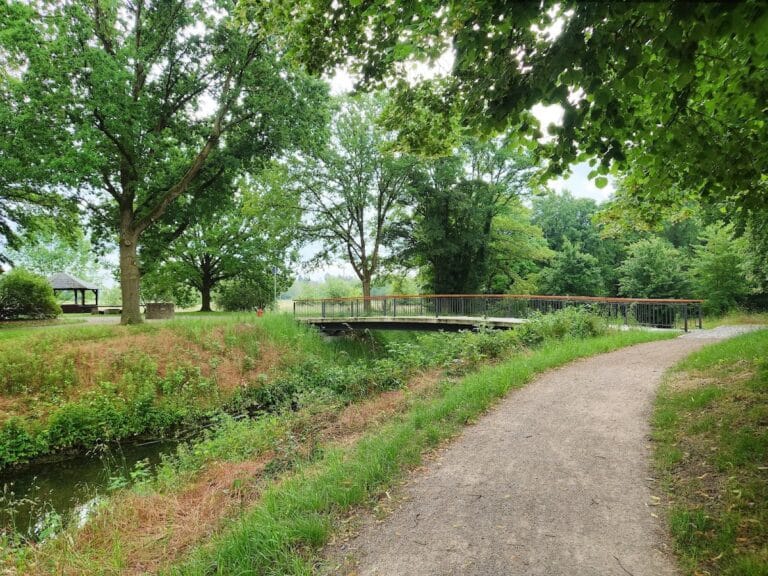
Unna desilted the surviving moat in 1994 and restored the original course of the Mühlbach in 1996, partly to provide the moat with sufficient water. In 1997 the 28 hectares owned by Unna became part of the Uelzener Heide-Mühlhauser Mark nature reserve. A 2006 proposal by a local heritage association to reopen the two moat arms filled during the demolition and mark the outlines of the castle complex with excavated material was rejected by the responsible heritage authority. The location of the medieval fortification and the survival of the manor house cellars therefore remain unresolved.
Remains
Moated complex and manor house
Haus Heyde probably developed from a farmstead surrounded by a moat, or water-filled defensive ditch. In the late Middle Ages, the moat was probably enlarged around the pond that still survives. A defensive tower-like structure may have stood on its island. One possible medieval arrangement consisted of two islands, with an upper castle on the smaller island and a lower castle occupying the moated farmstead. Archaeological finds have not confirmed this arrangement, and the original complex may instead have stood farther north beside the lower-lying Mühlbach, Ahlbach, or Kortelbach.
The manor house that was demolished in 1966 apparently stood on the large island of the moated farmstead. Its early seventeenth-century date is supported by a bell dated 1605, now lost, and by a surviving chest dated 1622. The two-storey building was constructed largely of rubble stone, with exterior walls about one metre thick and two barrel-vaulted cellars. Its knights’ hall measured 20.5 metres in length, just under eight metres in width, and five metres in height.
Baroque castle complex
The formerly separate buildings were later joined, probably under Christoph Friedrich von Plettenberg or Henrich Ludwig von Plettenberg, to form a U-shaped complex of three wings. The arrangement appears on the 1828 cadastral map. Each wing was about 50 metres long and reached a ridge height of approximately 20 metres. At demolition, the complex contained 56 rooms. The same map shows a large barn outside the moat; it was demolished in 1961.
The castle was surrounded by a park with additional bodies of water. The park was first arranged in the Baroque manner, with formal geometric organization, and was later developed as an English landscape garden with more naturalistic planting and spatial design. Several of its trees survive. The manor house had a broad view southward across the landscape toward the Haarstrang, the ridge forming the southern edge of the Hellweg region.
Family cemetery and landscape features
A family cemetery lay about 150 metres southeast of the castle. Established in 1832, it contained 19 burials by 1921, almost all members of the Bodelschwingh-Heyde family or their spouses. The cemetery was dissolved in 1938. Some of the dead and their gravestones were moved to the von Bodelschwingh family cemetery at Velmede, while others remained at Haus Heyde. A memorial plaque at Velmede commemorates those associated with the former cemetery.
The surviving landscape contains mature trees, including five protected as natural monuments: two plane trees, a copper beech, an English oak, and a horse chestnut. One plane tree has a trunk circumference of 7.12 metres measured at a height of 1.3 metres. It is estimated to be 250 to 300 years old and has been identified as the thickest plane tree in Westphalia and the second thickest in North Rhine-Westphalia. More than 20 black poplars, a rare tree in North Rhine-Westphalia, also grow on the former estate.
Water, wildlife, and associated objects
The surviving moat was altered when demolition material filled two of its arms in 1966. Later desilting and restoration of the Mühlbach returned water to the surviving moat. Investigations in 2002 and 2003 recorded eight bat species and unusually rare ground beetles there. A lesser noctule bat found exhausted in central Unna in 2003 was rehabilitated, ringed, and released at Haus Heyde. It was later recovered near Madrid, about 1,500 kilometres away, in what was then the second-longest recorded flight of a lesser noctule.
Material associated with the estate includes the lost 1605 bell, the surviving 1622 chest, former family gravestones, and the memorial plaque at Velmede. The gilded silver communion chalice donated to the Unna church by Aldenbockum von Ascheberg in 1620 also survives as part of the estate’s historical associations. Seven von Ascheberg gravestones remain visible in the Unna church.
The former estate, its moat, Mühlbach, cemetery, surviving park trees, and bat habitat also appear in the 2014 youth novel Border Crossers. In that work, the plane tree, stream, cemetery, and bats serve as important motifs connected with Haus Heyde.